
 The Taliban’s New War Begins at Home
  Panama removed from EU’s tax haven ‘blacklist’ a decade after the Panama Papers
  Crackdown and Controversy: The Battle Over Beach Bars and Noise in Phuket’s Bang Tao
 By Celia Kitzinger, 5th July 2026
In the aftermath of AGNI, I’ve watched many hearings where judicial determination as to whether or not P’s residence and care arrangements amount to a ‘deprivation of liberty’ has been deferred to a later hearing, apparently in the hope that there might be greater clarity by then as to how that determination should be made. But many of us are looking to judicial decision-making to understand how the AGNI judgment is implemented by the courts.
This is only the second case I’ve blogged about where a court has made a post-AGNI ‘deprivation of liberty’ determination (there are three more in the pipeline).
My first post-AGNI DOL blog reports on a case where the judge determined that there is a ‘deprivation of liberty’ for a person undergoing serious medical treatment under general anaesthetic in hospital (‘Judge authorises medical treatment and DOLS in hospital”).
In this, my second reported case, a judge determined that there is no deprivation of liberty for a young woman living under constant supervision and control in an annex to the family home. HHJ Burrows found, in accordance with the AGNI ‘clarification’ of an Article 5 compliant definition of ‘deprivation of liberty’, that she is not so deprived – and it was clear from his comments in court that he did so with considerable reluctance, referring to “deeply philosophically difficult” arguments.
The young woman at the centre of this case (COP 13189539) is in her 20s with complex needs and a severe learning disability. She has refractory epilepsy with multiple daily seizures and severe curvature of the spine that necessitates use of a wheelchair. She receives 24/7 care and is routinely monitored using CCTV cameras. Proceedings were initiated by the local authority in April 2024 (so more than two years ago) seeking (a) a declaration that P lacks capacity in relation to residence and care, (b) a determination as to whether the arrangements in place for her residence and care are in her best interests, and (c) authorisation of a community ‘deprivation of liberty’ order.
It’s taken a long time to reach a final hearing, in part because one of the previous judges allocated for the final hearing recused himself (DJ Manasse, in October 2025) and then his replacement (DJ Bland) sadly died before the hearing listed for March 2026. The case eventually came before HHJ Burrows on 30th June 2026 for final determination.
A complex case
The word “complexity” was used multiple times during the hearing. I think I heard the judge say that the bundle runs to 1036 pages. It was listed for a full-day hearing.
Unfortunately, given this ‘complexity’, the court did not respond to my request for disclosure of position statements or (failing that) for the three Gardner documents (i.e. those documents which “must” be – but probably were not – provided to the court according to PD4B para.4.2(a)-(c) COPR 2017, namely (a) the case summary, (b) a chronology of relevant events; and (c) the issues for determination at the hearing). It’s possible that my request never made its way to the judge – which is what I’ve been told in other hearings, there being no system in place for relaying observer requests to the court. So, this report is written simply on the basis of what I heard during the hearing and relies only on my contemporaneous touch-typed notes. I’m grateful to the judge for requesting, and to the applicant counsel for providing, an oral summary of the case – but it’s hard to capture the details at speaking speed: a document is far preferable for accuracy of reporting.[1] What follows is what I understood of the case, reported as accurately as I can under the circumstances.
Residence and care arrangements
First, P is in receipt of a personal injury settlement calculated on the basis of one-to-one support during the day and sleeping support at night, with a projected life expectancy of seventy-one. In fact, for the last five years her needs have increased and are greater than originally projected: she’s been receiving two-to-one daytime support and waking night care. The financial deputy appointed by the court is concerned that, with this model of care, her funds will be exhausted by the time she is in her early thirties. However, nobody actively disputes that the current level of support is in her best interests, despite its financial consequences.
Second, the family has installed CCTV cameras inside the annex in which P lives and there’s been ongoing dispute about the use of cameras and about the retention of data from them.
- Neither the local authority nor the Official Solicitor (OS) considers that the camera in the bathroom is in P’s best interests. It’s apparently there “for P’s safety following incidents with staff” (the judge confirmed “she’s never alone in the bathroom?”/”No”). The parents reported in court that they have now disconnected it – so this is no longer a matter of dispute.
- A camera above her bed is used to monitor her during the night – with the waking night carer in a separate room, observing P on an iPad. The judge asked, “Wouldn’t the alternative be that carers sit in the bedroom staring at her – so in terms of proportionality, this is less intrusive”, which was accepted by the OS – although there seemed to be some doubt that waking night care was actually necessary (I think only on the grounds that it had not originally been provided for in the personal injury settlement).
- The camera in the lounge is also contentious. According to the OS, the family at one point said that it was for P’s safety and for safeguarding, to monitor incidents with staff, e.g. “bruising and the cause of that”. But “now they [the family] say it’s in relation to staff training and the sharing of videos with clinicians” (said the OS). In particular, the family claim there is a need to monitor seizures and determine what might be triggering them. The case manager now supports the use of all the (currently operative) cameras – having changed her mind from an initial reaction that they were not the least restrictive option, to a position (as she got to know P better) where she says that non-clinical staff are “struggling to recognise the seizures which are sometimes very difficult to spot”.
By the beginning of the afternoon, the judge said he “was of the view that all the cameras [currently in use] are reasonable and necessary within the terms of Article 8. It seems to me that [the camera in the lounge] provides a function that cannot be adopted by ordinary carers because they don’t know what they are looking for [in terms of seizures]”. He considered that they are “not an unjustifiable intrusion into her privacy” and also that the “retention of data is useful” – since clinicians can inspect the videos to better understand the signs of seizures and possibly diagnose what triggers them.
Third, there is no comprehensive overarching care plan. The night staff are managed by one company, daytime care by another, plus the parents provide about 85 hours a week between them (“a crippling level of care, more than a working week each”, said the judge) – and their care is provided without a care plan that exists in writing. It’s also not clear who is in charge of her medication. “That’s bad, isn’t it”, the judge remarked. Later he added “What concerns me is that we’re two years into this case and we’re still asking what the care plan is. That is remarkable. It’s my first hearing, but two judges before me were none the wiser”.
Fourth, the care hasn’t been working out well. There have been tensions that “came to a head after an incident when one of the night staff was videoed asleep”. Both of the night waking staff were (or are?) on final written warnings for sleeping when supporting P as waking night staff. The parents (who were legally represented in court) want to move to a new model of care with directly employed staff. This would have the benefit of better governance (with the case manager responsible for all the people providing care), would enable better contingency planning (e.g., for staff sickness), and would also be cheaper.
Do P’s residence and care arrangements amount to a deprivation of liberty post-AGNI?
It was the Official Solicitor who, relatively late in the morning, pursued the question of whether or not P is deprived of her liberty.
OS: What we’ve not addressed is AGNI. The Official Solicitor’s submission[2] is that P is not now deprived of her liberty.
Judge: Is that on the basis that she’s implicitly consenting, using this new definition of consent, or is it on the basis of the unattractive proposition that she doesn’t have any liberty to be deprived of?
OS: The latter.
Judge: So, it’s that she’s so disabled that she doesn’t have any liberty to be deprived of, despite 24-hour supervision and control, including cameras, and she’s not free to leave, because she can’t unless she’s helped. Can I just ask you this. In a case of this sort where we have a profoundly disabled young woman who has to have this intensity of restrictions for her care, and where there are uncertainties about her future care plan (including because of financial issues), is this not a case where, whether it’s Article 5 or Article 8, there needs to be at least one review.
OS: That encapsulates our concerns. She would have had a Rule 1.2 representative. The issue the Official Solicitor is concerned about in this very particular situation is that P will not have any active involvement from the local authority, other than the Care Act review. Which is no criticism of them, but the local authority is very clear that their responsibilities are annual Care Act review and safeguarding issues.
After the lunch break, the court returned to the matter of deprivation of liberty. The judge referred to the “fact-sensitive multi-factorial test” that is now required and said he was “provisionally of the view that she does not consent – because she is incapable and cannot be said in any meaningful way to agree to her circumstances”. He continued: “The more difficult point is that she is in her home – a proper home, with her family. Now I must consider a comparator case, which Munby said was [‘obnoxious’/ ‘innocuous’][3] – but it can’t be [a deprivation of liberty?] because the Supreme Court [I take this to mean in AGNI] said that P must be compared to other people similar to her, and everyone with a similar level of disability to her will be cared for in a position like hers. And there’s an even worse argument – that because she’s incapable of liberty, she’s not deprived of it. I find that deeply philosophically difficult. It fails to look at liberty in its broadest sense. The State has obligations to ensure that people are enabled to have the best life they can”.
In the view of HHJ Burrows, the AGNI definition means that P in this case is NOT deprived of her liberty – a conclusion he didn’t seem happy to have arrived at. He quickly moved on to consider Article 8. “Privacy is hugely interfered with – it is necessary and proportionate, and nobody is suggesting there shouldn’t be 2:1 care or that cameras at night shouldn’t be used, but it does engage Article 8”. The judge referred to Baker J’s observations in Cheshire West at first instance – “even if it weren’t an Article 5 issue, he would be requiring review under Article 8 to ensure P’s best interests”.[4]
Counsel for P’s parents agreed that their daughter was not deprived of her liberty – but put the reasons differently. According to them, “P is cared for, not confined. Everything about her circumstances is tailored specifically to what she needs in that moment. And it’s not experienced as confinement”. They also believe that P “… is able to indicate happiness with her circumstances… she is able to vocalise happiness … she is happy in the situation that she’s cared in, albeit that the care is very intensive”. This sounds to me as though they were articulating, in effect, the AGNI notion of ‘valid consent’ (although the OS had previously indicated that the basis of the claim was not valid consent but lack of liberty to be deprived of – see the exchange between the judge and the OS above).
The hearing concluded with what I think was a expectation (I haven’t seen the order) that residence and care arrangements, which don’t amount to ‘deprivation of liberty’, would continue pretty much as they are for the time being, while the care manager draws up an overarching care plan which will (hopefully) be irrelevant in a couple of months or so once the company providing the day care is replaced with directly paid staff. If the parties can agree the care plan, no further hearing will be needed – at least not until the anticipated ‘review’ (which I think the judge will have ordered).
I have not yet received the approved order and will amend this post if it turns out there is more to report or if I have got something wrong – which is quite possible given the non-disclosure of documents relating to this case.
Reflections
It was apparent that HHJ Burrows is unhappy with the AGNI judgment – which seems to have divided the judiciary and the bar as much as it has divided opinion on the ground. Nonetheless, as judges must, he has applied it to this case and determined that P is not deprived of her liberty given the new criteria. I was disappointed that this hearing didn’t seem to involve a particularly rigorous application of the ‘multi-factorial’ analysis required by AGNI – which is of course what I hope to see in order to understand better how case law from the Supreme Court is applied in practice. For example, the judge didn’t engage with the parents’ argument that P was giving ‘valid consent’ by virtue of displaying ‘happiness’ with her arrangements. He didn’t return to and defend or revise his earlier ‘provisional’ view that “that she does not consent – because she is incapable and cannot be said in any meaningful way to agree to her circumstances”. There was clearly a difference of opinion on ‘valid consent’ here – but perhaps, being pragmatic, it didn’t matter, since the judge had already decided she was not deprived of her liberty on other grounds.
Finally, I see from the COP User Group minutes (1st July 2026) that HHJ Hilder has suggested the following ‘template’ (subject to amendment as considered appropriate for any individual case) in relation to AGNI directions. This goes to the heart of the issue that members of the public are legitimately concerned about in relation to how judges determine whether or not a person is deprived of their liberty – but as it’s reported via a witness statement, it won’t be at all straightforward for court observers to get disclosure.
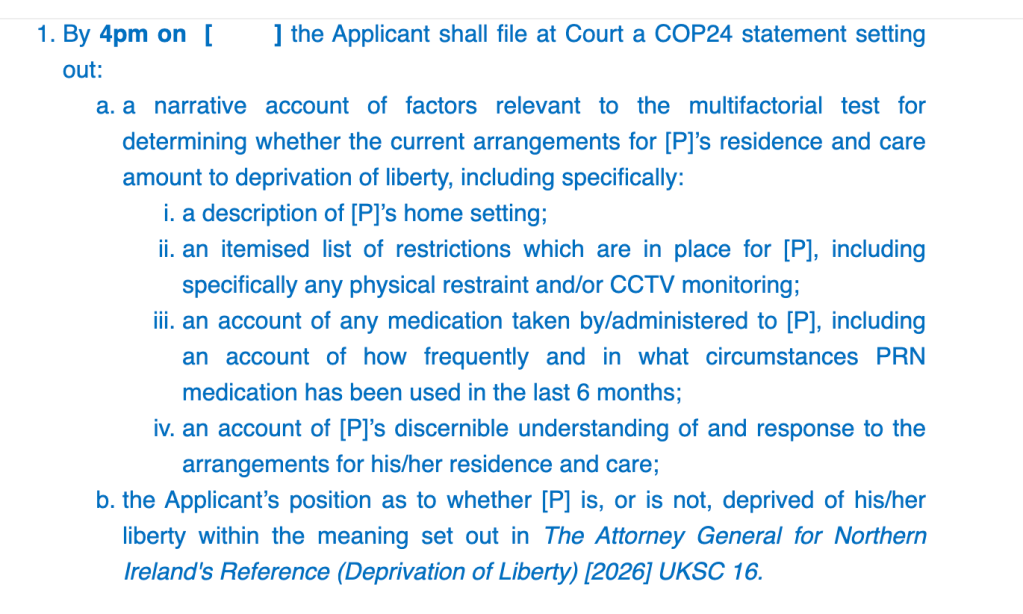
I am left with the strong view that the legitimate public concern about how deprivation of liberty decisions are being made in the post-AGNI Court of Protection requires more transparency from the court.
Celia Kitzinger is co-director of the Open Justice Court of Protection Project. She is on LinkedIn (here), and also on X (@KitzingerCelia) and Bluesky (@kitzingercelia.bsky.social)
[1] For reasons I have yet to discover (but suspect was the result of administrative error), this case was never publicly listed on CourtServe (or anywhere else on line). The judge said at the beginning of the hearing that it had been publicised via a paper copy of the listing displayed on a board in the court building in Preston. Since I was not in Preston and the listing was not more widely publicised, I did not know that the hearing was in person and I’m grateful to the judge for admitting me via video-link under these circumstances.
[2] The Official Solicitor’s position will have been set out in full in her Position Statement, but this was not disclosed to me. Consequently, I do not know the legal arguments on the basis of which the OS advanced her position in the kind of detail and with the appropriate case law that would have been useful to me, and to readers, in understanding how the judge arrived at his decision. It’s unfortunate that the Court of Appeal decision in Gardner has impacted so negatively on understanding how judges make decisions in the Court of Protection about key matters of public concern.
[3] I initially heard (and wrote down) the word ‘obnoxious’ – it struck me quite forcibly at the time. But when I tried to track down Munby’s use of the word in connection with ‘deprivation of liberty’, I couldn’t find anything (although he did use the word ‘obnoxious’ in relation to the values of some religious groups, see his keynote address in 2013 on “Law, Morality and Religion in the Family Courts”. I resorted to Chat GPT which produced an extraordinary hallucinated account of what Munby could have said about obnoxious comparisons between people with disabilities – but there’s no evidence that in fact he said any of it! I think either the judge misspoke, or (quite likely) I misheard him (there was no camera on the judge so I was deprived of the resource of ‘hearing’ supplemented by lip-reading). I am almost certain that what the judge said (or meant to say) and what I should properly have heard was not ‘obnoxious’ but ‘innocuous’ – which is a word that Munby does use in the Court of Appeal judgment (Cheshire West & Cheshire Council v P [2011] EWCA Civ 1257) – no fewer than FIVE times. The judge in the case I’m blogging about here, Simon Burrows, acted as junior counsel for the respondent, the Official Solicitor, in that Court of Appeal case back in 2011, so it might well have stuck in his memory. However, Munby’s point in using the word ‘innocuous’ was nothing to do with comparators, but rather that “a good motive or intention cannot render innocuous what would otherwise be a deprivation of liberty” (§76) – which isn’t the point I understood this judge to be making at this stage of the hearing. Munby did make observations about appropriate comparators in this judgment but without using the word “innocuous” (or “obnoxious”): he found that P was not deprived of his liberty, essentially because P was “living a life which is as normal as it can be for someone in his situation”. Given P’s disabilities, it wasn’t appropriate to compare him with a healthy non-disabled adult. The appropriate contrast to draw is with “the kind of lives that people like [P] would normally expect to lead” (§97). The restrictions and limits on his life were “the inevitable corollary of his various disabilities” (§110), and “there was nothing to show the life he is living at Z House is significantly different from the kind of life that anyone with his concatenation of difficulties could normally expect to lead….” (§110). So, something has got jumbled here. (I am open to correction!). Many thanks to everyone who responded to my social media and WhatsApp posts trying to figure out what was going on here.
[4] I have checked the judgment to which the judge seems to be referring here (Cheshire West & Cheshire Council v P & M [2011] EWHC 1330 (Fam)) and have not been able to locate this – but possibly it was said in course of the hearings (the judge in this present case, Simon Burrows, having acted back then as counsel instructed by the Official Solicitor). I am happy to be corrected if anyone can locate the source of this claim. This is the first instance Cheshire West case, before Baker J, finding that P was deprived of his liberty, subsequently appealed in the Court of Appeal (Cheshire West & Cheshire Council v P [2011] EWCA Civ 1257) where Lord Justice Munby finds that P was not deprived of his liberty, based on comparisons with other people with similar disabilities. Of course, this case then (joined with MIG and MEG) went to the Supreme Court which determined by a majority that all three protected parties were indeed deprived of their liberty – and it’s that Supreme Court decision in Cheshire West [2014] UKSC 19 that was overturned (albeit not definitively in the case of the particular individual P in Cheshire West) in the AGNI judgment.


Don't Miss:
-
P’s objections to early evening curfew are “compelling” evidence of deprivation of liberty after AGNI
-
After AGNI, are local authorities attempting to conclude proceedings inappropriately?
-
No public admittance to a ‘public’ post-AGNI hearing
-
“Wrapped in Cotton Wool”: Protection, Restriction and P’s Best Interests
-
“Complete failure” of Fit to Discharge proceedings before Lieven J: Carers suspended after allegations of abuse, and no immediate prospect of discharge