
 Donate to ICIJ
  Chelsea FC fined millions over secret payments under Abramovich ownership
  Nearly half of powerful .50-caliber ammo seized by Mexican government came from US Army plant, defense minister says
 The capture of Sebastián Marset, one of South America’s most wanted individuals, exemplifies why the takedown of major leaders should be just one part of a multi-pronged approach to tackling the drug trade.
Marset was arrested on March 13, 2026, in Bolivia in a joint operation between Bolivia’s Special Force to Combat Drug Trafficking (Fuerza Especial de Lucha Contra el Narcotráfico – FELCN) and the US Drug Enforcement Administration (DEA). He was almost immediately put on a plane to the United States, where he was charged with conspiracy to commit money laundering.
“This is a serious blow,” Nicolás Centurión, an organized crime analyst at the Latin American Center for Strategic Analysis (Centro Latinoamericano de Análisis Estratégico – CLAE), told InSight Crime. “There may be others higher up that we don’t know about, but let’s just say that at Marset’s level, all the key figures have fallen.”
SEE ALSO: Marset’s Inner Circle Crumbles as the Elusive Uruguayan Trafficker Evades Capture
That list of captured co-conspirators is long and prominent. Federico Santoro Vasallo, who already pleaded guilty and was sentenced to 15 years in a US prison in July 2025, laundered millions of dollars in drug proceeds through US banks on Marset’s orders, according to the indictment against Marset.
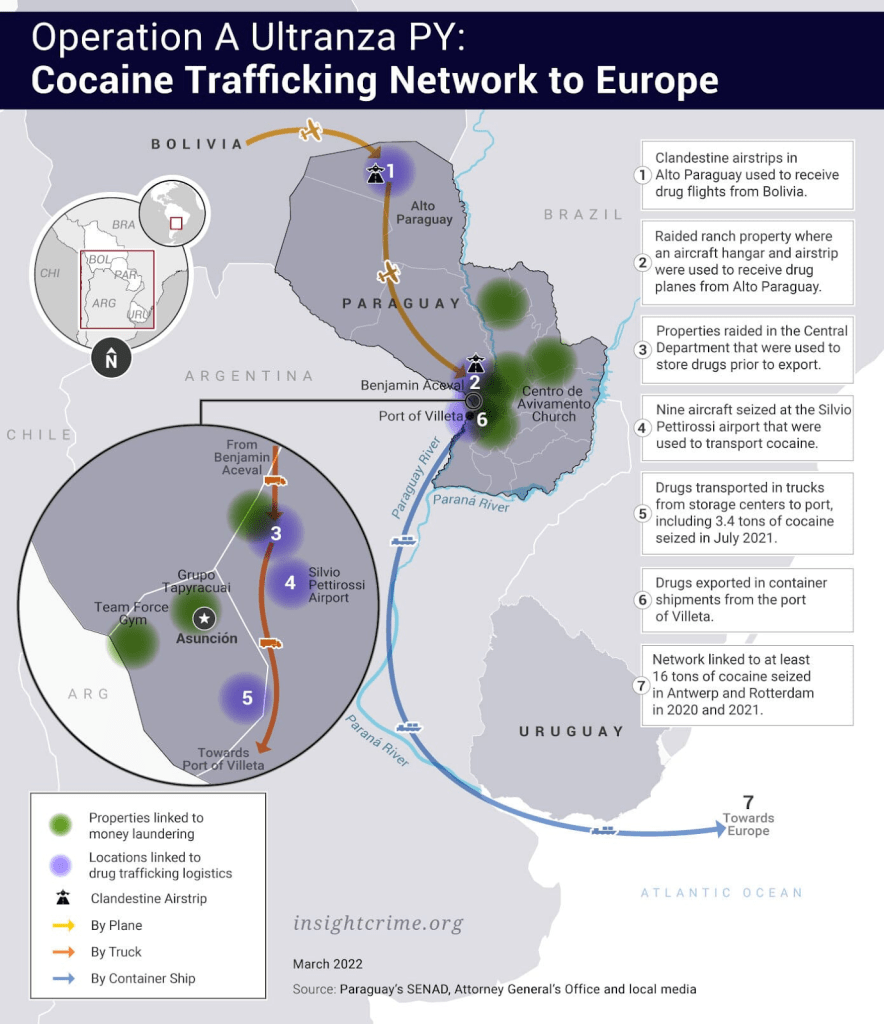
Paraguayan Senator Erico Galeano was convicted of money laundering and criminal association and Paraguayan businessman Alberto Koube Ayala was convicted of money laundering following a government sweep of suspected collaborators in the network in Paraguay dubbed A Ultranza PY.
Others are still awaiting trial in Paraguay. They include Miguel Ángel Insfrán, who is accused of leading the criminal network alongside Marset, former congressman Juan Carlos Ozorio, and Gianina Garcia Troche, the mother of Marset’s children.
In his native Uruguay, key arrests in 2025 took his main contacts out of the game, according to Uruguay’s Interior Minister Carlos Negro, including several top lieutenants, such as Fernández Albín and Betito Suárez, the minister stated during a press conference following Marset’s arrest.
How Did the Network Operate?
Prosecutors say Marset was a broker, sending shipments of cocaine produced in Bolivia to mafias in Europe while ensuring payments electronically.
His strength was likely his criminal connections, which he may have built up while in prison for marijuana trafficking in Uruguay. Upon his release in 2018, Marset went to Bolivia, where Brazil’s First Capital Command (Primeiro Comando Capital – PCC) has long had connections to cocaine producers.
He then went to work building one of the largest trafficking enterprises in the region. Specifically, Marset coordinated flights of cocaine from Bolivia to Paraguay, authorities say. The drugs would then be moved through the country to the Paraguay-Paraná waterway before being sent by ship to Africa and Europe.
Under Marset’s orders, Santoro Vallaso coordinated payments with money laundered through financial systems and currency exchanges, paying out percentages to those involved, according to US and Paraguayan prosecutors.
Many Brokers Make Resilient Networks
Brokers like Marset play an important role in the international cocaine trade. But their removal from the criminal landscape can disrupt cocaine supply chains only momentarily.
In fact, signs that others had begun moving on Marset’s trafficking routes began appearing even before his arrest. In September 2024, Erland Ivar García López, alias “El Colla,” who is awaiting trial for allegedly organizing cocaine flights and money laundering in Bolivia for Marset, was shot several times but survived. Bolivian police believe the attack was due to a conflict over control of planes and airstrips. In an October 2025 video, Marset doubled down, threatening El Colla and others.
“We’re ready to go to war with anyone—El Colla, the police—I don’t care who it is.”
As the illegal drug business has grown, trafficking has become increasingly controlled by networks of criminal players, with there often being several different operators at every level. This makes supply chains more robust when key individuals like Marset are taken down.
SEE ALSO: The Rise and Fall of Sebastián Marset
“We know we need to stay alert to see how things play out and where the consequences of this capture lead,” Uruguayan Interior Minister Negro admitted. “We also know that these organizations adapt to new circumstances and seek to replace their leaders with others.”
This has already happened. The PCC, for example, long relied on Gilberto Aparecido Dos Santos, alias “Fuminho,” to broker international deals. A childhood friend of the PCC’s top leader, Fuminho built up connections to facilitate cocaine and arms trafficking on behalf of the gang. Fuminho was likely the person that met with Dominico Pelle, the head of the ‘Ndranghetta’s Pelle clan, to help build the PCC’s business partnership with that mafia in around 2016. Yet Fuminho’s 2020 arrest in Mozambique, where he was attempting to further his international contacts, did little to hinder the PCC’s growth as one of the continent’s biggest players in the cocaine trade.
The ‘Ndrangetta has a similar modus operandi. In addition to Pelle, Nicola Assis and Rocco Morabito have acted as brokers, mainly in Brazil. The structure relies on flexibility and independence. And despite Morabito’s arrest in 2017 and Assis’ in 2019, the ‘Ndranghetta maintained its power in the European cocaine market.

Don't Miss:
-
CJNG Hitman Commander Killed in Shootout in El Alpuyequito, Colima
-
“Pepe” of the CJNG Has Been Captured; He Transported “El Mencho’s” Girlfriend Prior to his Death
-
Three Suspected CJNG Hitmen Arrested in Chiapas
-
Armed Attacks in Celaya Leave Two Dead and Two Injured in Santa Rita and Villas del Bajío Neighborhoods
-
What the Story of Meth Tells Us About the Future of Mexico’s CJNG