
 Canada revokes dozens of crypto firms’ registrations
  Questions swirl around US plans for record $15B Prince Group crypto seizure
  Donate to ICIJ
 Hugo Holland’s aggressive legal tactics made him one of Louisiana’s most renowned prosecutors and helped turn Caddo Parish, a majority Black community in the northwest corner of the state, into one of the nation’s leaders in death penalty convictions.
His nearly 40-year career, though, has been marked by controversies.
In at least two death penalty cases, Louisiana judges found that Holland withheld evidence. In a third, he secured the conviction of a Black 16-year-old, comparing the boy to a dog and telling the jury to “get rid of it”; prosecutors later admitted that Holland and his team had failed to turn over evidence.
Defense attorneys have also accused him of racism, pointing, for example, to a capital murder case several years ago in which Holland emailed one of them to say he was going to spend Veterans Day in his pickup truck looking for “a Black guy or a Mex-can.” Holland called it a joke.
Holland, 62, is now running for judge in the First Judicial District Court in Caddo Parish, and his nascent campaign appears to have substantial backing. He has raised more than $61,000 in less than two months, according to the first campaign finance report released in February — twice the amount many candidates running for the 1st Judicial Court spend in an entire campaign, said Jeffrey Sadow, an associate professor of political science at Louisiana State University in Shreveport.
Holland’s donors include an assistant district attorney with the Caddo Parish DA’s office, the district attorney of neighboring Bossier and Webster parishes, a former state judge, and members of major law firms throughout the area.
Holland’s funding haul might prove to be so daunting that it scares off potential challengers, Sadow said, though candidates have until the end of July to enter the race. “It shows he’s got an awful lot of support and that he’s considered a quality candidate,” he said.
In addition to his robust campaign fundraising, Holland has been able to bring on the head of the local Republican Party, Matthew Kay, as his campaign chair. (Kay also served as an elector for Donald Trump in 2024.)
Holland declined multiple requests for comment about his candidacy and record as a prosecutor. Neither Kay nor nine of the 10 donors Verite News and ProPublica reached out to would respond or agree to speak about their support for Holland.
Charles Jacobs, the city attorney for Bossier City and a former state judge who has known Holland for nearly 20 years, described him as a “very fair” prosecutor who sticks to the facts and the letter of the law. Jacobs donated $2,500 to Holland’s campaign, saying that his extensive trial experience will serve him well on the bench.
“That guy cuts it right down the line — black or white, brown or yellow. He doesn’t care,” said Jacobs, dismissing defense attorneys’ allegations of racism.
Civil rights leaders and defense attorneys say they believe Holland lacks regard for the rights of the mostly Black defendants he prosecuted, and that makes him uniquely unfit to serve on the bench.
“He’s demonstrated that he is untrustworthy, unreserved in his aggression and without any judicial temperament,” said defense attorney Ben Cohen, who represented the 16-year-old in the death penalty case in which Holland withheld evidence. “He brings disrepute to the justice system in a way that undermines people’s faith in it.”
He’s demonstrated that he is untrustworthy, unreserved in his aggression and without any judicial temperament.
Ben Cohen, defense attorney
As an assistant district attorney in Caddo Parish from 1991 to 2012, Holland displayed a portrait of Confederate Gen. Nathan Bedford Forrest, an early leader of the Ku Klux Klan, in his office. Local and national coverage of Holland’s affinity for Forrest drew accusations of racism from Black residents and defense attorneys. Holland has insisted that he is not racist, claiming in interviews that he appreciated Forrest as a cavalry commander in the Civil War and not because he was a member of the Klan.
In another controversy, Holland was forced to resign from the district attorney’s office in 2012 after the state inspector general found that he and a colleague had submitted “false information” to obtain a cache of fully automatic M-16 rifles through a federal program. Holland said a special investigations unit needed the weapons for protection because “we routinely participate in high-risk surveillance and arrests,” a claim local law enforcement agencies refuted, according to the inspector general. Holland and his colleague told the inspector general that if they had the opportunity, they would word the justification differently, citing situations in which the weapons would be useful in protecting district attorney employees who work in dangerous areas and advise local law enforcement.
These scandals, however, did little to damage Holland’s career. After his resignation, he became a successful prosecutor-for-hire for more than a dozen district attorneys who lacked the staff or expertise to try high-profile murder cases on their own. In 2017, Holland was paid to lobby on behalf of the powerful Louisiana District Attorneys Association to stop a bill that would have eliminated the death penalty; the effort succeeded.
Caddo Parish secured more death penalty convictions per capita than any other county in the United States between 2010 and 2014, according to the Death Penalty Information Center. Of the people sent to death row during that time period, 80% were Black, even though Black people made up just under half the parish population. (Nationally, Black people made up just over 40% of death row prisoners and 13% of the U.S. population at that time.)
Caddo Parish has long been a center of racial injustice, known from the Reconstruction era through the Jim Crow period as Bloody Caddo for having among the highest numbers of lynchings of any county in the country.
Theron Jackson, the pastor of Morning Star Missionary Baptist Church in Shreveport, the largest city in the parish, fears that a Holland victory would be a “step back” toward those days of Bloody Caddo, when the failure of elected officials to “protect and serve everybody’s community resulted in the victimization of Black people.”
Withholding Evidence
The doubts surrounding Holland’s death row convictions have taken on even more urgency since the election of Jeff Landry, who upon being sworn in as governor in 2024 said he wanted to execute every prisoner on death row as quickly as possible.
Of the at least 10 people Holland has sent to death row over four decades as prosecutor, one has been released, and two have had their sentences reduced to life in prison. Of the seven remaining on death row, at least two — Bobby Hampton and David Brown — are challenging their convictions after they discovered that Holland withheld evidence.
In 1997, Holland secured a death sentence against Hampton for a murder that happened during a liquor store robbery in Shreveport. The Louisiana Supreme Court later found that Holland had withheld grand jury witness testimony that someone else fired the fatal shot. The court nonetheless ruled that the omitted testimony would not have changed the verdict because prosecutors did hand over a similar statement the witness had made to police. But a dissenting court opinion pointed out that the grand jury witness testimony, unlike the police statement, was given under oath and unambiguously identified another person as the shooter. Hampton remains on death row.
Fourteen years later, a similar situation unfolded. The courts once again found that Holland failed to disclose evidence during his 2011 prosecution and conviction of Brown, one of five prisoners convicted of murdering a guard at the Louisiana State Penitentiary at Angola. Holland did not reveal that another prisoner had told prosecutors about a jailhouse confession from one of the five, who said he and another inmate — not Brown — had decided to kill the guard. As a result, a state judge vacated Brown’s sentence in 2014, but the Louisiana Supreme Court reinstated it after ruling that the withheld evidence would not necessarily have changed the jury’s decision; the confession, they said, did not preclude Brown’s participation in the killing.
Hampton and Brown maintain their innocence and are still challenging their convictions. Holland did not respond to requests for comment about the cases.
Holland withheld evidence in a third death penalty case, involving Corey Williams, a 16-year-old convicted in the fatal shooting of a pizza delivery man in Shreveport. Williams’ 2000 death sentence was reduced to life without parole because the boy has a severe intellectual disability, according to court documents. As a child, Williams was hospitalized for “extreme lead poisoning” and was institutionalized multiple times for mental health reasons, according to court documents filed by his attorneys.
Fifteen years after Williams’ conviction, his attorneys alerted the court that Holland had concealed a trove of evidence that they said proved his innocence: Witnesses on the night of the murder told police Williams was innocent, and detectives stated at the time that they believed several older men were responsible and trying to pin the blame on Williams, according to a court filing by Williams’ defense team.
The actions by Holland’s team led dozens of former U.S. Department of Justice officials and federal prosecutors to file a brief to the U.S. Supreme Court in support of efforts to overturn Williams’ conviction.
A former Caddo Parish district attorney, who took office on an interim basis 15 years after Williams’ prosecution, acknowledged in 2015 court filings that Holland and his team had withheld evidence, but insisted that it did not prove Williams’ innocence and would not have changed the verdict. Before the U.S. Supreme Court could take up the issue, however, Williams’ team agreed to a deal with prosecutors that allowed him to plead guilty to manslaughter and obstruction of justice in return for his 2018 release from prison. Holland has said he did not withhold evidence and maintained that Williams is guilty.
In other contexts, Holland questioned established law on the obligation to turn over evidence. Two years ago, a case came before the Louisiana Supreme Court to preserve a death sentence that defense attorneys claimed was secured after another prosecutor withheld key evidence. Arguing on behalf of the Rapides Parish district attorney, Holland expressed disdain for a 1995 U.S. Supreme Court ruling requiring prosecutors to turn over such evidence that could be considered favorable to defendants.
“It’s a very poorly written opinion because it leaves far too much to conjecture by people on the bench,” Holland said. “It’s got judges second-guessing juries.”
The state Supreme Court ultimately upheld the death sentence.
Matilde Carbia, a defense attorney representing a death row inmate whom Holland helped convict, said Holland’s antipathy toward transparency makes his candidacy dangerous. “If that is the kind of perspective that he would bring to the judiciary, that would be wholesale damaging to criminal defendants across the board,” Carbia said.
He was doing everything he could to attempt to intimidate me.
Matilde Carbia, defense attorney
Holland’s unprofessional behavior in and outside of the courtroom is also a grave concern, she said. During a 2018 postconviction hearing for a murder case, Carbia said Holland claimed he couldn’t hear when she was questioning a witness, so he began following Carbia around the courtroom as she spoke.
“He’d come stand looming over my shoulder with his coattail pushed back so that you could see the firearm on his hip,” Carbia recalled in a recent interview.
In another incident, Carbia said Holland displayed an AR-15 rifle on his desk when she entered his office to review some files. “He was doing everything he could to attempt to intimidate me,” she said.
Holland did not respond to questions about these incidents. Verite News and ProPublica spoke with another attorney who witnessed the events and confirmed Carbia’s account.
An Evolving Caddo
Caddo Parish has changed since Holland last worked for the district attorney’s office, with Black voters now making up just over half of the parish population. With that increase has come more political influence.
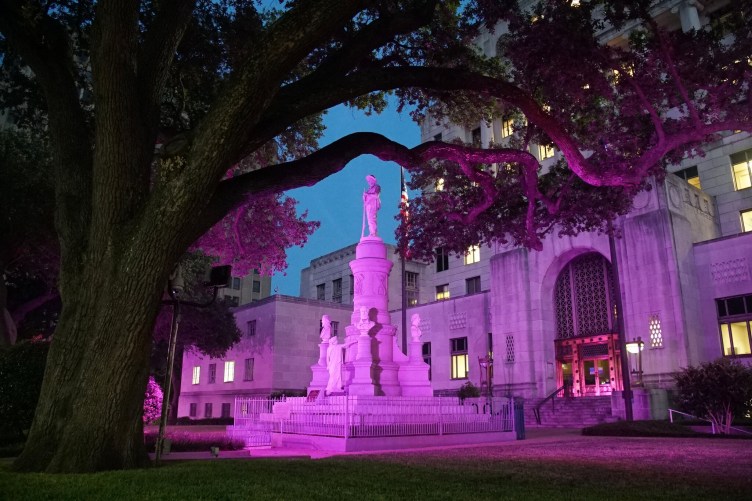
In 2011, parish leaders removed a Confederate flag that had flown in front of the courthouse for decades. Eleven years later, the parish removed a monument featuring four Confederate generals that also stood before the courthouse steps.
The changes go beyond symbolic. Caddo voters elected the parish’s first Black district attorney in 2015 by a 10-point margin. Nine years later, voters elected the parish’s first Black sheriff by a similar edge.
Holland, however, will not be facing voters parishwide. There are 14 open judicial seats in the parish, and candidates choose among three districts in which to run. Only one is majority Black, according to Sadow, the political science professor. Holland hasn’t announced where he would run, but running in a majority white, conservative district would increase his odds of winning, Sadow said; Holland’s prospects would also be boosted in one of the majority white districts by not having to run against an incumbent, who is retiring.
Defense attorney Nick Trenticosta, who once faced off against Holland in a death penalty case, said he hopes voters will remember Holland’s ethical controversies and reject him as a relic of the past.
“Caddo is not the same Caddo it was 30 years ago,” Trenticosta said. “The voters know who he is.”
Don't Miss:
-
Dancing On Graves: Going Low, Lower, Lowest (For Now)
-
ProPublica Adds Ownership Search to Nursing Home Inspect Database
-
Nominee for Ambassador to Hungary Co-Owns a Nursing Home That’s Suing the Trump Administration Over Medicare Payments
-
Trump Has Detained the Parents of More Than 11,000 U.S. Citizen Kids
-
She Was in Labor at a Florida Hospital. Then She Was in Zoom Court for Refusing a C-Section.