
 Trump administration gave firm with ties to ballroom donor the green light to do business with a sanctioned Russian bank
  Claire Sylvia on the Constitutionality of the False Claims Act
  School shootings in the Philippines put gun access under scrutiny
 Marie Gottschalk is a Professor of Political Science at the University of Pennsylvania. She specializes in criminal justice, race and health policy.
In 2006, she wrote the award-winning – The Prison and the Gallows: The Politics of Mass Incarceration in America (Cambridge Studies in Criminology, 2006).
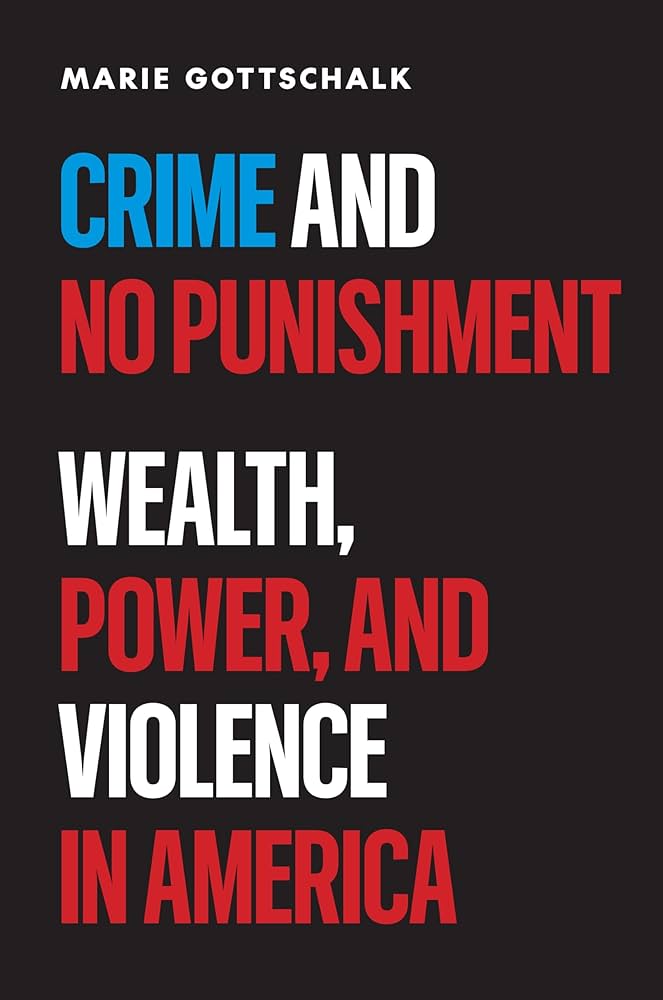
But it was only recently that Gottschalk began to address the problem of corporate crime in America. And now she is out with a new book – Crime and No Punishment: Wealth, Power, and Violence in America (Princeton University Press, 2025).
In it, Gottschalk argues that corporate impunity, the financialization of the economy, militarized policing, the burgeoning carceral state, and the forever wars in Afghanistan, Iraq, and elsewhere all have fostered corporate, economic, and state violence in America. And it is these developments that have undermined the legitimacy of American political and economic institutions.
Gottschalk analyzes how the concentration of economic, political, and military power has siphoned off vital resources, preying on the most vulnerable communities and normalizing violence and death. It has kept America from attacking the root causes of violent street crime and curtailing “deaths of despair” from suicide, alcoholism, drug overdoses, and chronic diseases.
The United States continues to incarcerate more of its people than nearly every other country even as it decriminalizes or turns a blind eye to elite-level corporate crime.
Public and scholarly attention, however, remains fixated on violent street crime – although corporate and white-collar crime and state and economic violence directly and indirectly hurt far more people in the United States.
In your book, you write this – “Like most scholars of crime in the criminal legal system, I mostly ignored white collar and corporate crime in my teaching and research.”
Why is that?
“It’s crazy,” Gottschalk told Corporate Crime Reporter in an interview last week. “This book in a way is my mea culpa. Why wasn’t I doing that? Why wasn’t I not teaching more about corporate crime? I can’t blame it on my training because I never trained as a criminologist. I trained as a political scientist. I wrote my first book on health care and health policy. I was fascinated by mass incarceration. I decided to try and understand the roots of mass incarceration. The common explanations didn’t make a whole lot of sense to me.”
“If you come out of criminology programs and sociology programs, they just don’t teach white collar crime. But I didn’t have that excuse because I didn’t teach those programs. It was a real blind spot of my own. I was so focused on the problem of mass incarceration, in particular the role of race, that I just didn’t teach about corporate crime.”
“Now, the incarceration rate has stabilized at about 600 per 100,000 population. That said, the carceral state is changing. Incarceration rates are increasing in suburbia and in rural areas. Your chances of being incarcerated in rural areas and suburbia is greater than your chances now in urban areas. Incarceration rates are still high for African-Americans, but the gap is closing compared to incarceration rates for white people. “
“Mass incarceration is now affecting a wide swath of Americans.”
What is the connection between corporate crime and street crime?
“There are a lot of connections. Corporate crime and the related issue of rising inequality means that there are fewer resources around to address what causes street crime and alternatives to incarceration. By creating a hysteria over street crime, you deflect attention from corporate crime. You create a panic over one while ignoring the other.”
“In the book, I trace some of the increase in corporate and white collar crime to the financialization of the economy and with that you get more concentrated economic and political power. And that means you are less likely to address the crimes of the powerful and that you are more likely to have unequal distribution of wealth, an unequal tax system and you are not going to be able to ameliorate these other problems in society.”
We have documented over forty years that corporate crime and violence inflicts far more damage on society than street crime. In fact, when you say crime, most Americans think street crime, not corporate crime. Why is that?
“It’s stunning to me that we don’t talk about them together, especially since the harms seem to be increasing – like the opioid crisis. At the peak of the crisis, we had 108,000 people a year dying from drug overdoses. That’s twice as many as the number of Americans who died in the Vietnam war.”
“It’s a social murder. It’s not a murder with a person with a gun. There are much more complicated reasons behind the opioid crisis. But at the end of the day, you have 108,000 dead every year. That’s more than four times the number of people who die from homicide.”
Almost forty years ago now, a Republican prosecutor in Indiana brought homicide charges against Ford Motor Company for the deaths of three teenaged girls who were riding in a Ford Pinto that was rear ended. They were not crushed to death. They were burned to death. The prosecutor got his hands on internal Ford memos and brought the homicide case. Ford was found not guilty. But that was the last time that a major American corporation was prosecuted for homicide in a product case.
In the United States, when you use the word murder or homicide, people think street homicide, not corporate homicide – even though corporate homicide or manslaughter is being committed by major American corporations every year. The Boeing 737 Max deaths should have been investigated as a manslaughter case, for example.
Your book seems to connect the threads of criminology. If we could create a strong social safety net for the 70 percent of Americans living from paycheck to paycheck, if we could hire more police officers to police corporate crime and level the playing field, many of these problems could be resolved. And you address the question of empire – spending $1.5 trillion on the military industrial complex – money that could be spent here at home ameliorating some of these problems.
It’s just very difficult to tell a convincing story about corporate crime. It’s easier to tell a story about street crime.
“The word violence works better than corporate crime or white-collar crime. When people hear white-collar crime, they think it’s a victimless crime or not a big deal. Yes there is corporate and white-collar crime and yes there is street crime. But what connects our real concern is violence, premature deaths, injuries that can be avoided.”
“If we think the Boeing crashes and the Pinto deaths as acts of violence, the grossly inequitable economic system where people are living paycheck to paycheck and they don’t have health care for their kids and the remarkable unprecedented decline in life expectancy – that’s violence to your society. That’s a society that is dying. I use the word violence a lot in my book and in the title of my book because people have a hard time thinking about corporate murder.”
In academia, when you start talking about corporate crime and empire, are you isolated? I don’t see many academics writing about it the way you have. Are there others within your profession who talk and write about it?
“Doing what I’m doing now, you might not get tenure. If you see the way the field of political science has gone, we get people who may be interested in politics, we bring them in to do PhDs, and then we turn them into mathematicians, looking at really small problems that you can really nail to the wall with a mathematical formula. But it is something that seems pretty everyday or common.”
“Political science is modeling itself much more after economics. The kind of interdisciplinary work that I do – crossing criminology, sociology, history, political science – is different from what your average political scientist is doing. On the other hand, all of my work has traveled really far. I have gotten awards. But I’m not your typical political scientist. This book is just out so I’m not sure what the reception will be, but we are not taught to think really big like this. We are not taught to even use the word empire to talk about the United States.”
“We talk about neoliberalism. And the United States is on this trajectory of small government, low taxes, anti-regulation. But that only works if you completely ignore the prison build up and the military build up and corporations getting these phenomenal subsidies even while they are pushing this neoliberal agenda.”
“I have enough colleagues in different disciplines that I don’t feel isolated. I also feel a hunger in society for understanding what’s going on, understanding the rise of Trump, and also to fight against these really simplistic explanations for the rise of Trump.”
In August 2019 the New York Times ran a report titled – A Secret Opioid Memo That Could Have Slowed an Epidemic.
The nutshell version of that report is that line prosecutors in the western part of Virginia – close to West Virginia – were about to criminally prosecute those responsible for the opioid crisis, but political appointees at the Justice Department stopped it.
“I do include that episode in my book. And it relates to the revolving door – putting in corporate lawyers at the Department of Justice. Same for the Obama administration, where people from Wall Street were filling key administration roles during the financial crisis. And the Department of Justice did not aggressively go after those responsible for the opioid crisis and the financial crisis.”
“Elizabeth Warren was raising bloody hell to James Comey about why there was no criminal prosecution of those responsible for the financial crisis – even though there were criminal referrals. Why aren’t you releasing the details of these criminal investigations?”
The term defund the police is controversial for a number of reasons, including the fact that you don’t want to defund the police when it comes to corporate crime.
“We certainly have defunded the regulators. But it’s not just resources. The Justice Department is in a habit of cutting deals with corporations. Many of these deals are done in back rooms. You only find out about them when the press release comes out. We often don’t know how many of these agreements have been made. It’s difficult to find out if the corporations are abiding by the terms of the deferred prosecution agreement.”
“But I do want to push back against the idea of locking up a few of these executives. I have concerns that we will have a couple of show trials, throw a couple of corporate executives in jail and then we solve the problem. We are going to need much more extensive regulation and accountability. We need to examine the structural rot in the system.”
“I just came across a story in the American Prospect about Mary Jo White and Jeffrey Epstein.”
I see it now – it’s titled – The Quintessential Epstein Files by David Dayen. It opens with this – “On June 5, 2015, Kathy Ruemmler, then a corporate lawyer for Latham & Watkins but just one year removed from her stint as White House counsel for Barack Obama, emailed her good friend Jeffrey Epstein. Ruemmler, who was once under consideration to become Obama’s attorney general, wrote, ‘I am working on a PR strategy for MJ White v. Elizabeth Warren.’ Epstein responded, ‘Good[.] mj is good.’ And Ruemmler followed on in a response, “Yes, and EW is the worst.”
“Yes, they are talking about how to contain Elizabeth Warren,” Gottschalk says. “It comes just at the time when Elizabeth Warren has released a scathing report on how the SEC under Mary Jo White has been completely asleep at the wheel.”
“Likewise, in my book, I talk about how Timothy Geithner had a – we have to contain Elizabeth Warren – strategy. Both on the Democratic and Republican side, they are talking about going after anyone like Elizabeth Warren who is exposing corporate wrongdoing.”
“In the Epstein files, we are so focused on the sexual abuse, which is significant. But it’s the Epstein class which cuts across Democrats and Republicans, academia, Hollywood and Wall Street. It’s being exposed as an untouchable class, even beyond what I thought it would be.”
We ran an interview with Mary Jo White in Corporate Crime Reporter in 2005 where we learned that she was in fact the mother of the deferred prosecution agreement for corporations. She told us in that interview that as U.S. attorney in 1994, she cut a deferred prosecution agreement with Prudential Securities.
“That was the first deferred prosecution agreement involving a major company,” White told us.
You have a concluding chapter in your book in which you map a way out.
“We need to think big and avoid non reformist reforms, like a couple of show trials of CEOs and their corporations. We need to follow the money and think seriously about this empire and the extraordinary spending on the military. We need to look at the rising income inequality and the lack of a progressive tax system and a wealth tax. If you are going to have a larger regulatory state, you need the resources.”
[For the complete q/a format Interview with Marie Gottschalk, see 40 Corporate Crime Reporter 9(12), March 2, 2026, print edition only.]
Don't Miss:
-
Trump administration gave firm with ties to ballroom donor the green light to do business with a sanctioned Russian bank
-
Claire Sylvia on the Constitutionality of the False Claims Act
-
School shootings in the Philippines put gun access under scrutiny
-
Statement on missing ICIJ journalist Micah Reddy
-
TRANSCRIPT: ‘China Retains Levers for Long-Term Territorial Ambitions’