
 Trump administration gave firm with ties to ballroom donor the green light to do business with a sanctioned Russian bank
  Claire Sylvia on the Constitutionality of the False Claims Act
  School shootings in the Philippines put gun access under scrutiny
 With corporate criminal prosecutions on the decline, how are we as a society going to deter corporate wrongdoing?
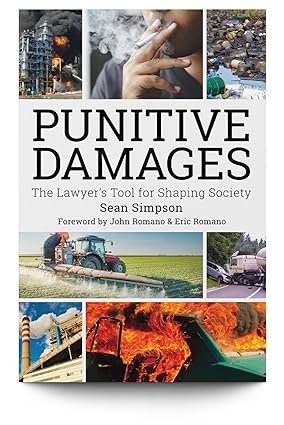
Sean Simpson, a trial lawyer based in San Diego, California, says we should try punitive damages. And he’s written a book titled Punitive Damages: The Lawyer’s Tool for Shaping Society.
“Because the criminal justice system prosecutes relatively few white-collar crimes, and the fines levied by civil agencies such as the Food and Drug Administration (FDA), the Insurance Commissioner, the Equal Employment Opportunity Commission (EEOC), and so on are relatively rare and modest, punitive damages in our civil cases are some of the only remaining forces we have to combat corporate greed and recklessness,” Simpson writes. “In many instances, we overlook or intentionally avoid punitive damages for a variety of reasons.”
“These are some common reasons we might avoid or overlook punitive damages – the heightened burden of proof required in most states, the challenges in collectability, the lack of insurance coverage for punitive damages (in most, but not all, policies).”
“Unfortunately, because we do not frequently and aggressively pursue punitive damages, the pendulum has swung widely against us in the courts. Even if we get past the initial efforts defendants make to dismiss our punitive damages claims, such as the standard motions to strike and dismiss, further into the case, efforts to knock out punitive damages will continue.”
Simpson says that although these hurdles create extra work for trial lawyers, “it is imperative that we continue pushing forward in our pursuit for punitive damages so that corporations and other ill-motivated defendants do not go unchecked.”
“We must break the pattern of letting someone else take on the big corporations. We are all in this together. The only way we can make a difference is to collectively work to keep corporate corruption in check.”
“Our fight has become even more important with embarrassingly unfounded cases like State Farm v. Campbell that use due process as a mechanism to put a limit on the amount that corporations can be ordered to pay through punitive damages judgments. In State Farm v. Campbell, the US Supreme Court imposed the 10 to 1 ratio, requiring scrutiny of any punitive damages awards that exceed ten times the compensatory award.”
“We need to remind the courts that, for many years, there have been plenty of laws providing corporations with the protections they may need to prevent putting them out of business. Indeed, from early on, there has been case law clearly instructing trial and appellate courts that punitive damages awards cannot be so extensive as to disrupt the defendant’s livelihood. Unfortunately, efforts to save corporations from financial extinction have backlashed.”
“They currently make it unlikely in most states that a punitive damages award can have the intended effect. A review of the current federal and state case law, and the statutory caps on punitive damages most states impose, makes it clear that, in most instances, corporations are protected from getting hit with more than a slap on the hand.”
Simpson says that “in the quiver of arrows we use as lawyers, the lone arrow to control corporate misconduct is punitive damages.”
Simpson realizes that the impact of punitive damages has been undermined by the corporations, the courts and the Congress.
“Because courts, in almost every instance, reduce the jury’s verdict to an amount relatively meager to a large corporation, we have seen firsthand examples of companies laughing off punitive damages awards and continuing to engage in despicable conduct – because they can. This insult to our efforts, however, can motivate us to continue pushing for reform.”
Simpson wants to equip his fellow lawyers with the tools to push back and restore meaning to punitive damages awards.
“We hope that, through our collective experiences, we can continually build a stronger front to challenge corporate abuse and other bad behavior deserving of punishment,” he writes.
“Judges tend to inherently be negative about punitive damage cases,” Simpson told Corporate Crime Reporter in an interview last week.
Why is that?
“Probably for the same reason that defense lawyers and insurance companies don’t like them. Punitives are not aligned with liability insurance. They will say – if you raise punitive damages, you’ll never settle a case. Most judges became judges because they wanted to be referees. Judges didn’t like the stress and unpredictability of the lifestyle of the law firm.”
“Judges don’t want fireworks in their courtroom. They don’t want the marshal to have to jump up all the time to control witnesses.”
Judges might also see punitive damages as the realm of the criminal law and not the civil law.
“It is quasi criminal. And a lot of judges are thinking – these punitive damages are just for the big megabucks. They just are not up to date with the current state of law. It’s almost impossible to get and keep a big punitive damages verdict. There are all kinds of restrictions.”
There was a Supreme Court decision limiting punitive damages to ten times compensatory damages.
“That was State Farm v. Campbell. They said – we find that any award that exceeds ten to one should be subject to scrutiny. Lower courts then started setting it at under ten to one saying that ten to one is the absolute max. But that’s not what the Supreme Court said. It has been misinterpreted.”
How many punitive damage cases have you taken?
“To verdict – twelve or thirteen. Most lawyers have hardly any.”
What’s your largest punitive damage award?
“From a jury, $180 million, but the judge reduced that to $6 million and there went the sting.”
What was the basis of the reduction?
“State Farm v. Campbell. The ratio of the punitive to the compensatory. It was a case about an employer who discriminated against a pregnant employee because she was pregnant. He didn’t like the fact that she had to put her feet up now and then. There was one instance where a supervisor came up to her and said – I’m about to punch you in the belly and get that damn thing out of you so you can get back to work. And that was ten years ago.”
What are the state restrictions on punitive damages?
“Many states have caps. Florida has three times compensatory or $500,000, whichever is greater. You have state caps and federal caps. You have the jury already thinking – we already gave this person compensatory damages and now we are going to give them more.”
Why do you think criminal prosecutions for corporate crime are so weak?
“They just don’t want to take on the monsters. It’s similar to judges in my civil cases not wanting to bring in impeachment evidence on cross examination. It’s a cringing moment.”
“There is so much apathy. Why so few corporate crime prosecutions? One, it’s too much work. You know if you got Facebook in here, Mark Zuckerberg could blow a gasket.”
You are saying it’s straight up corporate power. The last time a major American corporation was criminally prosecuted for homicide in a products case was the Ford Pinto prosecution more than forty years ago now.
“Part of it is the prosecutors don’t have the staff and resources to bring these cases. And part of it is straight corporate power. There is an inherent desire to protect these corporations. The judge looks at his stock portfolio and says – do I really want to have the state criminally prosecute these companies?”
Or as our Attorney General Pam Bondi said last week in testifying before Congress on the Epstein files – Why are you so focused on Epstein? The Dow is at 50,000.
Your book is a how to book for trial lawyers. You give the impression that lawyers miss these punitive damage cases. You say you have missed them. How many are being missed?
“There are probably twenty to twenty five percent of tort cases that could include punitive damages, but the lawyer chooses not to go in that direction.”
How many tort cases are not brought because people don’t know their legal rights, they can’t find an attorney, there is a cultural aversion to bringing lawsuits?
“That has to be similarly high. In California they are trying to limit attorneys fees. They are trying to trim every angle they can.”
How many winnable court cases are never brought?
“I’m hoping it’s not more than 15 percent to 20 percent. In worker injury cases, sometimes the workers just don’t want to complain or file a lawsuit – they just want to get back to work. They’re afraid. And they don’t understand. They think they are going to lose their job.”
The corporations have won the political argument over tort reform. It seems that the corporations’ telling of their story is much stronger than the trial bar’s telling of its story.
“Hands down. Elon Musk, Larry Ellison, Jeff Bezos and Mark Zuckerberg have more money than most of us. When it comes time to prime the pump of our political system, which is run by lobbyists in Washington, D.C., the lobbyists are going to get it done. We’ve had an oligarchy in this country since the 1960s, but it has never been as obvious as it is today.”
“They started running billboard ads forty years ago saying – stop lawsuit abuse. The insurance companies have invested so much money in brainwashing the public into thinking that our legal system is screwed up and these plaintiffs’ lawyers are sleazy money grubbers. And the plaintiffs’ lawyers play into the corporations hands by running sleazy advertisements themselves.”
[For the complete q/a format Interview with Sean Simpson, 40 Corporate Crime Reporter 8(12), February 23, 2026, print edition only.]
Don't Miss:
-
Trump administration gave firm with ties to ballroom donor the green light to do business with a sanctioned Russian bank
-
Claire Sylvia on the Constitutionality of the False Claims Act
-
School shootings in the Philippines put gun access under scrutiny
-
Statement on missing ICIJ journalist Micah Reddy
-
TRANSCRIPT: ‘China Retains Levers for Long-Term Territorial Ambitions’