
 From Iran to China: An Emerging Trans-Central Asian Corridor
  New documents show how a retail chain’s sales practices helped put guns on US streets
  Singapore a battleground of commodities fraud lawsuits
 Ask young activists today what they think of nuclear power, and odds are they will say – we need it to solve the climate crisis.
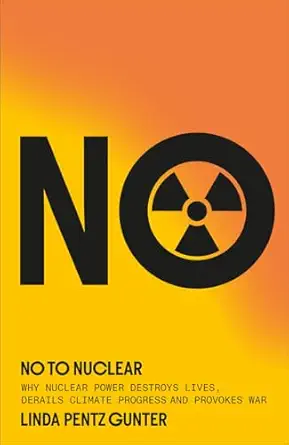
Not so, says Linda Pentz Gunter, the founder of Beyond Nuclear. Pentz Gunter is out this month with a new book titled No To Nuclear. Why Nuclear Power Destroys Lives, Derails Climate Progress And Provokes War (Pluto Press, April 2026).
The book is a 200-page indictment of the nuclear power industry and shatters the myth that nuclear power will help solve the climate crisis.
“I wanted to write a book that would appeal to a mass market audience, especially those in the climate movement who may have fallen prey to the saturation propaganda campaign being waged by the nuclear industry that paints itself as a solution to the climate crisis, when it is anything but,” Pentz Gunter writes. “In so doing, I have endeavored to put a human face on the story, to communicate what it feels like to be the victim of an industry that destroys the environment, harms health and leaves its lethal waste behind.”
“Both the nuclear power and nuclear weapons sectors have disproportionately harmed Indigenous peoples and communities of color, as well as women and children, the most susceptible to harm from radiation exposure. This has happened from uranium mining to atomic testing. No phase of this industry is benign.”
Especially topical is the section on Iran, written after Israel and the US bombed that country’s nuclear facilities last summer but before the current war.
“Iran is the poster child for the blurry line between a civil nuclear program and a military one,” Pentz Gunter writes. “Here you have a civil nuclear program in Iran being used as a pretext to attack a country with the US and Israel arguing that Iran could transition to a nuclear weapons program. This is of course always a possibility when you have arms reduction or abolition treaties that continue to allow for the development of nuclear power. Because of this, no one is sure of Iran’s true intentions while its civil nuclear program has made it a target.”
“The myths surrounding the nuclear industry’s latest push for small modular reactors – that turn out to be more expensive, more dangerous and will produce greater volumes of nuclear waste than current reactors – are clearly and systemically debunked.”
You say in your book that nuclear power relies on subsidies and crime. How so?
“Across the United States to date, in Illinois, Ohio and South Carolina – there have been criminal cases that reveal the extent to which nuclear industry executives and politicians are willing to collude for mutual enrichment,” Pentz Gunter told Corporate Crime Reporter in an interview last week.
“M.V. Ramana, in his book Nuclear is Not the Solution: The Folly of Atomic Power in the Age of Climate Change, dives into the question of subsidies. He rightly points out that none of these new nuclear reactors will happen without subsidies. The industry does not want to pay for it.”
“The most shocking example of this is Bill Gates. He is a multi-billionaire who has his small reactor with the company TerraPower. He said it would cost $4 billion. He went to the Department of Energy and asked for a $2 billion subsidy and got it. So we the taxpayers are paying a multi-billionaire half the cost of his vanity project, which probably is not going to materialize, and if it does, is designed for export. It’s a fast reactor, which means it’s highly proliferation friendly. It’s a little bomb kit. If he wants a project like this he should pay for it.”
The other point you make is that the insurance industry will not insure nuclear power plants. So the industry pushed through Congress the Price Anderson Act which capped the liability for each nuclear power plant at $16 billion. We the taxpayers will pay the excess damages.
“What does that tell you? They are not willing to cover their own risk. They know it will cost a lot more if something goes wrong. The Chernobyl disaster damages are now estimated at $700 billion. Probably at least $500 billion for the Fukushima disaster. The $16 billion isn’t going to go very far.”
“Price Anderson was renewed in April 2024 for forty years to cap the damages at $16 billion without any public intervention.”
“And now come these small reactor companies who say that these new reactors are meltdown proof, totally safe, and we don’t need an evacuation zone beyond the perimeter fence of the property. But, they want the protection of Price Anderson. And they got it.”
“Why do you need federal protection if they are totally safe and meltdown proof and we don’t need an evacuation zone beyond the perimeter fence and no sirens?”
In your book – No to Nuclear: Why Nuclear Power Destroys Lives, Derails Climate Progress and Provokes War – you point out that the nuclear industry propaganda is being spread not just by the industry but by self-described environmentalists like George Monbiot and Mark Lynas who write for The Guardian newspaper in the UK.
In The Guardian in 2021, Lynas wrote that “we must never forget that Fukushima has killed no one.”
“When Lynas says – no one died at Fukushima – we don’t know how many people died from the radiation exposure. To say – the plant blew up, no one dropped dead and then it’s fine – that’s not the way it works.”
The industry says there was not one death from Fukushima and Three Mile Island and even Chernobyl?
“Well, not even the industry would say no deaths from Chernobyl. They would admit that there were liquidators who were sacrificed. They were the firefighters and people sent in to clean up. But that’s by no means everyone.”
“Figures range from tens of thousands to more than a million eventual deaths. But it is not just about immediate deaths. It’s about long term horrendous illnesses. It’s about thyroid cancer. The Chernobyl story is also about the Chernobyl necklace, which is the scar on people’s necks after having their thyroids removed so they don’t die from thyroid cancer. There is the Chernobyl heart, the defect that children were born with afterwards. And then there is the displacement. And stress. If you are uprooted from the only life you know and only people you know, that’s an incredible burden.”
“The MIT Professor Kate Brown wrote a wonderful book Manual for Survival: A Chernobyl Guide to the Future. She speaks Russian and Ukrainian. She delved into the archives. She did a tremendous amount of research to see what really happened.”
“Actually counting the deaths and injuries is very difficult, in part because people moved away. The average acceptable moderate count is hundreds of thousands of people who have died from something they wouldn’t have died from if there hadn’t been a Chernobyl disaster. Same for Three Mile Island. There was a sudden bubbling up of all kinds of illnesses that were tied to exposure to radiation.”
“But they said there was no correlation, the doses weren’t high enough and so on. So we don’t really know. I would argue that if you support nuclear power, you are not an environmentalist anymore because it is so destructive to the environment. It’s not the solution to the climate crisis.”
“You can say you are a former environmentalist who now supports nuclear power, but I don’t think you can say you are an environmentalist. It’s a deeply extractive industry that discriminates against the people it exploits.”
“And those are often indigenous people in far flung places who nobody ever sees – including native people in the United States. But nuclear power is slow and expensive.”
“It’s not so much about the carbon footprint, which is there. The issue is it takes so long and costs so much. We are pouring our time and money in the United States into suppressing the ability for renewables to escalate and redirecting the time and money toward nuclear.”
“The timeline for building these nuclear plants is probably more than a decade, even for these small nuclear plants. And in that interim time, what we are doing is burning more fossil fuel. It’s just a diversion that is actually making the climate crisis worse.”
“The imperative right now is to reduce the most carbon for the least cost in the shortest time. If I gave you a dollar and you invest your dollar in nuclear and I invest mine in solar, I will reduce more carbon faster than you, for sure. You can bring renewables on very quickly. And they are here now. It’s not something we are uncertain about.”
“For the new reactors, the designs are uncertain, the safety measures are unknown, there are all sorts of known flaws. The Trump administration has decided to fast track them anyway and do away with the regulatory infrastructure and suppress the Nuclear Regulatory Commission so they can fast track these new reactors.”
“The new smaller reactors are very small – some of them are 10 megawatt reactors. So if one ten megawatt reactor gets built, it’s not going to make a dime’s worth of difference to the climate crisis. You would have to build hundreds if not thousands of them. That’s just not realistic. They are taking longer to build and they are more expensive. It’s the slowest, most expensive way of boiling water and also, of course, the most dangerous.”
Two years ago, Oliver Stone put out a pro-nuclear power movie titled Nuclear Now. At the same time, Christopher Nolan put out the box office hit Oppenheimer. And then there was House of Dynamite.
“House of Dynamite was a great movie against nuclear weapons. Oppenheimer was a biographical movie that didn’t really show the impact of nuclear weapons. But it did open up a window of opportunity for our community to make the argument against nuclear. It was huge at the box office.”
“The other one that made a huge impact was the television series Chernobyl, which was the most watched television series of all time on HBO. It had to explain all sorts of difficult technical concepts. But it was incredibly popular. People got a grip on what went wrong and the horrendous aftermath. But Oliver Stone took one book and decided that was the gospel on nuclear power. He went on talk shows and spewed this complete nonsense. It was rather sad to see him go on this slow downward trajectory to this Nuclear Now film.”
You say that there is only one nuclear power skeptic in Congress and that’s Senator Ed Markey (D-Massachusetts).
“And Bernie Sanders (I-Vermont).”
Okay, two skeptics out of 535. Why would that be?
“Most of them are not thinking about it at all. They all have their issues and nuclear power is not one of them.”
Who are the most pro-nuclear Democratic Party promoters in Congress?
“The two that I write about in the book are Senators Cory Booker (D-New Jersey) and Sheldon Whitehouse (D-Rhode Island). It’s partly because they are on the right committees and partly because they are evangelically pro-nuclear.”
“I tried reaching out to Senator Whitehouse to find out what he has read, seen or heard that put him on that path. I don’t know the answer unless we can get in the door and find out. But they don’t even answer our requests for interviews.”
“I really want to understand how he can be so concerned about the emasculation of the Nuclear Regulatory Commission, which is happening now. It’s being dismantled to the point where we will now see reactors licensed when they should not be licensed for safety concerns. And he is concerned about sea level rise and climate change. But he’s still this evangelical promoter of nuclear energy. What has he read or seen that puts him on that path? I don’t know the answer and I would like to get in the door and find out. I think we have to try and get meetings. But they don’t answer.”
[For the complete q/a format Interview with Linda Pentz Gunter, 40 Corporate Crime Reporter 17, April 27, 2026, print edition only.]
Don't Miss:
-
From Iran to China: An Emerging Trans-Central Asian Corridor
-
New documents show how a retail chain’s sales practices helped put guns on US streets
-
Singapore a battleground of commodities fraud lawsuits
-
From Propagandist to Criminal
-
On Indonesia’s fires, El Nino’s impact on the power sector, and other stories | Asia Sentinel Stories of the Week