
 School shootings in the Philippines put gun access under scrutiny
  Statement on missing ICIJ journalist Micah Reddy
  TRANSCRIPT: ‘China Retains Levers for Long-Term Territorial Ambitions’
 U. S. Government Offers Up to $102 Million for the CJNG Leadership
On August 5, the U.S. government, through the Narcotics Rewards Program and the Transnational Organized Crime Rewards Program (TOCRP), offered up to $102 million for information leading to the arrest and/or conviction of eight senior leaders of the Cártel de Jalisco Nueva Generación (CJNG). Additionally, the State Department is applying visa restrictions to 65 individuals identified as family members or close associates linked to CJNG. The U.S. District Court for the Eastern District of New York, together with the U.S. District Court for the District of Columbia, unsealed indictments against senior CJNG members, collectively placing unprecedented pressure on the cartel’s senior leadership. Combined with the rewards, these measures represent one of the most extensive U.S. efforts to target the leadership of a single transnational criminal organization.
In the indictments, the U.S. District Court for the Eastern District of New York and the U.S. District Court for the District of Columbia state that “CJNG’s leadership included a small group of top-tier commanders and a second tier of bosses that operated under the top-tier leaders.” This command structure helps explain why U.S. authorities can concentrate pressure on a relatively small group of senior leaders despite CJNG’s extensive territorial presence across Mexico.
The indictments also note: “The franchise model permitted each franchise group to customize its operations according to specific areas of expertise (for example, running clandestine methamphetamine labs) or market demands, provided it complied with naming, branding, and organizational structure requirements and followed the general direction of CJNG leaders. Because new franchises were easy to establish, the franchise model enabled CJNG to expand quickly.” This organizational structure allows CJNG’s leadership to combine centralized strategic control with decentralized operational autonomy, enabling the cartel to expand into new geographic areas and criminal markets while remaining difficult to dismantle at the local level.
This criminal franchise model has allowed CJNG to expand across Mexico and diversify its criminal portfolio without requiring the central leadership to directly manage every local operation. This decentralization reduces the organization’s dependence on individual regional commanders and allows local cells to continue operating even when specific leaders are removed. Although highly effective, the model is not unprecedented in Mexico; a similar structure was employed by Los Zetas during their expansion in the late 2000s.
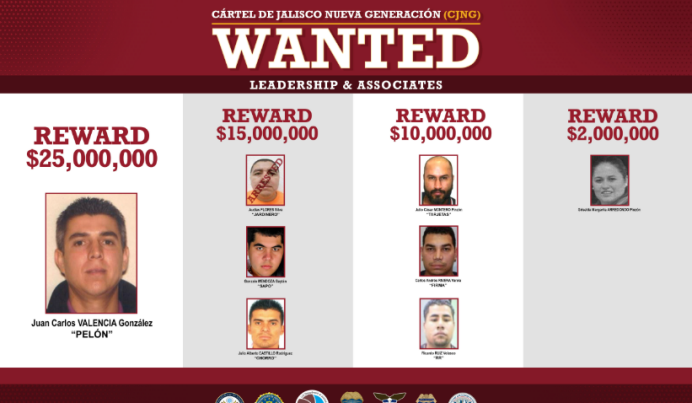
The following CJNG leaders are currently the subjects of U.S. rewards:
Capo di Tutti Capi
As previously reported, the U.S. government has identified dual U.S.-Mexican citizen Juan Carlos Valencia González (a.k.a. “El Pelón” or “El 03”) as the principal leader of the CJNG. The U.S. Department of State has offered a reward of up to $25 million for information leading to his arrest and conviction on charges related to the manufacture, transportation, and distribution of large quantities of narcotics, as well as the organization of numerous violent crimes.
The Captains
Audias Flores Silva (a.k.a. “El Jardinero”) is one of the highest-ranking CJNG leaders publicly targeted by the U.S. Treasury Department. He was later apprehended on April 27, 2026, during a targeted military operation conducted by the Mexican Navy’s Special Forces (SEMAR) in Nayarit. The U.S. Department of State has offered a reward of up to $15 million for information leading to his arrest or conviction. Despite his imprisonment, the U.S. government continues to consider him a senior CJNG leader who maintains influence over vast territories across Mexico, where his network oversees the production and export of synthetic drugs to the United States.
Gonzalo Mendoza Gaytán (a.k.a. “El Sapo”), El Mencho’s godson, is a senior CJNG commander who has served as the plaza boss for Puerto Vallarta, Jalisco. He allegedly procured a significant portion of CJNG’s weapons and trained sicarios at cartel training camps. He has also been linked to the Izaguirre Ranch in Teuchitlán and the escuelitas (schools), where he allegedly played a central role in the forced recruitment of new members. These facilities were reportedly used as training grounds for recruits lured through false job offers before being subjected to brutal indoctrination. The U.S. Department of State has offered a reward of up to $15 million for information leading to his arrest or conviction.
Julio Alberto Castillo Rodríguez (a.k.a. “El Chorro”) is the son-in-law of the cartel’s now-deceased leader, Nemesio Oseguera Cervantes (“El Mencho”), through his marriage to Jessica Johanna Oseguera González. U.S. authorities allege that he is responsible for maintaining criminal control over Pacific port of Manzanillo, Colima, Mexico, which serves as the principal point of entry for chemical precursors used in the production of synthetic drugs. The U.S. Department of State has offered a reward of up to $15 million for information leading to his arrest and conviction.
Below the cartel’s senior commanders, U.S. authorities also targeted a second tier of bosses responsible for enforcement, financial operations, and specialized criminal activities.
Lieutenants
Julio César Montero Pinzón (a.k.a. “El Tarjetas”) directed a sophisticated international fraud scheme that targeted U.S. owners of timeshare properties in Mexico. Over the past decade, this operation allegedly laundered hundreds of millions of dollars in non-drug revenue used to finance the CJNG’s drug and arms trafficking activities. The U.S. Department of State has offered a reward of up to $10 million for information leading to his arrest and conviction. Montero Pinzón is also an alleged leader of elite hitman units that have access to military-grade weaponry and are responsible for acts of extreme violence and high-profile assassinations.
Carlos Andrés Rivera Varela (a.k.a. “La Firma”), a dual Colombian-Mexican national originally from Cali, Colombia, has resided in Mexico for many years.U.S. authorities identify him as a high-ranking CJNG leader operating primarily from Puerto Vallarta, where he serves as both an enforcement commander and financial coordinator. The U.S. Department of State has offered a reward of up to $10 million for information leading to his arrest and conviction.
“Montero Pinzón and Rivera Varela founded and led a group of highly trained and heavily armed sicarios, or hitmen, known as the Grupo Elite. The Grupo Elite allegedly serves as the CJNG’s enforcement arm to further the cartel’s drug trafficking operations, including overseeing CJNG territories and murdering public officials and rival cartel members. Montero Pinzón and Rivera Varela allegedly had over 1,000 personnel reporting to them and ran the Guadalajara Plaza, one of the CJNG’s most important territories.”
Ricardo Ruiz Velasco (a.k.a. “Tripa” or “RR”) is identified as a commander of Grupo Élite, widely considered one of CJNG’s most violent tactical branches of the Jalisco New Generation Cartel (CJNG). He has also been publicly linked to several high-profile acts of violence in Mexico, including the 2025 assassination of influencer Valeria Márquez. Ruiz Velasco is also allegedly involved in the transportation, importation, and distribution of drugs, including methamphetamine, fentanyl, and heroin, within the United States, as well as the collection of narcotics proceeds. The U.S. Department of State has offered a reward of up to $10 million for information leading to his arrest and conviction.
Beyond its senior and second-tier commanders, U.S. authorities are also targeting individuals who supported CJNG’s financial infrastructure and revenue-generating schemes.
Supporters
Griselda Margarita Arredondo Pinzón served as a contadora (accountant) and worked at a CJNG-controlled central office that oversaw the operations of the call centers managed by other contadores. She helped promote the Timeshare Fraud Scheme and conceal the proceeds derived from it. The U.S. Department of State has offered a reward of up to $2 million for information leading to her arrest and conviction. Her inclusion illustrates how the current U.S. campaign extends beyond CJNG’s commanders and armed operators to individuals supporting the cartel’s financial infrastructure and non-drug revenue streams.
Taken together, the rewards, indictments, and visa restrictions suggest that the United States is moving beyond targeting individual CJNG leaders toward attacking the central command structure that holds the cartel’s franchise system together. CJNG’s decentralized model may allow regional cells to survive the removal of individual commanders, but the current campaign appears designed to pressure the relatively small leadership group responsible for coordinating those decentralized operations.
If this pressure succeeds in significantly weakening CJNG’s central leadership, regional cells with substantial operational autonomy could increasingly operate independently, potentially accelerating the fragmentation of the cartel into smaller regional criminal organizations. Rather than producing the immediate disappearance of CJNG, leadership decapitation could therefore result in a more fragmented criminal landscape in which former CJNG cells compete for territory, trafficking routes, and criminal markets.
Sources: state.gov – justice.gov – dea.gov

Don't Miss:
-
Singapore nets US$862,000 from first auction in money laundering case
-
Japan asks for US$43 million to weed out cherry tree-devouring longhorn beetle
-
3 stray mongrels captured after cyclist dies in suspected dog attack
-
Philippine tribe vows to stand ground against US-led Pax Silica: ‘listen to us’
-
Chinese woman in her 70s wakes up in coffin before dying for good 2 days later