
 TRANSCRIPT: ‘China Retains Levers for Long-Term Territorial Ambitions’
  On Indonesia’s new oligarchy, China’s state bank, and other stories | Asia Sentinel Stories of the Week
  ‘Tinder Swindler’s’ plan for a dating app sparks industry backlash
By: Majid Maqbool
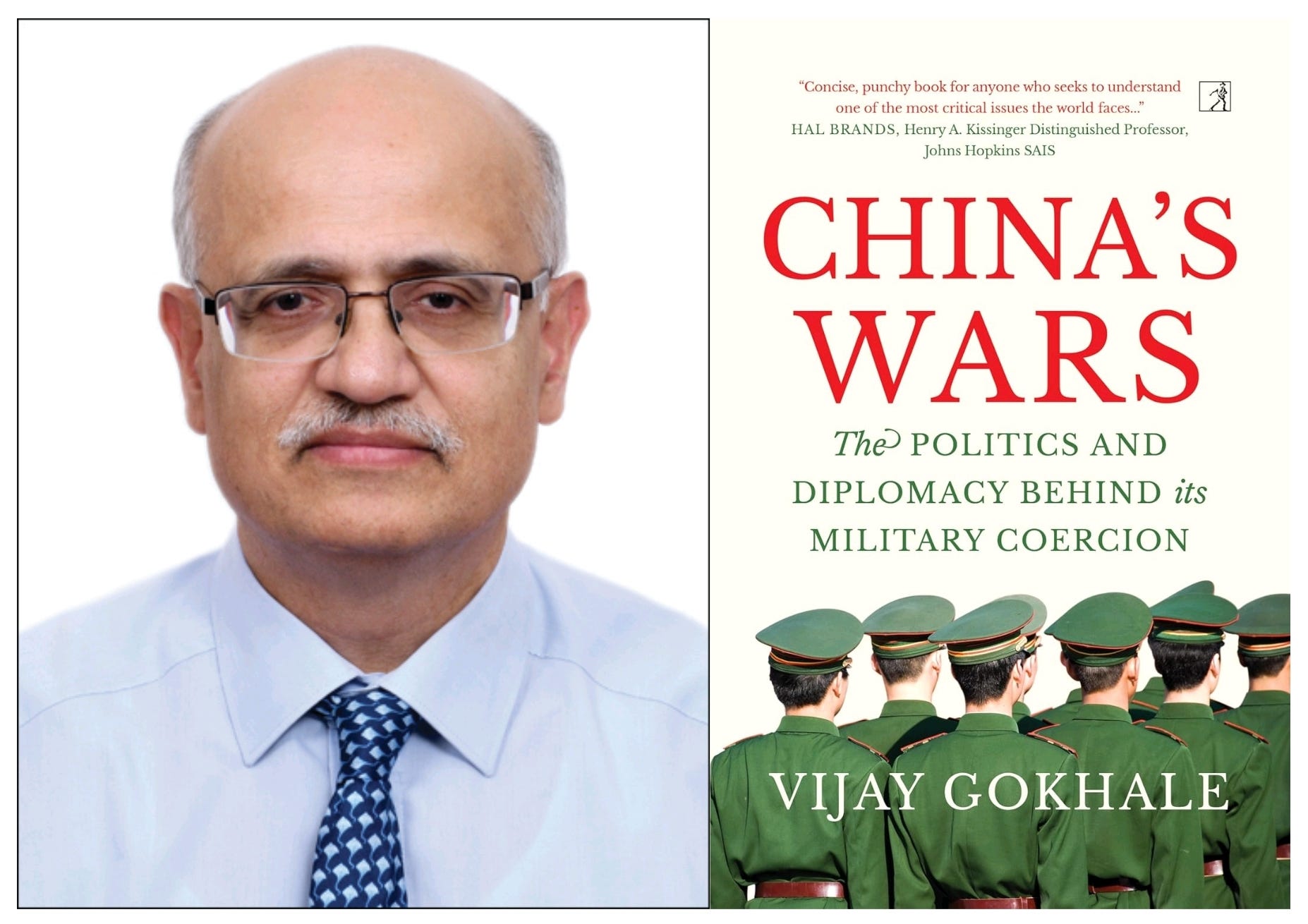
The People’s Republic of China has consistently utilized military pressure and gray-zone tactics against regional neighbors and global powers since its founding in 1949. Foreign countries that threaten Chinese sovereignty could be framed as adversaries, and the PRC’s offensive action could be deemed as necessary and defensive countermeasures, argues a new book on China written by India’s former Foreign Secretary Vijay Gokhale.
In his recently published book, China’s Wars: The Politics and Diplomacy Behind its Military Coercion (Simon & Schuster India), Gokhale, who has roughly four decades in the Indian Foreign Service, examines the strategic calculations behind Beijing’s decision to wage war or use force, based on case studies from the 1950s to modern confrontations. Gokhale retired as India’s Foreign Secretary in 2020, having also served as India’s Ambassador to China from 2016 to 2017.
The author, whose previous works on Chinese statecraft include The Long Game: How the Chinese Negotiate with India, examines how China uses domestic politics, statecraft, ideological doctrine and information operations to build a diplomatic cover, while also looking at when and why China may turn to military coercion in future geopolitical crises.
In this exclusive interview with Asia Sentinel, Gokhale talks about China’s regional ambitions; the tactics deployed against its neighbors, particularly India; how China employs a “talk and fight” approach, creating new military facts on the ground while dragging out negotiations on the altered status quo, leveraging AI and big data to its strategic advantage; and why he believes India should stay vigilant while strengthening its informational and cyber capabilities to breach China’s firewalls.
Edited excerpts:
Q. Why do you think China’s enhanced military and strategic capacities are a cause of concern for its peripheral and proximate neighbors, even though it has not engaged in a major war since the late 1970s?
A. The People’s Republic of China views itself as the primary power in the Indo-Pacific and at the apex in terms of the power hierarchy in this region. It expects other states, big or small, both partners and rivals, to accept the PRC’S dominant position, and to accommodate its concerns and interests without question. Non-acquiescence to Chinese demands for reasons that might be intrinsic to the other regional states is not viewed from the perspective of the other state. Consequently, the PRC interprets such actions or activities as a challenge or a threat. Its assertive and, some say even aggressive behavior over the past two decades is, therefore, a cause for concern, especially when its comprehensive national power is rapidly outpacing that of other states in its proximity.
In what ways do you think China’s past conflicts with India can provide insights into its coercive methods, and how might those lessons shape the way we understand future India-China confrontations?
Since the beginning, the preferred modus operandi of the People’s Republic of China to secure its territorial objectives vis-à-vis India has been to create new facts on the ground and to thereafter attempt to legalize the new status quo through negotiation. They play a long and deceptive game through the careful deployment of historical, legal and psychological methods, such that the changes are subliminal and gradual and the other state hopes to restore the status quo through negotiation without risking an escalation. A number of methods are used by the PRC to delay the resolution of the problem they have created, such as through simultaneous action both on the ground and at the negotiating table, until the ground situation has changed in their favor. If, by then, the other state is unwilling to submit, the PRC does not hesitate to use force to pursue its objective.
You write in the book that the PRC bets on the asymmetric advantage it has already created on the ground through force, in order to deter an adversary from using military means to regain lost territory. Does this logic also apply to China’s recent conflict along the Line of Actual Control (LAC) with Indian troops in Ladakh?
Yes. These methods, and others elaborated in my book, are used in situations of both conflict and military coercion below the threshold of conflict such as the incidents along the LAC since 2013.
You note that “how and when China will deploy force in pursuit of its claims in the future” is a legitimate question in the minds of Indian strategists and thinkers. How worried, in your assessment, are India’s strategic thinkers and defense community about the possibility of China using military force in future conflicts against India?
India aspires to have stable and predictable relations with the People’s Republic of China. Every government in India has made specific efforts to resolve the boundary question to little avail. China professes a desire to resolve the boundary dispute peaceably, but retains leverages that speak to its possible longer-term objective of seizing territory. This includes recent provocations such as the renaming of towns and places in the Indian state of Arunachal Pradesh and the activation of the Sino-Pak Joint Boundary Commission to exercise jurisdiction over integral parts of the territory of the Indian Republic. India’s strategic community remains hopeful that China will abide by its commitment to finding a fair, reasonable and mutually acceptable settlement through negotiations, but remains vigilant against potentially hostile acts, and is preparing itself accordingly.
You write that for the PRC, “fighting and talking” go hand in hand, and that political warfare and battlefield combat are deeply intertwined in its strategic culture. What can India learn from a neighbor so adept at combining military pressure with political and informational tools to achieve its objectives?
The PRC’s use of discourse power (narrative-shaping) is one of its strengths. As part of its “three warfare” strategy, China is deploying the use of big data, artificial intelligence and other new digital technologies to enhance its penetration into the social fabric of its rivals in order to influence or transform the cognitive capabilities of entire social groups. The methods include perception-molding, altering historical memory or questioning the framing of an issue in ways that cause the population to question its own leadership. India will need to develop its own set of informational tools to both counter PRC discourse power, and to penetrate the internet and cyber firewalls in order to take the information war to the domestic population in China.
What has your lifelong interest in, and study of, China taught you, especially about the complexities of China’s relations with India?
It has made me aware of the deep gaps in our knowledge and understanding of the People’s Republic of China, and of the pressing need to encourage young scholars to do research in new fields that will provide Indians at large with a balanced view of China. I see my books as a small contribution to this national effort.
Don't Miss:
-
On Indonesia’s new oligarchy, China’s state bank, and other stories | Asia Sentinel Stories of the Week
-
‘Tinder Swindler’s’ plan for a dating app sparks industry backlash
-
US prosecutors accuse Huawei of ‘far-reaching criminal scheme’ spanning decades
-
Exposé of Chinese State Bank Shines a Light on Lending Practices
-
Thailand and a Tale of Two IMF Meetings