
 Rick Claypool on Pay to Play Corporate Crime Enforcement
  Labaton Launches Whistleblower Practice with Former SEC Acting Chair Allison Herren Lee
  Kremlin payment firm A7 has been pumping billions in ‘untraceable’ cash into global financial system

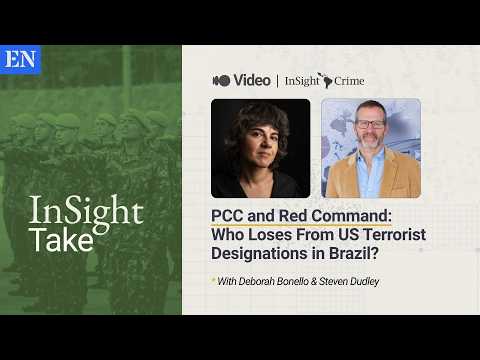
In this week’s InSight Take, Managing Editor Deborah Bonello and Co-Director Steven Dudley discuss the recent US terrorist designations of the PCC and Red Command gangs, and how they promise to affect Brazil’s security landscape, elections, and economy.
Transcript:
[00:00:00] DB: Morning all. I’m Deborah Bonello, managing editor of Insight Crime, and I’m joined today by one of our co-directors, Steve Dudley, who’s in São Paulo, Brazil, to talk about the recent terrorist designations by the administration of United States President Donald Trump on two of Brazil’s biggest gangs, the PCC and the Red Command.
Steve, we’ve had signs that these designations have been coming for a while, and they were finally announced at the end of last week, bringing the number of Latin American organizations with FTO designations to 17. But this is the first time Brazilian organizations have been added to the terrorism list, a mechanism that gives the US government the legal justification for more aggressive actions against groups they now deem as a threat to national security. Steve, talk to us a little bit about the PCC and the Red Command.
[00:00:55] SD: Thanks, Deb. The PCC, or the Primeiro Comando da Capital, is the biggest criminal organization in Latin America in terms of numbers, in terms of reach, and maybe in terms of the amount of money that they have going through their system, their criminal system. And they are just an incredibly sophisticated group born in prisons in the state of São Paulo, Brazil’s biggest, back in 1993. They’ve evolved from that initial space of controlling these prison areas to slowly then moving outside the prisons and operating outside of prisons and now operate on an international scale. They have a wide variety of criminal economies that they’re involved with, but they’re not really a kind of top-down, vertically structured organization. In fact, they’re much more of a kind of federation of sorts, and they are more than anything; we would say they’re kind of super administrators of all kinds of criminal activity.
SEE ALSO: US Foreign Terrorist Designations in Latin America: An Interactive Map
So as it relates to, for example, the international drug trade, they’re deeply enmeshed in the transport side of that. And so they get access to large amounts of cocaine, mostly coming through Bolivia and Peru, but also Colombia. And then they’re facilitating the movement of that cocaine to Brazil’s major ports, most notably the Port of Santos, which is also in São Paulo state, which is the second largest in Latin America.
[00:03:12] SD: So this is an example of what the PCC has evolved into after having started as this sort of rudimentary prison gang. The other gang is the Comando Vermelho, and that’s a Rio-based gang, also born in the prison system of Brazil, before the PCC was actually born. So now we’re talking about the late 70s, early 80s. And this criminal organization is much more, I would say, rooted in control of territory, whereas the PCC is much more about being the super administrators of lots of different types of criminal economies. The Comando Vermelho is much more about controlling physical space. And then within that physical space, controlling those criminal economies that are inside of that space, most notably local drug peddling.
This is a huge market. Brazil is the second largest drug market on planet earth after the United States. So it is a very lucrative market. So control of that space and then control of that kind of drug market is super important for any criminal group. They don’t need to be necessarily international in nature. And to be honest, the Comando Vermelho is not particularly international, at least as of now. Of course, it could evolve like the PCC has evolved and reach into foreign spaces.
[00:05:00] SD: The PCC is particularly active in Europe but is also known to be active in many other countries, including countries in Asia and in the United States. So all of this is to give you the background as to why these groups would have fallen on the United States radar. That said, they have never really been talked about in terms of being terrorist groups. They might employ terrorist-style tactics, attacking state forces. Certainly the PCC over the years has executed a number of campaigns that led to the deaths of many police in Brazil. So there have been those kinds of attacks. And the Red Command is known to be very confrontational with the state. But neither group is known to use these kinds of tactics in any sort of ideological way. So the Brazilians, for example, have never categorized these groups as terrorist groups, as opposed to some of the other groups on the United States list of terrorist groups where the countries where they operate. I’ll give you an example: the MS13 in El Salvador has been designated as a terrorist group in El Salvador and the United States. But that’s not the case with the PCC and the Comando Vermelho.
[00:06:44] DB: Right. And I think both those gangs are relatively unknown names to the average American, whereas the MS13, the Jalisco cartel, the Sinaloa cartel, are very much kind of household brands, if you like, that people would already have heard of for sure.
SEE ALSO: PCC Criminal Profile
[00:07:02] SD: The Brazilian criminal landscape is not very well known in the United States. I would say in large part because there isn’t a lot of connection between the United States and Brazil in these criminal terms. At least to date, again, this could be changing. There are known PCC cells operational in the United States. There have been a couple of cases involved involving PCC members in the United States, at least alleged PCC members in the United States. But it isn’t like Colombian groups, which have long-standing historical ties to the US market. That just isn’t the case. So they’re relatively unknown, even though they are huge, they are very sophisticated, and they do pose all kinds o threats, even if they aren’t necessarily categorized as terrorist threats in places like Brazil.
[00:08:17] DB: Yeah, yeah. That’s interesting—the limited size of their footprint in the US—but talk to us a little bit about what you think the impact of these designations is going to be on, well, the gangs themselves, but also around the organizations and the financial institutions that might have come into contact with them.
[00:08:41] SD: Well, as the PCC has evolved into an international drug trafficking organization, obviously, its revenue stream has also increased. And, you know, to the extent that we had one official tell us in the last few days that they’re making upwards of $2 billion a year. A significant amount of money. So this money needs to move through the systems at hand. And they’re obviously going to use what is available to them in places like Brazil. And so what we have seen them do is steadily get more involved in things like gaining access to municipal contracts for cleaning services or for transportation services. This was the first big red flag in terms of their connections, not just to a business or businesses, but also to the politicians who are handing out some of these often state contracts. This was a red flag for us in terms of their evolution.
SEE ALSO: Brazil’s New ‘Terrorist’ Groups – the PCC and the Red Command – Explained
And then we started seeing them move into other spaces. And this was via judicial cases that are playing out now in Brazil. And these judicial cases illustrate the way in which they were getting involved in things like the fuel and gasoline trade.
[00:10:38] SD: This was connecting them to not just the gasoline infrastructure and industry and the fuel industry writ large, but also the financial industry. So they were both moving the actual products, and then they were also laundering that money through the system here. Now this system, it’s got various layers. Of course, you have big banks and financial institutions, and you also have these really poorly regulated things they call fintechs here. So the ability for them to move this money through these different mechanisms was laid out in this case; it was a very famous case that is still playing out. They’ve done several steps already and will continue to do more, and with each step, you can see how they have intertwined their activities with the traditional banking sector, with these fintechs, and with, you know, Wall Street, if you will, of Brazil. So we already have these cases where now this designated terrorist group is interacting with the largest financial institutions here in Brazil, or some of the largest. And those institutions are obviously in business with institutions outside of Brazil.
SEE ALSO: Red Command Criminal Profile
[00:12:22] SD: So we don’t know how many, how many different parts of the system will be prosecuted. But it does give prosecutors and regulators an opportunity to go after not just the Brazilians who are directly connected, but also those that are working with the Brazilians who are directly connected. So you can see how this would have a potential ripple effect on the economy and on the relationship between Brazil and other countries and all the businesses that are operational here. And it just adds so many more layers of, of checks that these different companies will have to do when doing business here in Brazil going forward. So everything around compliance will now be a multi-layered process that will cost them a lot more money. That may lead some to just say, well, it’s not worth it. And on the other side of the equation, it obviously gives prosecutors and others an incredible amount of leverage over what they do, their political posturing, any sort of thing. So it’s just a huge, huge, amount of power that is granted to you as a state when you make this kind of designation. So all of these things are at play right now in Brazil.
[00:14:04] DB: Yeah. We go into the implications of these designations for financial institutions a little deeper in a written piece on the site today. But let’s stick on the political mention there. It would be amiss of us, I think, not to mention the Brazilian senator Flavio Bolsonaro, who’s, of course, competing in the upcoming presidential elections in Brazil, reportedly met with President Trump in Washington just days before these FTO designations were announced. And this is part of his promise of a hardline approach to organized crime should he win the presidential vote. Can you explain a little bit how all of this is playing into the upcoming elections in Brazil?
SEE ALSO: US Terrorism Designations Will Hit the PCC’s Money—and Everyone Else’s
[00:14:48] SD: Yeah, I mean, the backdrop to all of this is a three-time president, Luiz Inacio Lula da Silva, who’s known more popularly as Lula. He’s now coming down to the end of his third term, and he’s preparing to go for a fourth against what appears to be probably Flavio Bolsonaro. It hasn’t been settled just yet, but he’s a pre-candidate, as they say here. And so these are the two sides that are matching up. Lula is from the Worker’s Party and they’ve tried to brandish him as being soft on crime as well as the PT of the Worker’s Party here. That’s the acronym for the Worker’s Party here. And when this was coming about or even before, when, you know, before it came about, it was always about Lula and the PT being very soft on crime.
So of course Flavio Bolsonaro wants to position himself as someone who could do something against crime. And this was a sort of master play. I mean, he thought of himself as sort of checkmating up Lula and the PT with this. And you got all kinds of social media activity around this in the days that followed, including memes of Lula sitting on a rocking chair with a baby with PCC across its chest, you know, kind of coddling the baby.
[00:16:32] SD: So this is the backdrop of these designations. But the reality is that this could hurt both candidates. I mean, if you’re going to impede business activity here, if you’re going to put higher levels of compliance in, if you’re going to strangle in some way, shape or form the economy, then this may not be the best stance to take going forward. I mean, the first round of elections is in October. And so we’re quite a ways away. But nonetheless, you could see this actually coming back to bite Flavio Bolsonaro if this has a major impact on the economy.
And on the Lula side, it’s just a no-win situation. I mean, they have come out, and Lula himself came out very strongly against this. But then that just feeds into this narrative that, oh, well, then they’re coddling the PCC and the Comando Vermelho. So it’s really a no-win situation for Lula, no matter what position he takes. And then on the Bolsonaro side, you know, it may be that it comes back to bite him. So this is a tough one, I think, for both candidates.
[00:17:59] DB: Yeah. I guess we’ll just have to see how that plays out over the coming weeks and months. But it’s definitely a master play.
[00:18:10] SD: Yeah. I mean, I certainly think that he thought that. And he made statements to this effect as well on social media about how, you know, in one single visit, he had done more than three Lula administrations to deal with the security problem. And the security problem, by the way, is the number one issue right now in the election. So it’s not a small thing, and this will play out in the months to come.
[00:18:42] DB: Yeah. And of course, we’ll be watching that one. Just to remind our readers and our viewers that we have deep profiles of both the PCC and the Red Command on insightcrime.org, as well as Brazil’s criminal history. And the genesis of all of that is something that we’ve been covering since we began 15 years ago, so please don’t forget to dip into that. Steve, thanks very much for joining me, and thanks for watching, everyone.
[00:19:11] SD: Thanks, Deb.
[00:19:12] DB: Bye for now.
Don't Miss:
-
A Total of 13 Mass Graves Have Been Found in Viesca Containing the Charred Remains of Men and Women
-
Jorge Luis Zambrano, alias “Rasquiña”
-
El Taliban Fell In Mazatlán… And What He Confessed Ties Everything Together
-
Inside the Camp at the Heart of Honduras’ Garífuna Land Struggle
-
This Is How the MataZetas Captured and Executed the Zetas