
 The Taliban’s New War Begins at Home
  Panama removed from EU’s tax haven ‘blacklist’ a decade after the Panama Papers
  Crackdown and Controversy: The Battle Over Beach Bars and Noise in Phuket’s Bang Tao
 The US State Department has added the Chone Killers in Ecuador to its list of foreign terrorist organizations operating across Latin America. InSight Crime Managing Editor Deborah Bonello discusses this latest development and what it means for organized crime dynamics on the ground in Ecuador with Co-director Steven Dudley and investigator Gavin Voss.
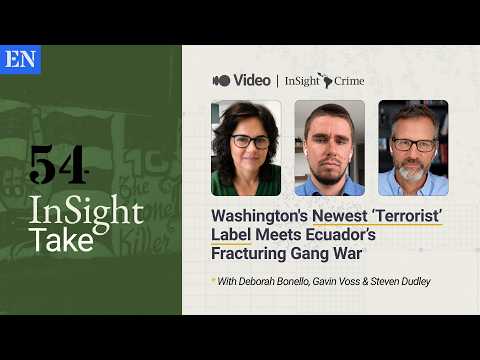
Deborah: [00:00:00] This week, the US State Department added another Ecuadorian gang to its list of foreign terrorist organizations. This time, it’s the Chone Killers accused of numerous attacks targeting civilians, law enforcement officers and government officials, including high profile assassinations of public officials. This is the latest move in a fast moving campaign. By Washington’s own count, this is now the 18th Latin American gang or cartel added to the terrorism list since February.
SEE ALSO: US Foreign Terrorist Designations in Latin America: An Interactive Map
Deborah: [00:00:34] But here at InSight Crime, we feel compelled to do some setting the record straight. And whether the Chone Killers comply to the foreign terrorist designation. On the ground in Ecuador they’re a gang that has splintered into rival factions shooting at each other over turf. I’m Deborah Bonello, managing editor of InSight Crime, and I’m joined this week by our Co-director Steven Dudley and by Gavin Voss, who have both been digging deep into Ecuador’s criminal panorama and the Chone Killers. Thanks for joining me, both of you.
Steven: [00:01:09] Thanks, Deb.
Gavin: [00:01:10] Thank you. Deb.
Deborah: [00:01:12] Gav, let’s start with who these guys actually are, because the State Department statement gives us one line that they split from the Choneros in 2020. Can you walk us through the gang a little bit?
Gavin: [00:01:25] Yeah, absolutely. And I think in some sense, that one line is pretty accurate in that in order to understand the Chone Killers as a group, you also have to know a little bit about the history of the Choneros. So for those of you who don’t know, the Choneros today are one of Ecuador’s top criminal groups, and they were designated a terrorist organization by the United States last year. So a year before the Chone Killers. And this group, the Choneros, started out in the coastal region, which is very strategic for drug trafficking routes that we see today. And starting in the late 1990s, they were involved in very local criminal economies. We’re talking about things like robbery, extortion, but kind of over the course of the following two decades in the 2000s and 2010s, the Choneros rose from being a local group to really this kind of national criminal force. And they did this mainly by getting involved in the international drug trade. They forged alliances with some of the biggest cocaine traffickers that would bring cocaine from Colombia through Ecuador to be exported. I think also in addition to drug trafficking, they also exploited Ecuador’s very vulnerable prison system, and they used that as a base through which to kind of expand their national brand connections, eliminate rivals, things of that nature.
SEE ALSO: Behind Bars, Beyond Control: The Fall of Ecuador’s Prisons and the Rise of its Mafias
Gavin: [00:03:02] So I think probably one of the most important people for understanding Ecuador’s criminal history is Jorge Luis Zambrano, alias “Rasquiña.” He was the leader of the Choneros, and he was a very charismatic figure. He wanted more power. He wanted to expand the group. And he knew that in order to do that, the Choneros needed allies all around the country. Right? So he, being pragmatic as he was, he connected with leaders of already existing gangs and incorporated them under this kind of confederation that was the Choneros. So instead of being kind of a monolithic criminal group, they really incorporated a bunch of different gangs under their wing.
[00:03:49] But then in 2020, Rasquiña was murdered and that whole structure collapsed. So that’s when we start to see the Chone Killers, along with the Tiguerones and the Lobos, who were kind of among those gangs that were under the Choneros’ umbrella, but then began acting more independently after that murder.
Deborah: [00:04:10] So the Chone Killers were born more out of a power vacuum, rather than something built from the ground up with a fixed command structure like, say, the PCC in Brazil.
Gavin: [00:04:23] Well, yeah, I’d say kind of. I’d say yeah, probably yes and no to that question, because one thing I didn’t mention before is that the Chone Killers had, you know, already existed for years before they joined forces with the Choneros. So they were based in Durán and they were originally a faction of what was called the Netas. And the Netas were a prison gang of transnational nature that kind of originated in the prisons of Puerto Rico, and then deportees from the United States that were part of that gang established factions in Ecuador. So it was very much a similar kind of trajectory that we see in other gangs, such as MS13 in El Salvador and Central America. So yeah, that’s kind of the basis of the Netas. But that’s where the Chone Killers, that’s what they originally were, right. And this group, it was originally a low-level street gang composed largely of youth. They were involved in criminal economies like drug dealing. But then their leaders, who were in prison at the same time as Rasquiña, they met up and under the umbrella of the Choneros became the Chone Killers. obviously adopting the name Chone as homage kind of to the group that they were now a part of. So it’s kind of interesting because they’re called the Chone Killers, but they really don’t have anything to do with Chone. They’re from Durán. That’s where the base of their power is. So yeah, it was kind of really only after Rasquiña’s murder in 2020 and the fragmentation of the Choneros that we begin to see the Chone Killers, we kind of start to see them acting more independently. They can choose their own alliances now. Sometimes they work with the Choneros, sometimes not. So instead of being subordinate to the Choneros like they were before, they’re now much more autonomous.
Deborah: [00:06:31] So now today in 2026, with this FTO designation, what does the group look like?
Gavin: [00:06:38] So now, in the past couple of years, the situation with this group has become increasingly more complicated. So their original leaders, who were also the leaders of the group when they were technically a Netas faction. These are two people named Ben Diez and Trampudo. Ben Diez was killed in Colombia in 2024. His brother Trampudo is on the run. Other top leaders with names like Negro Tulio, Bob Marley, Gato Selly, who are also big names in and around Durán and in Guayaquil’s underworld. These people have been captured, and they’re in prison. So basically the group now is without its main original leaders. And this has resulted in kind of chaos and fracturing. So kind of in and around Durán, which is this suburb of Guayaquil that’s the historic base of the Chone Killers, there’s now a police say at least five separate factions of just Chone Killers factions. And they’re fighting each other to kind of carve up the territory that’s left in the wake of the death and capture of these guys who are now gone or out of the picture. So Durán police say that a big chunk of the murders that occur in the specific area are due to Chone Killers factions versus Chone Killers factions. And I think this is really important when we’re talking about the terrorist designation because it means that it’s kind of muddying the situation. It’s kind of hard to tell who is who.
SEE ALSO: Durán: A Window into Ecuador’s Organized Crime Explosion
Deborah: [00:08:24] Sure. Yeah. I mean, it’s a problem with criminal brands across the region, I guess. Let me bring in Steve here. Steve, walk us through what you thought when you heard about the designation and what it does, how it fits into this wider pattern that we have been tracking at InSight Crime.
Steven: [00:08:42] Well, my first reaction is that there are groups in Ecuador, and beyond that I would definitely put higher, as higher threats or greater threats than the Chone Killers. Within Ecuador, we have organizations like the Latin Kings, which is another criminal group that’s operational in various countries like the Netas was before this faction in Durán became the Chone Killers, as Gavin described. If we’re really following the logic, then certainly they would be higher on the list. And then there are others like the Tiguerones, which is a faction also that Gavin mentioned that is definitely more potent, works in the international drug trade, has been involved in what can more sort of credibly be called terrorist actions, such as the violent takeover of a television station while it was transmitting live its news broadcast in a very dramatic event in early 2024. So you you have all these other groups.
Deborah: [00:10:07] I think that event was kind of what precipitated or was the straw that broke the camel’s back over President Noboa’s decision to declare an internal war, right?
Steven: [00:10:19] Yeah. So in terms of trying to understand the logic, it’s very hard, to be polite about it. So I think that’s my first reaction. And then the second is that this is logical in another way. And that is that it just expands exponentially the amount of power that it gives the Trump administration and security forces and judicial forces of the United States as they seek to establish much more command and control of what they consider their, what the Trump administration considers their sphere of influence. So it really is mostly about that, or seemingly mostly about increasing this jurisdiction, increasing the amount of power connected to this sort of establishing a kind of command and control over these spaces and having a willing partner, and always testing the willing partnership that they have with a place like Ecuador. This is an affirmation, another affirmation, again, that Ecuador is very high on the list because obviously there are many, many other groups that are much bigger than the Chone Killers around the region. So if we just, you know, not even talking about other groups like the Tiguerones, but around the region, there are much bigger groups, if we’re being honest. The Chone Killers have maybe a few hundred members. And so this is a relatively small group as well that has never operated in any international way whatsoever. So, it really is befuddling on its face, but also logical if you put it in the context of what’s been happening over the last year and a half with the use of these terrorist designations.
Deborah: [00:12:28] Right, of course. And those terrorist designations have been used to justify the bombing of suspected drug boats around the Caribbean, and other parts of the region. Dozens of vessels hit, over 200 people killed since last September. And of course, we’ve seen this move before across the region, with terrorist designations on groups in Central America, Mexico, Colombia, Venezuela. Did the designations of the Choneros and the Lobos, did that change anything on the ground for Ecuador in terms of security?
Steven: [00:13:05] I think it opened up and continues to open up and strengthen the relationship between the United States and Ecuador. When they’re given more jurisdiction, and they’re given the terrorist designation, then the judicial authorities, for example, do not necessarily have to follow the same rules they did before if they’re going to implement, for example, wiretapping, or other measures. So it expands their power often very much in conjunction, I think in this case, in the Ecuadorian case, in conjunction with Ecuadorian authorities. So I don’t think necessarily they they needed that. But I think that this is just an element of saying we’re much more in line with what’s happening with Ecuador, and we’re going to work hand in glove with Ecuadorian authorities. And I think that’s had an impact for sure. I mean, we have seen increased numbers of actions against criminal organizations in Ecuador since the designations and, and certainly the bombings in the high seas have been concentrated off the Ecuadorian coast, even if they’re in international waters.
Deborah: [00:14:36] Right. But we’ve also seen in Ecuador homicides jumping between 2024 and 2025, I think increasing by 31% if I’m not wrong.
Steven: [00:14:48] Deb, sorry to just jump in, but the contention, Gav correct me if I’m wrong on this, but I think they, what they’re claiming is 2026 is going to be a much better year, right?
Gavin: [00:14:59] Yeah. And so far, statistically, it has been slightly better if you compare it to last year, but like you said last year homicides were up 31%. It was by far the most violent year in Ecuador’s history. So to make, 10 to 20% reductions in homicides like they’re claiming so far this year, I’m not sure how much progress that really will represent long term.
Steven: [00:15:28] Yeah. Sorry, Deb. Go ahead.
Deborah: [00:15:29] Yeah. And talking of progress, how practical is it going to be to implement this? We know that the FTO designations make it illegal for companies and individuals to do business with members of these gangs. If there’s this level of fragmentation that we’re talking about, and leadership is muddy, how will the governments of the United States and Ecuador be able to tell who is who, who are true members of the Chone Killers, who are, masquerading because they want to capitalize on the criminal brand? How are they going to get around those pretty serious, logistical challenges in terms of implementing the FTO designations and what they imply?
Gavin: [00:16:20] Yeah, that is the question. I’ve done a lot of field work in and around Durán, I’ve looked at this group pretty deeply, and that’s really the issue, who is who. How do you affiliate someone back to this now loosely defined entity that is the Chone Killers. So I think there are a couple of ways, like Steve said, and expanding the toolbox for authorities. I think there are a couple of ways that it could help, and one of those could maybe be going after some of the leaders that are abroad. So with Ecuador’s recent gang crackdown, high levels of gang conflict, a lot of the leaders have found it very hard to continue living in Ecuador, and they have sought refuge abroad. For example, Ben Diez, who was the old Chone Killers leader, he was murdered in Colombia. Just off the top of my head, another leader, Negro Tulio, was captured in Panama. So these guys, while they may be directing things in Durán, in the Guayaquil area, a lot of them aren’t even residing in Ecuador. So in terms of international cooperation, maybe even extradition, I think the terrorism designation might facilitate those types of people moving in. I don’t know if Steve, you had something to add to that.
Steven: [00:17:48] It’s hard to tell at this stage, but if you’re a business right now and you’re trying to figure out how to navigate this terrain, you’re going to have an incredibly tough time for all the things that Gavin is mentioning. We don’t know who is who. You don’t know who you’re paying if you have to pay extortion, or even if you have a service provider who’s having to pay extortion or a service provider that might be owned or partially owned by one of these groups or a relative of some of these groups, and designations of these sorts of these smaller groups that really is almost at this stage are sort of subjective process in determining who is who. At what point is this even manageable from a compliance standpoint, from a business standpoint? I don’t know if they’re realistically going to enforce the rules around doing business with terrorist organizations, spreading them out like this and naming groups like the Chone Killers is not going to help business. I don’t know what the US government is going to do. Is it just going to be sort of a wink and a nod? We’re not really going to enforce this. This is obviously for bigger political reasons. It’s very unclear. And I think what it does is just it just muddies the waters further if you’re seeking to do business in places like this. So I find it contradictory to talk about how this is supposed to foster business when in reality it is complicating business.
Deborah: [00:19:54] If we zoom out of the micro away from the implementation challenges and more about the geopolitical issues, it does seem to be more about the US- Ecuador relationship and Noboa’s political needs at this moment in time.
Steven: [00:20:14] Yeah, I think that sounds right. I mean, the Noboa administration has in many ways mirrored, even preceded, what the Trump administration did. I mean, if we go back to early 2024, they designated 22 of their own groups as terrorist organizations. So they have already established themselves as willing partners in this idea that more power, in terms of judicial power and security forces power, was going to be the answer to this. So that makes sense, Deb, that this is more sort of signaling between these two nations and reinforcing their already tight bond.
Deborah: [00:21:15] Yeah. Well, that feels like a good place to leave it. A designation with real legal teeth? We’ll have to see. But landing on a gang that’s already coming apart at the seams, we’ll have to watch whether it actually changes anything for the factions fighting out in Duran, or whether, like the Choneros and Lobos designations, before it ends up being one more data point in a spiral that’s proving quite hard to reverse.
Deborah: [00:21:41] If you want the full picture, we have deep investigative work here at InSightCrime.org tracing the Choneros rise and collapse, the Lobos and Ecuador’s slide from a handful of local gangs to scores of them fighting over prisons, drug routes, and other things, including, of course, reporting from Durán itself. Steve, Gavin, thank you both very much for joining me.
Steven: [00:22:06] Thanks, Deb.
Deborah: [00:22:07] You’ve just watched The InSight Take, a weekly video chat analysis on the biggest crime stories in Latin America. You can find it on our website, in our multimedia section, or on YouTube in video and Spotify in audio.
If there’s a story or subject you’d like us to take apart, please reach out to me at [email protected]. We’ll be back with another InSight Take next week. Bye for now.
Don't Miss:
-
Drug Trafficking, U.S. Banks, and the Economic Reality Under Trump
-
Ivan’s Mob Beheads A Los Mayos Member
-
Ex-OFAC Official: The Cartel Risk Companies Can’t See | The InSight Take
-
Why Ecuador Is Losing Its Fight Against Organized Crime
-
‘El Cromo’ Arrested in Guadalajara; He Is Linked to a Group Affiliated with the CJNG