
 New documents show how a retail chain’s sales practices helped put guns on US streets
  Singapore a battleground of commodities fraud lawsuits
  From Propagandist to Criminal
 There are more than 1.2 million Americans living in nursing homes in the United States.
How many of them are being mistreated in violation of federal laws and regulation?
And is the enforcement of these laws deterring wrongdoing?
The Rockefeller Institute put out a report last month that began to probe these questions.
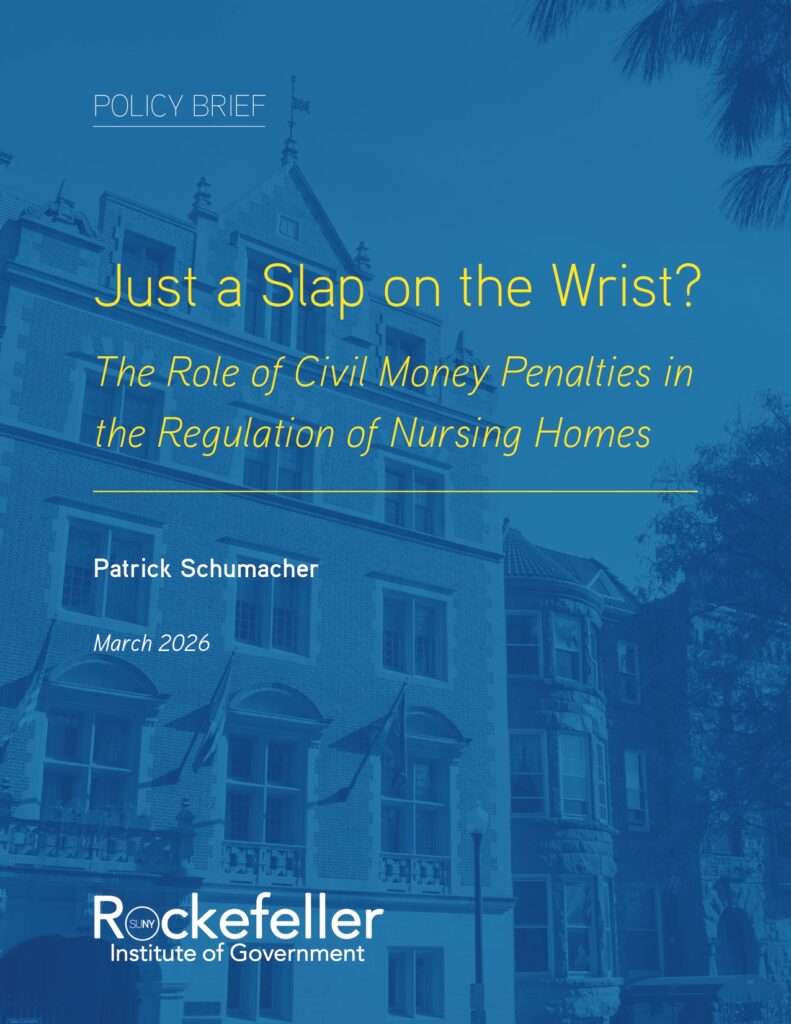
It’s called – Just a Slap on the Wrist? The Role of Civil Monetary Penalties in the Regulation of Nursing Homes.
The report found that for more than half of facilities, penalties amounted to less than a quarter of a percent of net patient revenue for the nursing home and for about 70 percent, less than half a percent.
At the other end of the spectrum, some facilities faced penalties that were far larger: 225 facilities had penalties exceeding 2 percent of annual net patient revenue.
Twenty-one facilities faced penalties ranging between 5 and 10 percent of their net patient revenue.
“These results bring into question whether CMS is striking the right balance in calibrating the size of penalties,” wrote Patrick Schumacher, the author of the report. “Penalties that are less than half a percent of annual net patient revenue may not be enough to deter future regulatory noncompliance. Research on enforcement in other sectors, including environmental regulation, suggests that fines must be large enough to exceed the cost of noncompliance to change behavior.”
“Conversely, there is some evidence that beyond a certain threshold, large penalties could harm the financial stability of nursing homes. What constitutes the appropriate size of penalties to drive improvements in care remains an open question.”
How did this report come about?
“I have long been interested in nursing homes and government oversight of nursing homes,” Schumacher told Corporate Crime Reporter in an interview last week. “The Centers for Medicare and Medicaid Services (CMS) is charged with overseeing the quality of care in these facilities. CMS partners with states to conduct annual inspections, also known as surveys.”
“During these inspections, regulators can identify health and safety violations, and in response to these violations, they have the option to impose a couple different types of sanctions or remedies. The most common type of sanction is a civil money penalty.”
“I was interested in providing an overview of what civil money penalties are and their role in protecting residents of nursing homes. I think that this is a really important issue, given that a lot of research shows that many nursing homes have substandard care, and I’m interested in understanding what the government can do to protect residents.”
You have a chart in your report that lays out civil money penalties and other enforcement actions, and it shows that there have been more than 8,500 civil monetary penalties in 2023 which I guess was the most recent year you could get data on. The title of your report is A Slap on the Wrist?
So what was your determination? Is it a slap on the wrist?
“When people talk about these penalties, they often just say the dollar amount is a $10,000 penalty or a $50,000 penalty, but that lacks context. I wanted to look at the size of these penalties relative to the financial scale of facilities.”
“So what I did was I looked at all penalties that were imposed in 2023, the dollar amount of each penalty, and compared that to the revenue for each nursing home. I found that in most cases, these penalties amount to less than half a percent of total revenue. I think that this can give an idea of the scale of these penalties. I’m not able to do this analysis to determine what the appropriate size is to deter non-compliance, but I think that this can spark some discussion and give a sense of the size of these penalties that were perhaps missing in some previous discussions.”
The top four nursing home chains in the country have more than 200 facilities each. Did you compare the penalty to the revenue of each chain, or each home?
“Each facility within a chain. Each nursing home is identified by a unique identifier from the Centers for Medicare and Medicaid Services, which is what I used for my analysis.”
“Nursing homes are required to submit cost reports, which are annual financial statements. These provide some detailed information on the profits, revenue and expenses for each nursing home. Those are a valuable tool for understanding how nursing homes are operating. And there has been a push from CMS to make the ownership of nursing homes more transparent.”
You report that in 70 percent of these penalty cases, the penalties amount to less than half of one percent of revenues. Is that enough to have a deterrent impact?
“More research is needed. It would be interesting to talk to administrators at nursing homes to understand how they perceive these penalties, perhaps how they change their operations in response, maybe also talk to regulators to get their perspective. I think that maybe there’s only so much that can be seen with data from CMS.”
Tell us a little bit about the industry – for profit versus nonprofit companies.
“About 70% of nursing homes are for profit, with the remainder being nonprofit or public. Multiple studies have shown that for profit nursing homes are more likely to incur health and safety violations than their nonprofit or public counterparts.”
“But the regulatory framework is ownership blind. All nursing homes are held to the same regulatory standards to protect residents, regardless of ownership type. But you could make the case that for profit nursing homes deserve perhaps additional scrutiny, especially as private equity is buying nursing homes.”
“This has been a recent trend that’s been reported on in the news – private equity is buying up nursing homes.”
Some health care professionals see using civil monetary penalties as an effective tool to bring nursing homes into compliance with federal and state laws, and they also believe generally that the deterrent effect is pretty weak given the current level of fines.
“There is a debate surrounding the penalties. Health professionals say that the only way to induce compliance is to have a financial consequence, that an honor system won’t work, and that you have to hit nursing homes where it hurts, which is in the wallet.”
“But there are people on the other side of the debate, people in the nursing home industry who argue that these fines take resources from the nursing homes, resources that would otherwise be spent on patient care.”
“They may argue that nursing homes are already in a financially precarious position, many have thin operating margins, so financial penalties could potentially impact their financial stability.”
“One reason this is a difficult area to study is because CMS also can use other enforcement actions besides civil money penalties, like additional state monitoring or denial of payment for new admissions under the Medicare and Medicaid program.”
“So it’s hard to say which works. New research could look at focus groups with administrators and nursing homes and with regulators to try to understand the impact of these various enforcement actions.”
How many nursing homes are there in the United States?
“There are about 15,000 nursing homes that are certified to participate in the Medicare and Medicaid programs and that are subject to this regulatory framework.”
And your report found that 3,745 nursing homes received one or more penalties in 2023 so that’s about a quarter of all nursing homes that were fined in 2023.
What were some of the larger penalties?
“These penalties can reach into the hundreds of thousands of dollars – particularly for the per diem penalties. In the report, I cite a story about a nursing home during the covid 19 pandemic that received a $600,000 civil money penalty for failure to protect residents.”
“My report found that many penalties constitute a low share of revenue. But there were also some penalties that were above two percent of annual revenue. So there is this wide distribution. And I think a takeaway is that CMS can think more carefully about how these penalties are calibrated.”
You report that for more than half the facilities’ penalties, the penalties amounted to less than a quarter of one percent of net patient revenue and that for about 70% of the penalties, they amounted to less than half of a percent of the nursing home’s revenues.
At the other end of the spectrum, some facilities faced penalties that were far larger. You report that 225 facilities had penalties exceeding 2% of annual net patient revenue. Twenty-one faced penalties between five percent and ten percent of their net patient revenue.
What’s your sense as to what percentage would secure some kind of deterrence effectively.
“The cost of the penalty has to outweigh any benefit of not correcting a violation. But I think that this is a tricky thing to answer, because you want a penalty that’s large enough to deter non compliance, but not so large that it harms the financial health of the nursing home. And I don’t have the answer. So I think that more research is needed, more thought into how these penalties are structured. So I think this is an important area of future research.”
Are you going to continue researching the nursing home industry?
“This is an important area of research. I certainly would like to continue studying it. If CMS recommends that a certain type of enforcement action be taken, I would look at whether that action is actually taken. State operations manuals recommend certain types of actions be taken for violations that cause serious harm or injury to residents. I want to look at the data to see if those actions are actually being applied based on that operations manual – looking at fidelity to enforcement.”
“CMS has ultimate authority over what enforcement action is taken. I’m interested in looking at the question – if violations indicate serious harm to residents, and there are certain types of regulatory tags, I’m interested in seeing if those result in a violation.”
[For the complete q/a format Interview with Patrick Schumacher, see 40 Corporate Crime Reporter 15(12), April 13, 2026, print edition only.]
Don't Miss:
-
New documents show how a retail chain’s sales practices helped put guns on US streets
-
Singapore a battleground of commodities fraud lawsuits
-
From Propagandist to Criminal
-
On Indonesia’s fires, El Nino’s impact on the power sector, and other stories | Asia Sentinel Stories of the Week
-
WATCH: Inside the China Capital investigation — a live panel