
 ICIJ’s investigations into systemic failures highlighted in 2025 annual report
  Judge orders Nazi-looted Modigliani linked to Panama Papers be returned to heirs
  Ten years after the Panama Papers, enablers and tax cheats are still being brought to justice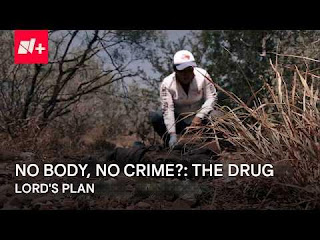
“Sol Prendido” for Borderland Beat

Our colleagues Victor Vález Mata and Fernando Guillén show us how, in Tamaulipas and the La Laguna region, the search across the territory continues. This is a site where mounds of human skeletal remains were discovered—what we refer to as “clandestine kitchens.”
These remains consist of vertebrae, long bones, rib fragments, and all manner of human skeletal material. Here, one can clearly see the bullet impacts on the bones. In just the last two years, the collective *Amor por los Desaparecidos* (Love for the Disappeared) has located 21 potential clandestine crematoriums in Tamaulipas.
Although every site has been reported to the Public Prosecutor’s Office, according to the collective itself, the full complement of human remains has yet to be recovered from any of them. This site continues to be reused; criminal groups return to utilize it to burn bodies, and—tragically—the few remains that might have survived are completely lost in the process.
For seven years, Edith has been searching for her brother, Abel Treviño García, who disappeared in Reynosa at the age of 15. His is one of more than 13,700 cases reported in Tamaulipas.
According to the National Registry of Missing and Unlocated Persons: if we have a government that is negligent—a government that refuses to acknowledge the problem—then it will never formulate a strategy for improvement, precisely because it refuses to accept the reality of the situation.
In the La Laguna region—straddling the states of Durango and Coahuila—the collective *Madres Buscadoras: Grupo Vida* (Searching Mothers: Group Life) has also identified at least 10 clandestine crematoriums operated by organized crime groups in recent years.
One such site is known as Patrocinio: a desolate desert tract spanning 64 hectares, where the group claims to have recovered over 700 kilograms of human skeletal remains. At this particular site, the perpetrators utilized 200-liter drums.
Once a body had finished burning, they would empty the drum and use shovels to finish crushing the remains into dust. The twisted logic being: as long as there is no body, there is no crime. Yes. And the law is the law; nothing can be done to them because there is no way to prove anything.
That is why, during every search expedition, Silvia holds onto the hope of finding some trace of her daughter, Stefanie Sánchez Viesca—who disappeared in 2004 when she was barely 16 years old. We face a major challenge because the remains are extremely small.
It is truly staggering just how tiny they are. Look at this one, for instance—believe it or not, this is just a tiny fragment, yet it represents a human being who deserves dignity, respect, and proper forensic analysis. We have already had cases of identification, and believe me, they are excruciatingly painful.
It hurts because if just a single bone fragment recovered here is identified, that is all they will hand over to you—nothing more. Figures from the National Registry of Disappeared and Unlocated Persons indicate that the states of Durango and Coahuila alone account for a cumulative total of over 4,800 missing people.
As long as no one stirs up the issue of disappearances, all the actors involved in the security apparatus remain relatively at ease; and when this is coupled with a narrative of supposed “pacification,” there are even fewer incentives to uncover—or unearth—the massive mass grave that is our national territory.
Sources: NMás, Borderland Beat Archives

Don't Miss:
-
Iran war: Russia and China veto UN resolution to reopen Strait of Hormuz
-
Nasa’s Artemis crew snaps historic Earthset photo on way home from moon
-
Why Cocaine Keeps Flowing Through the Caribbean: A Visual Guide
-
Did US Military Strikes Impact Caribbean Drug Trafficking?
-
Hong Kong doctor axed for posting resuscitation photo faces Medical Council case