
 Rick Claypool on Pay to Play Corporate Crime Enforcement
  Labaton Launches Whistleblower Practice with Former SEC Acting Chair Allison Herren Lee
  Kremlin payment firm A7 has been pumping billions in ‘untraceable’ cash into global financial system
 By: Ainur Rohmah
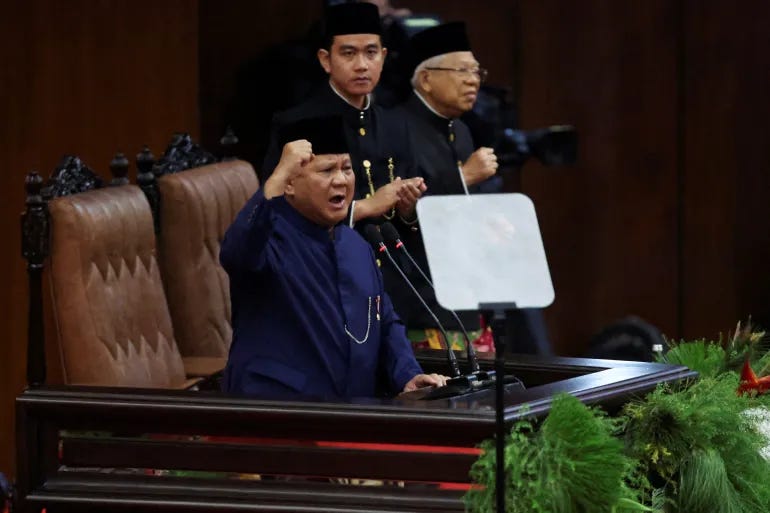
Through plans to centralize exports of strategic commodities, expand the authority of state-owned enterprises and place the state back at the commanding heights of development, President Prabowo Subianto is attempting the most ambitious reassertion of economic nationalism Indonesia has seen since the fall of the New Order. Supporters see overdue corrections. Critics see the early architecture of a new state capitalism vulnerable to the same patronage, opacity and rent-seeking that once defined the country’s monopolistic past.
When the president addressed Parliament on May 20, his speech was presented as a roadmap for growth. He spoke of manageable deficits, inflation control, currency stability and ambitions of reaching 8 percent economic growth by the end of the decade. But the speech’s deeper message was not about macroeconomics. It was about power. .In modern Indonesia, economic nationalism has always arrived wrapped in the language of rescue. It promises sovereignty over natural resources, protection from foreign exploitation and a stronger state capable of defending the national interest. But it also awakens an older anxiety — that when economic power becomes too centralized, wealth stops flowing outward to foreign actors and begins concentrating inward among domestic elites.
Throughout the address, the state appeared simultaneously as regulator, financier, trader, industrial planner, welfare provider and guardian of national sovereignty. State-owned enterprises were no longer merely commercial actors but instruments of geopolitical and developmental strategy. Cooperatives were envisioned not simply as rural businesses but as tools for restructuring the national economy itself.
Economists in Jakarta have begun quietly describing Prabowo’s new plan as a signal toward “state capitalism” — a system in which the government becomes the dominant player in strategic sectors. The problem is that state control does not automatically eliminate leakages. If corruption remains embedded in the system, the leakages merely change location. Indonesian history suggests that monopolies without transparency almost inevitably produce new centers of rent extraction.
Prabowo’s belief has deep historical roots. It echoes the economic nationalism associated with Sumitro Djojohadikusumo, Prabowo’s father, who long argued that newly independent nations could not rely entirely on market forces to achieve development.
But history also suggests that state capitalism succeeds only under specific conditions: competent institutions, disciplined bureaucracy, legal predictability and credible accountability. Without those foundations, interventionism risks sliding into patronage politics, opaque decision-making and concentrated economic privilege. Moreover, replicating that old approach ignores the fact that the world has fundamentally changed — globalization, supply chains, capital markets, geopolitics and the demands of foreign investment are vastly different from what they were in earlier eras.
The Return of Commodity Nationalism
Indonesia, Prabowo argued, had spent decades growing statistically while becoming structurally weaker. Export revenues increased, yet prosperity failed to spread evenly. The country remained dependent on foreign capital, vulnerable to currency shocks and unable to retain enough value from its own natural resources. Repeatedly, Prabowo returned to the same argument: Indonesia had surrendered too much control over its national wealth. That diagnosis became the moral justification for a more interventionist state.
For that reason, Prabowo offered a plan to centralize exports of strategic commodities through a state-linked intermediary tied to Danantara. Under the proposal, exports of palm oil, coal and ferro-alloys would gradually move through a “single-gate” system beginning this year before fuller consolidation by late 2026. The government argued that the policy was necessary to stop leakages caused by transfer pricing, under-invoicing and export earnings parked overseas. Prabowo claimed Indonesia had lost as much as $908 billion over the past 34 years through such practices.
In emotional and political terms, the argument resonates strongly. Many Indonesians believe the country has spent too long exporting raw materials cheaply while importing expensive finished goods. Economic nationalism offers a seductive promise: that Indonesia’s immense resource wealth should finally benefit Indonesians themselves.
Yet the idea of centralized commodity control also carries historical memory — and not all of it is reassuring. For older Indonesians, the phrase “single gate” immediately recalls one of the most controversial monopolies of the Soeharto era: the Clove Support and Trading Board, or BPPC.
Officially, BPPC was established in the early 1990s to stabilize clove prices and protect farmers from market volatility. In practice, it became one of the defining symbols of centralized rent-seeking under the New Order. Farmers were forced to sell cloves through the system. Cigarette manufacturers were forced to buy through it. Prices were dictated from above. Competition disappeared. And because the institution was closely associated with Tommy Soeharto, Soeharto’s son, the arrangement quickly became synonymous with political favoritism masquerading as economic management.
The system’s logic was brutally simple. Cloves were purchased cheaply from farmers and resold at higher prices downstream. Profits accumulated at the center while producers absorbed the losses. Families that had relied on cloves for generations saw incomes collapse under a system supposedly designed to protect them. Indonesia Corruption Watch estimated state losses linked to corruption within BPPC at Rp3 trillion — and that was only what investigators could prove.
The damage extended beyond economics. BPPC permanently altered how many Indonesians viewed state intervention itself. It left behind a lingering suspicion that monopolies justified in the name of nationalism often become mechanisms for elite enrichment once transparency disappears. That historical memory now shadows Prabowo’s proposal.
The Problem of Trust
There are, of course, important differences between BPPC and the current policy. BPPC controlled the domestic clove trade, while the new system focused on exports. The operator is not a semi-political body from the authoritarian era, but a state-owned enterprise with a formally modern oversight structure. The government has also yet to implement the policy fully and continues to speak of phased execution.
Those distinctions matter. But they do not erase the central concern. Whenever a single entity gains authority over strategic exports, it also gains immense influence over margins, contracts, market access and pricing mechanisms. Even if the intention is to reduce leakages abroad, centralized control can easily create new leakages at home.
That concern surfaced almost immediately in financial markets. Even before Prabowo formally unveiled the policy, investors had already begun reacting nervously. Indonesia’s benchmark stock index fell sharply on May 19, while coal and energy-related shares slid in tandem.
The reaction highlights the broader challenge facing Prabowo’s economic project. Nationalism can mobilize political support, but long-term growth still depends on investor confidence, institutional credibility and legal predictability. Without those foundations, aggressive intervention risks undermining the very growth it seeks to accelerate.
Questionable Pattern
The concern surrounding the export proposal does not emerge in isolation. It is reinforced by broader patterns already visible within the administration. Several flagship programs introduced under Prabowo have faced scrutiny almost immediately after launch. The free meals initiative raised questions surrounding procurement oversight and budget management. The Merah Putih Village Cooperatives program drew criticism over expensive procurement plans and operational efficiency. The People’s School initiative has also encountered suspicions regarding inflated budgets.
Indonesia’s own experience offers repeated warnings. The country’s state enterprises have often struggled under the combined weight of corruption, political interference and inefficiency. Massive public projects routinely encounter procurement scandals. Regulatory systems remain vulnerable to elite capture. And perhaps most importantly, implementation frequently lags far behind political ambition.
Controversy has also begun to surround Danantara, the institution expected to become the backbone of Prabowo’s industrial and investment strategy. Critics have questioned its transparency and oversight, particularly given the enormous assets and authority it is set to manage. Concerns have grown further because Danantara has yet to publish a comprehensive public report on its investments, asset management or internal governance. In Indonesia, where state enterprises have long been vulnerable to corruption and elite capture, such opacity inevitably raises suspicion.
The issue is not the state’s ambition to play a larger role. The issue is what happens when the state expands its power faster than it strengthens accountability. In Indonesia, policies rarely fail because their stated goals are inherently wrong. They fail because too much darkness exists between noble intentions and actual implementation. And history suggests that rent-seeking flourishes most easily in the dark.
Don't Miss:
-
Rick Claypool on Pay to Play Corporate Crime Enforcement
-
Labaton Launches Whistleblower Practice with Former SEC Acting Chair Allison Herren Lee
-
Kremlin payment firm A7 has been pumping billions in ‘untraceable’ cash into global financial system
-
New US law requires dating apps to include warnings on romance scams
-
Southeast Asia Welcomes Japanese Investment but not Soldiers