
 Canada revokes dozens of crypto firms’ registrations
  Questions swirl around US plans for record $15B Prince Group crypto seizure
  Donate to ICIJ
Thoughtful stories for thoughtless times.
Longreads has published hundreds of original stories—personal essays, reported features, reading lists, and more—and more than 14,000 editor’s picks. And they’re all funded by readers like you. Become a member today.
Peter Wayne Moe | Longreads | March 26, 2026 | 16 minutes (4,551 words)
“You’re holding the guitar wrong.”
I’m sitting across from Fabián Carrera, guitar professor at Whitworth University. It’s our first lesson. He has just strummed “Happy Birthday” and asked me to play it back to him. I’ve not yet played a note and he has already offered a correction.
“When we get into more technical material, you’ll want the guitar up like this,” Carrera says. He shifts his guitar so that the neck is no longer parallel to the floor but running diagonal to it. “And your wrist, flat. That will make it easier to play quick.”
He gives me a footstool. I put my left foot on it, and as my guitar raises into classical posture, my clawed wrist straightens into an easy, natural, comfortable position. I strum “Happy Birthday.”
“Good. Can you play it like this?” Carrera asks, fingerpicking the chords as he sings along. This, too, I do. We go back and forth, each rendition of “Happy Birthday” a little more difficult than the previous.
“And this? Can you do it like this?” Carrera now plucks the melody in single notes.
I stumble a bit finding the melody but after two tries get it. “Now, listen to this,” he says, and here, Carrera plays the song with jazz chords—a major chord to begin, then some major and minor seventh chords, a ninth, and a diminished too, as he ascends the fretboard. The song is over before I can process what I’ve heard. I strum the first chord, stumble into the second, and then my fingers fail.
“Okay then,” Carrera says. “This is where we begin.”
I enrolled in MUS 253: Classical Guitar out of desperation. I’m an English professor, and since the advent of ChatGPT in late 2022, things have changed. I watched students, staff, colleagues, and administrators outsource their thinking to the machine, and the academy soon became a sham to me, a farce of its former self. I once taught students to spend time inside sentences, to wrestle with difficulty, to make productive use of their uncertainty by paying close attention to how language works on the page. We once sat inside paragraphs, dwelt inside language in its richness and complexity.
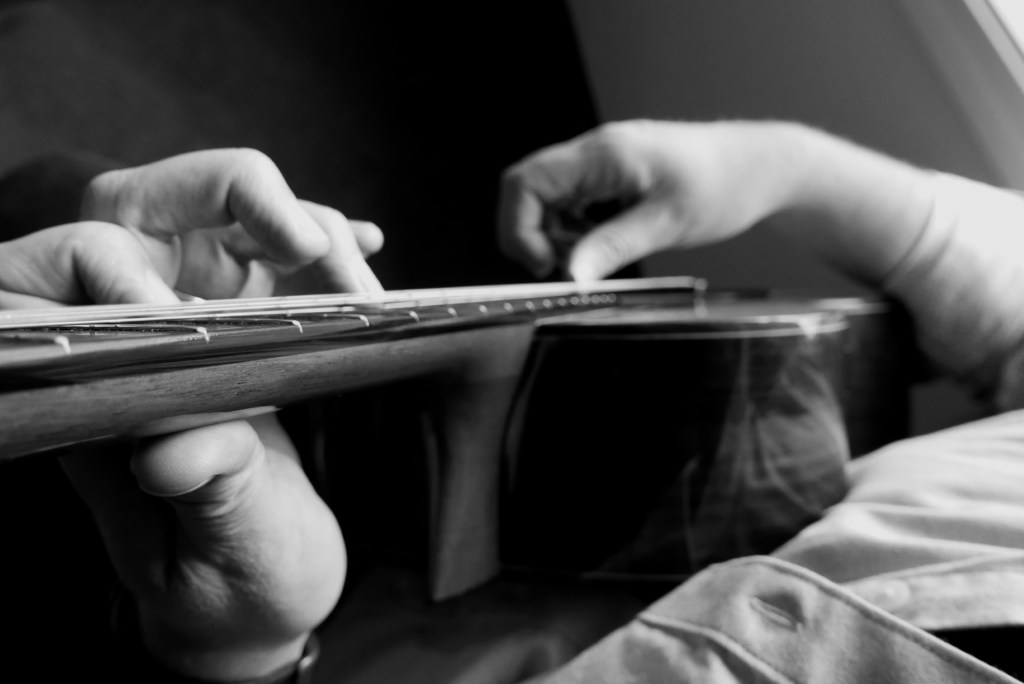
But the ease of AI has devalued language, difficulty, and the work and perseverance and focus necessary to make meaning out of words. Believing a writer should write her own sentences and a reader should read instead of relying on AI summaries, I have become Sisyphus pushing that rock up the hill, the work of teaching and learning, reading and writing seemingly pointless in the face of the juggernaut offering to do my students’ work for them. After years of this, I descended into a severe depression marked by panic attacks, substance abuse, self-harm, and suicidal ideation. A complete loss of meaning in your life’s work will do that.
A therapist once told me that one way to manage the hollow of depression is to find an activity that creates pleasure but also demands mastery—something like baking, or the arts, or sports. Such pursuits engage both mind and body, reorienting your focus away from the myopic self-obsession of depression and toward, instead, something beyond the self, some palpable problem that can be worked through and, with enough time, eventually solved. There is peace in that, my therapist said; satisfaction too. And, he added, these activities tend to be much better for you than the many vices people often turn toward to fill that emptiness when stressed, anxious, and depressed.
So I signed up for guitar lessons. I wanted to do something with my hands, something real, tangible, and material. Pleasure and mastery. I also wanted to retreat into a familiar role, to become a student again, and to rediscover what it means to, and how one does, learn. I hoped that, in the long hours of practicing, I might somehow cast aside the cynicism and despair overtaking my teaching and so rekindle my love of the classroom—and of life.
I’ve been playing the guitar since I was 12—mostly blues, rock, soul—but have never before taken lessons. Never needed to read music, never needed more than a chord chart. The aura of the classical guitar intimidates me. Compared to my Telecaster and Stratocaster with their pickups, their wiring, their knobs and switches, the classical guitar has a certain simplicity in the way this wood resonates and thereby creates music. An unadulterated sonic purity emanates from its soundhole. I think of the classical guitar as an instrument “real” musicians play.
And I’m hoping I can become one. I still want to believe that education can fundamentally change you. Even as so much of higher ed is transactional—check this box, get that degree, and then land your job—I’m not yet ready to give up on the idea of education as transformation. This is why Socrates warned to be careful who your teacher is: That teacher will shape you into a particular kind of person.
My teacher is Fabián Carrera. He sits in a wheelchair, his guitar perched on a rubber mat on his thigh, the kind of mat you’d use to keep a rug from slipping on the floor. He wears a black shirt, black pants, and black shoes with thick soles to accommodate leg braces. During our first lesson, as we played “Happy Birthday,” he shared a bit of his story. He grew up in Ecuador and contracted polio when he was nine months old. His parents brought him to a military hospital in Quito, a 10- to 15-hour journey over treacherous mountain roads from their home in Cuenca. There, he spent the next five years inside an iron lung. For fear of contagion, the hospital staff housed him in a storage shed. In the shed, inside the lung, he listened to the radio nonstop. (Here, when telling me his story, Carrera paused and played a few of the Ecuadorian songs that got him through those years.) It helped his recovery, Carrera slowly gaining enough muscle to tap his toes and nod along to the beat, the music healing him. Carrera saw his parents once a month but never his siblings. When he came home at age five, he told me it felt like being adopted. The following years were marked by multiple surgeries and long periods of physical therapy. Carrera spent his days listening to his father play traditional Ecuadorian folk tunes on a guitar. (Again Carrera paused his story to play some of these songs for me.) His mother bought him a cheap guitar, and he begged his father to teach him to play.
I grew up on The Beach Boys and, later, Garth Brooks, followed by B.B. King and Jimi Hendrix. The first classical guitar album I heard was Laurindo Almeida’s Guitar Music of Spain. I was in high school; it was my father’s record. One evening, a month into lessons with Carrera, thumbing through my vinyl, I came across the record and put it on. The opening song is “Leyenda,” now commonly called “Asturias.” Isaac Albéniz wrote the piece for the piano, wanting it to evoke Spanish guitars and flamenco dancers. Every song we’ll learn, Carrera tells me, was written either for the Church or for dancing.
I ask Carrera if we might try “Asturias.” He says we can add it to the repertoire. “We’re making Thanksgiving dinner,” he says. “On one burner, we have the beans. On another, we’re boiling the potatoes. They’ll be done before the turkey in the oven. Now we have to knead the bread, then slice the apples for pie.”
He pauses. I’m confused. He continues: “This is how a repertoire works. Some pieces will be ready before others, and those we’ll set aside and keep warm while the turkey cooks. ‘Asturias’ is our turkey. It will take a long time.”
As our repertoire grows, I find it difficult to keep all the songs in my head. Some are harder, and others fade because they’ve not been slow cooked into memory. Each week, as Carrera adds more pots to the stovetop, I must keep returning to the others, stirring here and there as everything comes along.
He assigns me the first four measures of “Asturias,” and a week later, I’m second guessing myself. I tell Carrera this song is the 10-meter high dive at the Olympics, and perhaps I should return to the kiddie pool.
Carrera scoffs. “And go back to playing ‘Twinkle, Twinkle’? No.” He tells me it took him three months to learn and memorize “Asturias,” and another to polish it for performance. “And then,” he tells me, putting his hand on his chest, “‘Asturias’ became part of my soul. You never finish learning a song. And some songs, you’ll carry with you to your grave.”
This catches me off guard. In the academy, where so many people are just going through the motions, using AI to hop through hoop after hoop, Carrera’s comments remind me of how education can shape a soul. What would need to happen in a classroom, I began to wonder, for my own students to engage course material in such a sustained and attentive manner? For a book we read to become part of a student’s soul? Maybe we’d read the same poem every day at the start of class, or perhaps we would read the same novel three or four, even five times over the semester, going over the text again and again, coming to know it as Carrera knows “Asturias”—knowing it as part of himself. It’d be the antithesis of the AI academy, with its speed, false sparkle, and promises of a rich and limitless future. It’d be a class where the goal isn’t to complete this next module or assignment or quiz for the sake of some impending assessment. No, it would be a class where students and teachers together seek to learn something directly tied to our shared humanity, something with the potential to change who we are as humans.
If I want to play “Asturias” in a week, Carrera tells me, that would be unrealistic. But the first page after a few months of practice? Maybe that’s possible. And being able to run through the whole piece at a slow pace within a year? Yes, that’s doable. If I work on it long enough, Carrera tells me, “Asturias” can become part of my soul too.
At our first lesson, Carrera asked to hold my guitar. He stuck his nose in the soundhole and inhaled deeply. He then played his way up and down the fretboard, flashed his fingers in a flamenco flourish, strummed loud and then soft, and finished with a run up to the 17th fret, holding that final note, moving his hand back and forth for vibrato. I didn’t know my guitar could sound like that.
People say, “The tone is in the fingers,” and that certainly is true—Carrera can make any guitar sound magical—but so, too, the tone is in the guitar and its strings, in the stiffness and density and species of its wood, in the shape and position of its struts and ribs and kerfing and soundhole. The material realities of our tools matter.
These lessons have me thinking a lot about tools—about how the tools we use (whatever our craft) enable us to do a certain kind of work. And I realize, too, that much of my despair at the state of teaching and learning has to do with tools. Writing has always been mediated by technology: The chisel and stone, brush and papyrus, the scroll and quill, the printing press, moveable type, typewriters, computers, and now, sadly, AI. (After writing one of his novels longhand, Stephen King called his Waterman fountain pen “the finest word processor ever invented.”) Tools and writing go hand in hand; it’s foolish and misguided, then, to think writers can write without tech. But while these tools have evolved over time and have significantly changed how we write (revision looks a lot different on a stone tablet where you can’t cut-and-paste), until now, the mind hasn’t had any competition in being the primary tool for writing.
Because our tools shape how we work, and because I want my students to learn to think for themselves—and to think against the ease of AI—I decide to make my classroom screen-free. It’s an act of defiance, an act of resistance. Students read books and print PDFs; they trade their laptops for spiral-bound, college-ruled notebooks; they buy pens. I teach with literary theorist I. A. Richards in mind: “A book is a machine to think with.” I hope my students will learn that a pad of paper and a pen are too, as are sentences if you can learn how to use them.
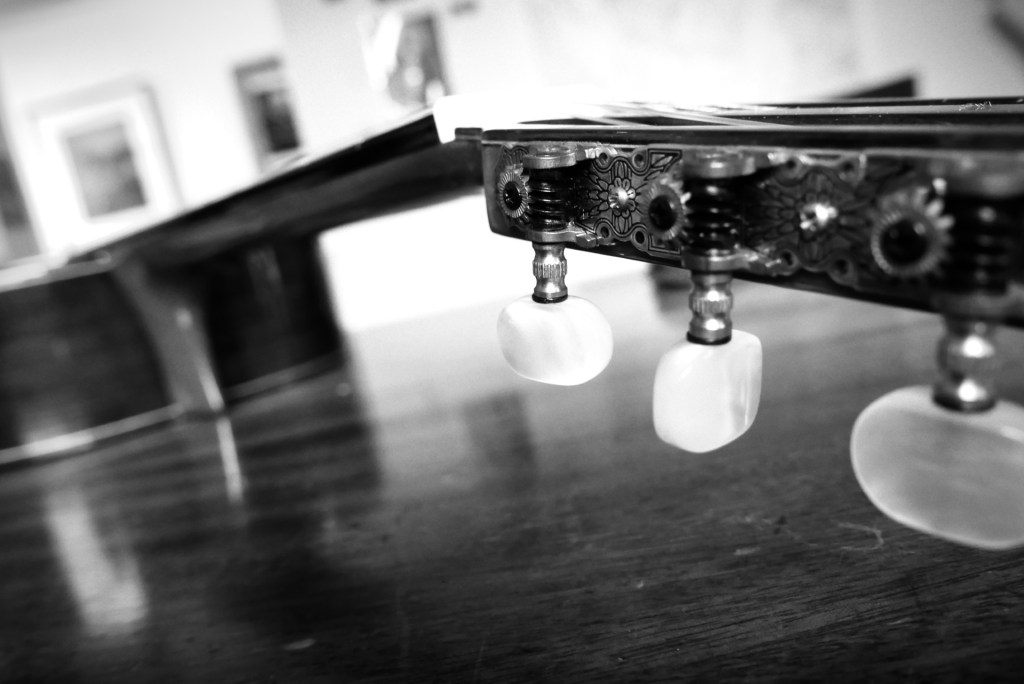
Five months into our lessons, I realize my steel-stringed Taylor doesn’t quite work for the études and minuets and suites we’re playing. It’s too metallic, not soft enough, its tone too jarring. My grandfather used to say that if you’re having trouble with a job, make sure you’re using the right tool. So I ask Carrera what to look for in a classical guitar. (He has seven guitars; his concert guitar was made from 400-year-old wood salvaged from a renovation of Quito’s Iglesia de San Marcos.) Carrera advises me to buy used in order to get more guitar for my money, and he tells me to play every note on every string on every fret. Listen to the tone of each, and for any buzz or hum or anything else infelicitous. “And speak into the soundhole,” he says. He speaks into his, and I can hear his voice call back, amplified, resonant. Classical guitars are built to project.
Searching for a proper nylon-stringed classical guitar, I descend the stairs into Dusty Strings, an underground shop in Seattle just across the Fremont Bridge. They have several classical guitars hanging on the wall. Another customer side eyes me as I smell each guitar: one from Uruguay, a few from Japan, one from China, another from Bulgaria. A Californian one too. And then I see an Alhambra, built in Muro de Alcoy, Spain.
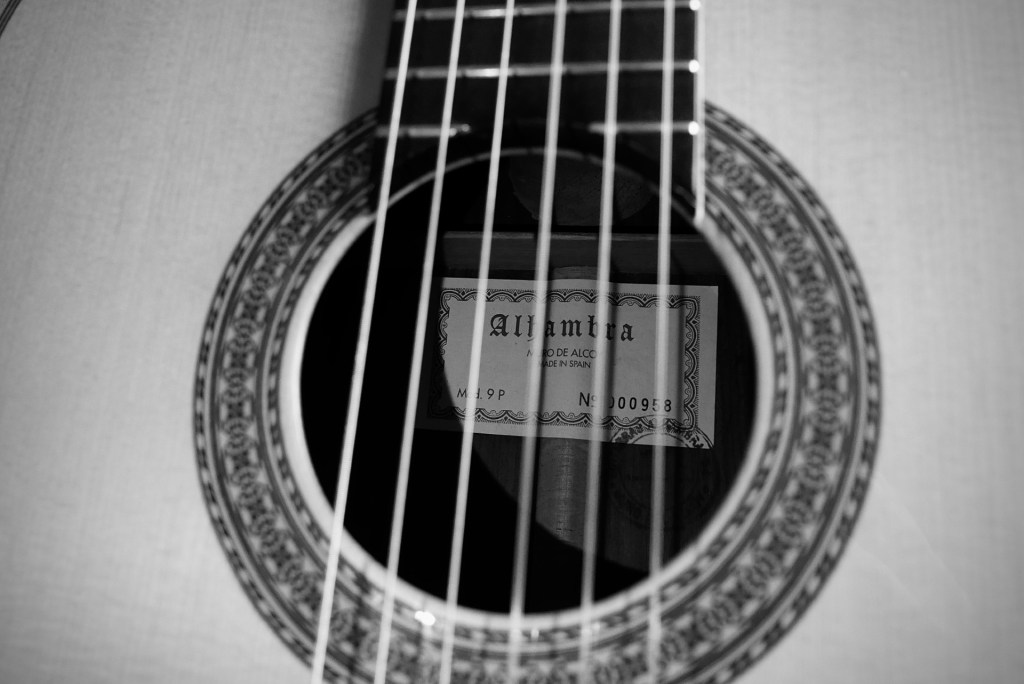
At our next lesson, Carrera tells me to get the Alhambra: “Many guitarists will disagree with me on this, but the Spanish invented the classical guitar, so you should buy the Spanish guitar.” I tell him that I played them all, and that they all were excellent. “That may be,” Carrera counters. “But Spaniards make the best guitars.”
I buy the Alhambra, built in March 2005. When I hand it to Carrera, he sticks his nose in the soundhole and again inhales deeply. I ask him what he’s trying to smell. “To see what kind of wood it is,” he answers. “The top is German spruce. You can tell that much just by looking at it. But smell this.”
He hands me my guitar, and I stick my nose in the soundhole. “That’s what Indian rosewood smells like,” he says. My guitar smells woody, floral, like mulled spices even.
Ten months into lessons, I realize there’s no syllabus in MUS 253. We move week to week, song to song, arpeggio to arpeggio, Carrera assigning me pieces based on where our conversations and my questions take us. When the moment requires it, Carrera pulls out certain songs to teach certain skills, certain concepts. His is a responsive pedagogy, one that draws from Carrera’s storehouse of guitar history and composers and songs.
Because there is no syllabus, there are no explicitly stated Student Learning Outcomes for the course. These are the terms favored in higher ed, terms that make assessment possible, terms that accreditors and deans like. (They also like Course Learning Objectives and Departmental Mission Statements.) But Carrera’s course has none of these administrative shackles. I’m here because I want to learn how to play the classical guitar; he’s here to teach me. There are no quizzes, no midterm, no final exam. We’ve never once discussed grades. There’s a purity here, the course free from the taint of bureaucracy governing so much of the academy. It is learning for the sake of learning, and it reminds me of Cornel West, who speaks of education as “soulcrafting,” education as “the shaping of the kind of human beings people are”—which, of course, raises the question of what kind of human being Carrera’s lessons are turning me into.
Carrera is very concerned with details. He wants me to learn to hear them. When he was working on his doctorate at the University of Miami, every week Carrera and his classmates attended Friday Forum. For two hours, they’d take turns playing for each other the music they were working on. Each performer would pass around sheet music, and the other students would read along as they listened. At the end of the piece, the critique would begin. It wasn’t personal, Carrera tells me. It was focused on details. This is how Carrera trained his ear. When I play the songs I’m working on—songs that are part of Carrera’s own soul—he listens, eyes closed, and when I finish, he’ll take me to a measure and point out that I’ve played a C instead of a C#. A single note. Details.
Every Saturday afternoon, Carrera puts on a pair of headphones and listens, loudly, to his favorite songs. “Sometimes I’ll hear something I’ve never heard before in a song I’ve been listening to for decades,” he tells me. “You need to learn to listen for details.” I need to grow bigger ears. When I play cleanly, I begin to hear how my guitar will produce sympathetic resonance—unplayed strings vibrating in concert with notes I’ve intentionally plucked.
At our next lesson, Carrera pulls up a few YouTube videos of “Asturias,” one performed by John Williams (the guitarist, not the conductor) and another by Ana Vidović, an acquaintance of Carrera’s. “Look at this,” he says, and we watch how they each manage the moment the piece moves from 12 to 18 notes a measure. “And now, look at this,” Carrera says as he pulls up Andrés Segovia. Williams, Vidović, Segovia—they each finger those two measures differently. We are listening (and watching) for details. And we can see, because of these videos, the techniques used to create these different tones. I notice Segovia’s tempo is all over the place. He speeds up, he slows down. He doesn’t keep solid time the way modern musicians do. Carrera tells me this is called playing with rubato.
Mary Oliver writes that “Attention is the beginning of devotion.” I am learning to pay attention, to be devoted to these songs, this craft, this instrument. And this is formative. As screens fragment our attention, as AI pushes for speed and efficiency at the cost of our humanity, as the academy puts a pinch of incense on the altar of innovation, slowing down and revisiting a text again and again (whether sheet music, a book, a recording, a poem) is a revolutionary act. It turns you into a particular kind of reader, one attentive to the minute, to nuances, to how meaning can shift ever so slightly when this word is used rather than that. Each time I listen to “Asturias,” to João Teixeira Guimarães’s “Sons de Carrihões,” to Francisco Tárrega’s “Capricho Árabe,” to Ariel Ramirez’s “Balada para Martín Fierro,” I think of this, from literary theorist Toril Moi:
When Henry James had to give advice to writers, he didn’t tell them to work hard to develop a specifically literary language. He simply said that they should try to notice everything: “Try to be one of the people on whom nothing is lost.”
Perhaps that is the unstated outcome for these lessons: to become the kind of person with ears to hear.
When I walk into the studio, Carrera is working his nails with a three-inch square of sandpaper. He tells me I have soprano, alto, tenor, and bass on my guitar, and to always be aware who has the melody. We discussed this months before with Jorge Cardoso’s “Milonga,” where the bottom of the first page declared “marcar al bajo,” which Carrera told me means “the bass sings.” But learning is recursive, and so we revisit the idea. He asks me who’s singing in “Asturias.” I play through the first two pages, and he stops me.
“I’m only hearing the accompaniment,” he says. “Who has the melody?” In these measures, the tenor does. But I’m playing the other strings much too loudly; they’re drowning out my tenor.
“Let the melody sing,” he tells me. “Listen to this.” Carrera plays “Asturias” and I can hear all the parts singing distinct yet together, the tenor carrying the melody, the other strings coming around him, softly, in support.
This is what I work on the following week, and I note it in my practice log. I quickly come to love the stark honesty of this diary. I either practiced or I didn’t. With guitar lessons, you can’t fake it—and neither can my students now, their notebooks the fruits of their labors, their own ideas filling the pages. There’s a moment of truth when I review their notebooks and when I tell Carrera how much I practiced each week. He started me at 30 minutes a day, but I’m now aiming for an hour. At first, I was reluctant to keep a log; I didn’t want to obsess over minutes. But then I remembered that routines are life-giving; they make certain things possible; they are liberating—a daily ritual of running is what gives you the freedom to run a marathon—and they are transformative. The small increments add up: Steps become miles and soon marathons, words become sentences and soon essays, notes become phrases and soon songs. “You’re building a castle,” Carrera tells me. “And every hour you practice is another brick.” He takes the long view. When I tell a friend about my castle, he replies, “Yeah, in 20 years you’ll be good!” I’m a bit dismayed—I’ve already been playing for 30 years—but in guitarist and teacher Ricardo Iznaola’s book On Practicing, I read this: “We cannot accelerate the growth of a tree by pulling on its branches.”
If I want my classroom to be the kind of place where students encounter sentences that then become part of their soul, if I want those bricks to become castles, I need to create space for that slow growth. Carrera has reminded me of what I once thought education could be, and he’s showing me, even in this age of AI, that I don’t have to surrender that belief. So I try slowing things down, making space for slow, sustained, deep engagement. I assign fewer readings, and my students and I move through the texts we read with care. Just as Carrera is teaching me to listen to details and so forming me into the kind of person who is more attentive to the world around me, I begin to teach my students to read like this, attentive to the work words do on the page. We begin reading aloud—first sentences, then paragraphs, then longer sections of an essay, and, eventually, an entire book—and we begin rereading passages. “We are looking for details,” I tell them. Channeling Carrera, I tell my students “The more you read these sentences, the more you’ll see. The more time you spend inside these sentences, the more you’ll hear.” Our work changes, and slows, considerably. We are no longer yanking on the branches of the tree.
My own progress on “Asturias” is slow. Ana Vidović plays it in six minutes—six minutes that never sound rushed, six minutes wherein the notes have space to breathe, six minutes wherein each phrase has its moment to sing and then silence speaks between the notes. When I play it, after a year of practice, pushing the pace as much as I am able, trying to conjure those flamenco dancers the song is intended to evoke, I clock in at a frantic and sloppy 7:45.
I ask Carrera how Vidović can play “Asturias” so clean and yet so fast. Carrera once asked her that same question. “Ana practices slow and in sections, identifying technical problems along the way and how to solve them,” Carrera tells me. “She plays really slow so that each and every note can be given the same amount of care and attention. She plays so slowly that every note is audible. You want to be able to hear every single note. Every note deserves our attention. And then you build speed. Slowly.”
My brother, a trumpet player, says the same: “You play slow to play fast.” But no matter how slowly I practice, when I come to my lesson, my fingers lose control. Carrera tells me that’s how it is. “When I play alone,” he says, “it’s so beautiful the notes make me cry.” Carrera pantomimes wiping away tears. We laugh. “When we panic,” he says, “we play fast so we can go home and hide in our beds.” He then admonishes me, “Don’t obsess over speed. You’re a human, not a robot. It’s a dance, not a show-off. Only play as fast as the dancers can move their feet.”
So, just as I slowed down my classroom, I slow down my practicing, focusing on scales, arpeggios, playing cleanly, playing slowly, trying to get each tone to sing distinctly, articulately, trying to play notes with shape and character. I set aside the desire to play as quickly as the recordings I’m listening to. I resign myself to the reality that it will take decades to learn to play this instrument. I learn to be content within my limits, to be patient in the repetitive hours of practice. Learning cannot be condensed into an accelerated course, shoehorned into a semester calendar, rushed and prodded along. It just takes the time it will take.
And in those scales, in the slowness, in focusing on playing each note cleanly and clearly, trying to figure out the technical problem of how to get my fingers from one position to another without accidentally causing a string to sound—in these particulars, I find repair. Amid the darkness of despair and disillusionment, these songs become a balm, healing me as Carrera had said music helped heal him of his polio. Amid my powerlessness in the face of big tech, I can focus on getting these notes to ring pure, one after another as I move up a chromatic scale. I pay attention to the particulars of each individual tone, the notes becoming sutures across my depression.
Pleasure and mastery. I devote myself to the feel of the cool ebony fretboard, to the gentle pressure on my ring finger as I use it to mute the fourth string, to the difference in tone when I pluck a string with my nail or with the pulp of my finger, to the vibration of my guitar against my belly when I strike the strings with gusto. When I play the final chord of “Asturias,” I lift my guitar to my ear, pressing it hard against my concha. I hear the notes resonating within the wood long after the string itself has gone silent, filling this hollow body with music.
Peter Wayne Moe is an associate professor at Whitworth University and author of Touching This Leviathan.
Editor: Krista Stevens
Copyeditor: Peter Rubin
Photographs: Mischa Willett