
 On China’s territorial push, coal’s comeback, and other stories | Asia Sentinel Stories of the Week
  Hasina’s Shadow Dogs Bangladesh ties with India
  Philippine Power Crisis Gives Coal an Uncomfortable Second Life
 By: Thai Scam Watch
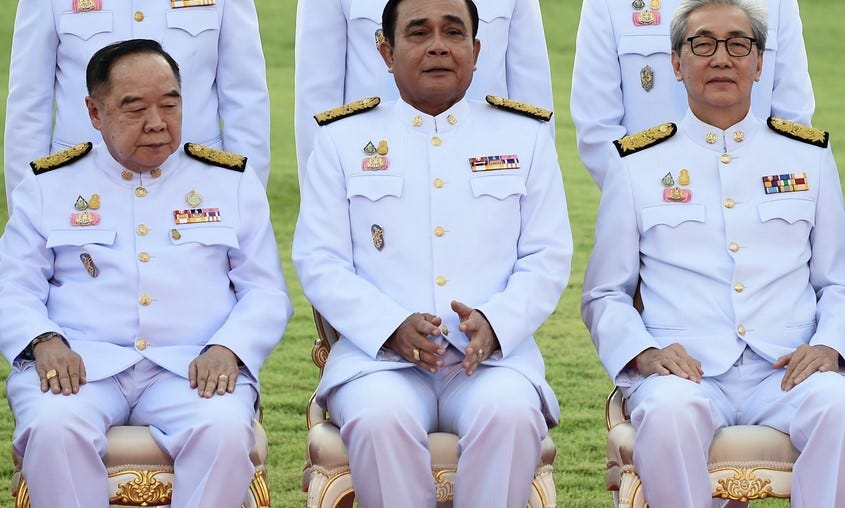
Although military rule in Thailand officially ended years ago, its footprint in the boardrooms of the country’s biggest state-owned companies is less well known, with interventions into the economy and in particular the vast state-owned enterprise (SOE) sector replacing dozens of civilian directors with military/police officers since the military coup that ended participatory democracy for more than a decade.
In 2025, the 38-member Organization for Economic Co-operation and Development reported that Thailand’s SOEs generate revenues equivalent to almost one-third of the nation’s GDP, amounting to US$161.3 billion. Thailand has 52 SOEs covering sectors including energy, public utilities, telecommunications, transport, media, finance and banking.
Critics have long argued that military-proxy governance often results in national economic stagnation, dampening foreign direct investment and delaying crucial institutional reforms. Sustained high defense spending and complex military procurement – in Thailand’s case accompanied by massive, endemic military corruption – and often protected even during broader national budget austerity, draw public resources away from high-yield investments like education, technology upgrading, and social welfare.
Thailand has become the poster boy for those criticisms. Since the 2014 military coup, its economic trajectory has shifted from healthy growth to structural stagnation. Formerly one of Southeast Asia’s economic powerhouses, its performance has steadily lagged its faster-growing neighbors, reflecting a loss of regional competitiveness. The country has consistently recorded some of the lowest GDP growth rates in the ASEAN-6 major economies.
Strategically important sectors
Several of these SOEs operate in strategically important national infrastructure sectors, with Airports of Thailand (AOT), Thai Airways (TA) and Petroleum Authority of Thailand (PTT) among the most prominent examples. Many are commercially operated corporations listed on the stock exchange with foreign investors. However, because of their strategic importance and state ownership, board appointments carry significance beyond ordinary corporate governance.
The number of senior serving/former military and police officers presently on the boards of Airports of Thailand, Thai Airways and Petroleum Authority of Thailand is striking, particularly when considering the political events of the last 12 years. Both Airports of Thailand and Thai Airways, for instance, have operated with 15 board members since at least 2013. Both have two board members who are senior serving/former military or police officers. Before the 2014 military coup, each had one and in the year after the coup this increased to three each.
The pattern extends beyond aviation. Thailand’s energy giant PTT and its major subsidiaries show an even more pronounced increase in military and police representation, although the group structure makes it less straightforward to summarize. Pre-2014, across PTT’s parent board and its four key subsidiaries PTTEP, PTTGC, Thai Oil and IRPC, there was only one military/police connected board member. Including PTTOR, the retail arm founded in 2018, there are now 12. In the year after the coup, this increased to four. Since that coup and across the existing 52 companies of the present-day SOE sector, dozens of civilian directors have been replaced with military/police officers.
The military takeover
How did the Thai military – who, historically, have had their own business interests in everything from banks to golf courses – take control? On the evening of May 22, 2014, Thais switched on their televisions and discovered that their democratically elected government had been removed, their political and civil rights suspended, and the media placed under military control. Hundreds of activists and political opponents were arrested and the coup leaders, led by General Prayuth Chan-ocha (who was, while commander in chief of the Thai Army, also a director at the Thai Military Bank), created a body entitled the National Council for Peace and Order (NCPO) and seized power.
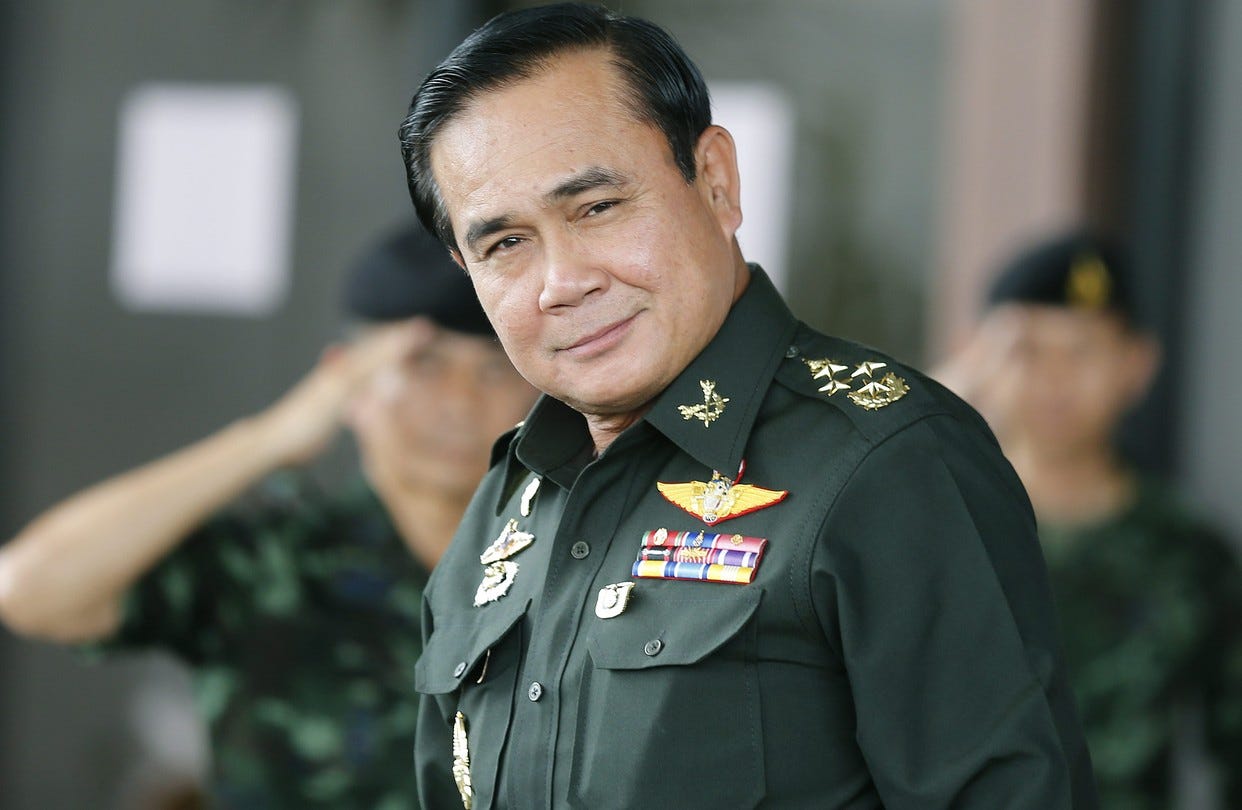
Yet the NCPO didn’t just have its sights set on political control. It also had Thailand’s economy as a target, particularly the massive SOE sector. The message the NCPO pushed was “reform” and within a month of staging the coup it created a “superboard” of military officers, with Prayuth as chairman, which brought every Thai SOE under its control. The superboard – officially the State Enterprise Policy Committee – then began pushing out civilian board members and directors from a range of companies. At the same time, according to Thai newspaper Khaosod, the National Anti-Corruption Commission’s deputy secretary general Worawit Sookboon stated there was no basis to investigate the personal assets of junta members who’d taken up these positions.
Not only were the military requisitioning a vast swath of the Thai economy, but oversight had also taken a back seat. The NCPO’s replacement of civilian board members with military and police officers loyal to the junta took place in the context of the complete suspension of political and civil rights. Thais faced military courts if they dissented and those who publicly criticized the junta risked imprisonment in a military barracks. The civilian directors of these companies had little choice but to acquiesce. The generals had not merely seized political power; they had embedded themselves into the leadership of the companies that powered a third of Thailand’s economy. The post-2014 coup Thailand that the generals were in control of was, arguably, less democratic than Myanmar.
Getting away with it
Impunity is written into the Thai system in a manner hard to comprehend for anyone living in a functioning democracy. As Asia Sentinel reported on July 13, (also raised at thaiscamwatch.blogspot.com), senior police and business figures from Thailand met notorious US government-sanctioned cyberscam center criminals Rithy Raksmei and Ly Yong Phat. One complete lack of institutional accountability was by Airports of Thailand (AOT), whose directors were photographed meeting these operators – Thai Police Lt Gen. Jirabhop “Kong” Bhuridej and Police General Visanu Prasatthong-Osoth – both of whom have served or are serving on the AOT board, with Visanu as the chairman, with several of its directors replaced with military officers post- coup. AOT has issued no statement, answered no questions and offered no explanation.
The cycling of loyal and unaccountable senior military/police officers through Thailand’s SOE boardrooms continues. At AOT, experienced civilian directors were replaced with senior military officers by the NCPO. In 2023, Visanu, a “loyal” police general, was appointed Chairman of AOT. Also in 2023, Kong was appointed as an AOT director and presently sits on various boards, including PTTOR, the retail arm of PTT. His family are closely linked to the Thai king. His brother is the head of the King’s personal security, and the King led the funeral rites for Kong’s mother – and he is now head of Thailand’s ‘Anti Cyber Scam Center”.
Yet questions remain regarding how Kong secured his senior position. He has been alleged to be a beneficiary of the “elephant ticket” system, in which junior officers are promoted rapidly after outside influence is exerted, an allegation made by a Thai lawmaker in parliament.
The “perk” for well-connected senior police and military officers of a directorship at a Thai SOE continues. External questioning by foreign investors remains limited. Even “ethical” funds fail to address this, including when chairmen and directors of Thai SOEs meet wanted and notorious cyberscam center criminals.
The meetings Kong and Visanu held with Rithy Raksmei and Ly Yong Phat—meetings AOT has never addressed—should not be forgotten. Southeast Asia’s cyberscam industry is associated with rape, murder, confinement, torture, and severe human rights abuses. That the chairman and a leading director of a major Thai SOE could attend such meetings without facing accountability should concern anyone focused on ethics.
The question that remains is whether ethical-investment frameworks are equipped to recognize corruption and governance risks when they emerge, not through a single company’s actions, but through the political capture of an entire state-enterprise system. The effective rule of law – and corporate governance – in Thailand remains a challenge.
Thai Scam Watch has chosen to remain anonymous, saying it is concerned individuals who believe these unanswered questions deserve public scrutiny, and who are committed to exposing organized criminal networks and the corruption that enables them in the face of considerable personal retribution. Asia Sentinel has satisfied itself as to their legitimacy and agreed to publish periodic articles from the group.
Don't Miss:
-
On China’s territorial push, coal’s comeback, and other stories | Asia Sentinel Stories of the Week
-
Hasina’s Shadow Dogs Bangladesh ties with India
-
Philippine Power Crisis Gives Coal an Uncomfortable Second Life
-
Christen Civiletto on Thundering Waters: The Toxic Legacy of Niagara Falls
-
Khazak President Tokayev’s Influence may extend beyond his Term