
 Philippine Power Crisis Gives Coal an Uncomfortable Second Life
  Christen Civiletto on Thundering Waters: The Toxic Legacy of Niagara Falls
  Khazak President Tokayev’s Influence may extend beyond his Term
 Every year, millions flock from around the world to Niagara Falls, New York to hear the roar of the falls and feel and smell the spray.
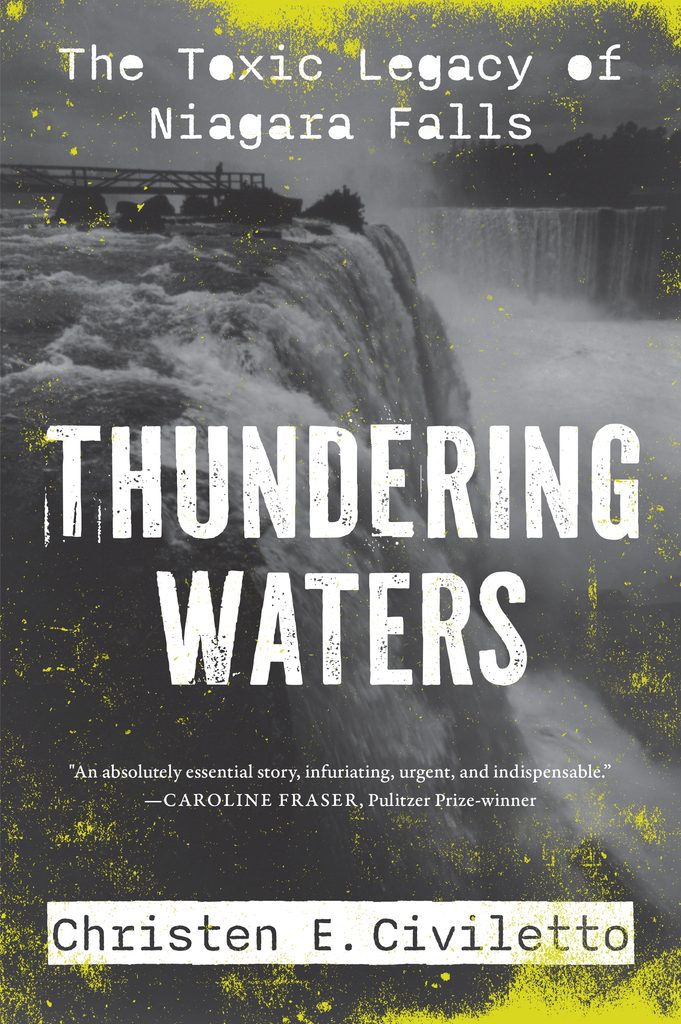
What most don’t know is that the city of Niagara Falls is the setting of one of the most horrific tales of environmental desecration of the past hundred plus years.
By virtue of the Falls’ might, Niagara Falls was the birthplace of the commercial electro-chemical industry – and for decades, those massive corporations dumped, buried, vented, incinerated, and piled their millions of tons of toxic and radioactive waste in the surrounding farmlands, rivers, meadows, and empty lots.
Just a few minutes walk from the waterfall you’ll find the bones of a decayed city. Its residents are plagued by major health problems, often at rates that far exceed state and national averages. The harm is ongoing and generational.
In her new book – Thundering Waters: The Toxic Legacy of Niagara Falls (Princeton University Press), Niagara Falls native Christen Civiletto relates how the major chemical kingpins of the twentieth century relentlessly and indiscriminately laid waste to Niagara Falls.
Perhaps the most harrowing corporate crime book of the year, Thundering Waters exposes the astonishing story of exploitation and ongoing abuse lurking in the shadows of one of the world’s most treasured natural wonders.
We interviewed Civiletto on August 27, 2026.
Tell us a bit about yourself, where you were born and raised and how you came to write this book.
“I was born and raised in Niagara Falls, New York,” Civiletto told Corporate Crime Reporter in an interview last week. “I grew up with it being normal seeing pollution, toxic chemicals and hearing people talk about cancer and illnesses. Those were all pretty normal things for us to hear. Our first home was underneath the plume of Goodyear. We didn’t know it at the time but it was a deadly plume of toxic waste that now is coming to the fore in the news pretty much on a weekly basis.”
“After that, we moved to a home on Cayuga Drive. We owned property near Cayuga Creek, which ringed the Love Canal area. I spent most of my growing up years playing in that creek and playing in the Love Canal area, because that’s where my friends and classmates and even family members were.”
“I was one of those kids who was like — I can’t wait to leave Niagara Falls and go on to bigger and better things. And I did get that chance to attend law school at Vanderbilt in Nashville and then work at the law firm – Powell Goldstein – which is now Bryan Cave.”
That is a corporate defense firm?
“Mostly yes. We did all kinds of work. My job was intellectual property litigation. I represented both plaintiffs and defendants in trade secrets and patent infringement cases.”
“My career started out there, not in environmental litigation. But while I was away, my family remained in the Niagara Falls area and I visited here often. I started to notice a pretty significant decline in the city itself. I was hearing more and more of my family members being diagnosed with cancers and chronic illness. Then it was my turn.”
“I had a diagnosis at 31 years of age that was relatively unusual for my age. I didn’t have any risk factors for this cancer. And I remember that a friend of mine in Atlanta said to me – you talk a lot about cancer back home. And you know a lot of people with cancer. That’s odd. Here in Atlanta, we don’t know people who are publicly battling cancer.”
“That struck me. I was at a very large law firm. And even in my circle of friends, I didn’t know anybody who had this disease. Kicking and screaming I ended up moving back to the Niagara Falls area. The circumstances of my life were such that I had to come back here. I moved back to Niagara County.”
“I was immediately struck by the decay that was going on in the city. But also the fact that it was true – I was seeing so many people coming down with illness.”
“When I was still in Atlanta, I returned to Niagara Falls to attend my ten year high school reunion. And I was surprised to see how many we had already lost to cancer. We were too young.”
“When I came back to the area, my father was diagnosed with an exceedingly rare cancer. It was a soft tissue spindle sarcoma. I couldn’t understand where this came from. I wanted to start researching. A doctor told me that this cancer is connected to iodizing radiation exposure. That was a little surprising to me.”
“My dad was a long time teacher at Niagara Falls High School. I couldn’t figure out where he would have had that exposure. But I learned that my dad worked to put himself through school at Carborundum. Carborundum was a chemical manufacturer. I learned that my grandfather worked there for 46 years and that my great grandfather worked there for 44 years. It was like a right of passage, to get your son the next job in line.”
“My father and grandfather didn’t know it, but the Carborundum company had converted some of their operations over to the Manhattan Project work. They were doing some step in the uranium refining process. But my father and grandfather didn’t know about this work – it was top secret. Much of it took place in the R&D building where my grandfather and father spent a lot of time. My grandmother was able to submit a claim through the Atomic Workers Act and recover. But they denied my dad’s claim. For seventeen years I’ve been arguing with the Department of Labor about this.”
“When I started my research, I found that Niagara Falls was the scene of prolonged and widespread environmental devastation. I had no idea it was that bad. I grew up hearing about Love Canal. I had friends in school who had to be shifted around because of Love Canal evacuations. I knew of that.”
“What I didn’t know is that there were 89 other hazardous waste sites in the Niagara Falls area. I was stunned because I found a list back in 2006 and I started investigating every one of them. It took me a long time. I probably became a little obsessed.”
“As I was doing this research, I kept coming back to this conclusion that something far bigger that we didn’t comprehend as citizens. Not only were these chemical companies inventing new chemicals that didn’t exist before, but they were also generating tremendous amounts of toxic wastes.”
“I didn’t think about this at the time, but that waste had to go somewhere. Unfortunately, that somewhere was any empty field, any sewer, any creek, any farmer’s lot, any canal – hence Love Canal. I found a Carborundum employee interview where the employee said – our waste went anywhere and everywhere it could go. That became what I zeroed in on. It was quite shocking to me.”
“Around that time – I was mid research in 2011 – I got a call from a family who didn’t know they lived right across from Love Canal. They had a child who had ultra rare chromosomal difficulties – she had clubbed feet, a heart defect, you name it. They had chemicals coming up in their basement. They thought I was a chemical researcher, they didn’t know that I was a lawyer. And that eventually led to 14 years of litigation on behalf of not just that family but on behalf of 1,500 plus residents in the Love Canal area.”
“That case was dismissed on a legal technicality three years ago. That’s when I decided I needed to write this book. I had already been writing and amassing research and data. But when that case was dismissed, that was it.”
“What happened to us in Niagara Falls was terrible. And it should never be repeated anywhere else. I wanted people to be able to have the facts that I never had.”
What’s been the result of the litigation?
“There were eighteen cases with hundreds of residents in each case. These cases were all dismissed. Our attorney team did not appeal those decisions, for a variety of reasons. The interviews, testing data still exist. People still have their stories and test results. I’m encouraging people now to speak up.”
“There has been a complete and total environmental awakening in Niagara Falls.”
What triggered the awakening?
“I’m trying to figure that out. It started in June. A couple of things happened. Six major issues came to light. The book came out. I started doing public interviews talking about what I had learned over these years of litigation and research. That was one trigger.”
“In addition to that, we had a YouTube documentary that somebody did. It was called America’s Most Embarrassing Border City. It talked about the horrendous state of our city, from an illness and violent crime standpoint.”
“Around the same time an article came out highlighting the very poor mental health of many of the teens in Niagara Falls. They tied it to environmental exposure. Our suicide rate in Niagara County is nearly twice the state average. I’m quoted in this article.”
“The Pulitzer Center then did a discussion conference based on that article. It was a steady drumbeat.”
“There was an area on the Niagara River next to an infamous dump, connected to Love Canal. It’s called the 102nd Street dump. It’s much bigger than Love Canal. Chemicals started surfacing in this area. People were very alarmed. That started the whole thing. Online, people were starting to take pictures and videos of the chemicals and do little documentaries. And then, it just ramped up exponentially at the end of June. In 2023 and 2024, the EPA and DEC had been doing radiological scans of Niagara Falls. They found 800,000 points of interest. Some of those points of interest are rocks or something on buildings. But in 2025, they started narrowing it down to residences.”
“In 2026, they sent letters to families saying – we need to further investigate your house because we detected radioactivity there. And now we are in a full blown crisis. That started coming to the fore at the end of June. I was involved in that. I was one of the first people to go with an engineer into these homes. We found radioactivity outside the homes. And another person went inside the homes and found radioactivity inside the homes. This was before the EPA and DEC tested.”
“The EPA and DEC sent out property owner access forms that included a waiver of all liability claims in connection with the investigation. We advised people not to sign these forms but they refused to test unless the residents signed. We called them out publicly and they eventually removed that waiver.”
“Now we are in the middle of a multi-agency effort going through homes one by one. We had four families that have been relocated or are in the process of being relocated this week. And they are sending letters now to everybody as they are identifying radioactivity. It is astonishing what is going on.”
“One other big thing happened. In July, we had a family in Love Canal who had a pool being put in. When they were doing the excavation, they came across all kinds of industrial wastes. Things like cylinders, cores, ash and stained soil. This is Love Canal. The family went on TikTok. They did not know about Love Canal. They are not from this area. People were hysterical. They told the family – you need to call the DEC and EPA right away. Which they did. I became involved immediately.”
“We had testing done. And there were exceedances inside and outside the home. Now, every single news outlet is covering the plight of this family. Now our news outlets are completely focused on radiation, Love Canal, Goodyear, the Griffin Park wastes that are surfacing. Now citizens are involved. People have mobilized. An activist group formed.”
“We have young people who are absolutely angry about what they have inherited in Niagara Falls. I have never seen anything like this in my lifetime. But now I would have to say that there is a re-awakening.”
I first heard of your work when you were on the University of Buffalo Law School podcast talking about your book. During that podcast, you were asked whether Niagara Falls can be cleaned up. I don’t think it can and I have proposed making Niagara Falls a national park. It’s unsafe for people to live there, but it is so beautiful we should celebrate its beauty by making it a national park.
But your answer wasn’t clear. So let me ask you – do you think Niagara Falls can be cleaned up so that it will be safe for people to live there?
“I wrestle with this question. My first instinct is to agree with you. These are toxic wastes in the bedrock and in hard to reach places. I don’t know that we can ever fully address them. However, with the right amount of money, there is the potential to clean up Niagara Falls so that it will be a safe place for people to live. It would require a massive overhaul. We would have to somehow figure out a way to remove the wastes that are buried and barricaded throughout the city. We have to remove them or find a way to render them inert through some kind of bioremediation.”
“I don’t know that the technology exists to do that. But perhaps some future technology will get us to a point where the city will be liveable again. Again, my first instinct is to agree with you.”
Have the corporations ever been held to account for this criminal activity?
“Criminally, never.”
There has never been a criminal prosecution?
“Not to my knowledge, which is unacceptable. On the civil side, only minimally. Very few cases have been successful. We had very high hurdles in terms of the standard of proof needed before an expert could testify – the Daubert standard. There were so many obstacles to litigation. Our Love Canal case was bouncing back between federal and state courts. And then everything was appealed. That is why it took fourteen years – and we never had depositions done. We were still at an early stage – the motion to dismiss stage.”
Has there ever been a civil settlement?
“In the first Love Canal litigation in 1978, there was a settlement. Lawsuits were filed. And they did have a civil settlement. Ironically, my cousin Sam Civiletto worked on that litigation.”
One quote that jumps off the page for me is from the late ex-wife of Occidental Chemical chair Armand Hammer. And you quote her as saying about her ex – “It causes him no pain to see the suffering of others.”
You report that the life expectancy in Niagara Falls the city is lower than in Niagara County and that seventy one percent of black residents of Niagara Falls die prematurely.
“At a recent community meeting, more than 160 people attended. The speaker asked everyone who had cancer in their immediate family to raise their hand – and I think every single hand was raised, even the security guards.”
“The metropolitan Buffalo area has the highest cancer rate in the country. That includes Niagara Falls.”
Why do you think the people of Niagara Falls didn’t rise up against the chemical companies?
“I asked my mom this question. She said – first of all, it seemed normal to us. That is what we knew – seeing these chemicals, seeing pollution. There was this sense that it was everywhere and what can you do? I heard that from so many people I interviewed. Even to this day, I have a man who is sitting on an important piece of information and I’m asking him to come forward with it. His response to me – it’s everywhere, what can you do, no one will believe me anyway.”
“There is that sense of futility that a lot of people in Niagara Falls – until this summer. I don’t think we will ever go back to what it was before.”
“The other factor was – those factories put food on our table and that is something you should be grateful for. I know that is what older residents will tell me. What they don’t realize is that there are generational impacts and people are paying the price for that pollution.”
“I have interviewed individuals over the past several years who shared stories that broke my heart. One of them is a farmer in the area who used to patrol property with a shotgun because he was worried about Hooker Chemical Company truckers making the rounds and dumping the wastes on farmers fields when the farmers were not paying attention. This individual knew of many places where there were farmers accepting money for dumping that was taking place on their property. It’s a heartbreaking thing to think about – all the areas we don’t know about that haven’t become an official superfund site or hazardous waste site. Those places still exist.”
They were dumping it on farmers properties because it was cheaper than taking it to a dump, where they would be charged a lot to dump toxic wastes?
“Absolutely. Taking waste to the dump was a very expensive proposition. There was so much waste. They had a group of individuals who were moving that waste around Niagara County. They didn’t have scruples either. I call them toxic traffickers. They were sloppy the way they maintained their dump sites. They all became Superfund sites later. Now we are not only in the hands of these chemical companies trying to dispose of millions of tons of hazardous and radioactive wastes, but also we had these toxic traffickers who were in on it.”
[For the complete q/a format Interview with Christen Civiletto, see 40 Corporate Crime Reporter 34(11), September 7, 2026, print eidtion only.]