
 Anwar Ibrahim: The Man Who Became the Compromise
  The US is letting a convicted Bolsonaro spy chief stay in Florida. Brazil wants answers.
  Rick Claypool on Pay to Play Corporate Crime Enforcement
 By: Toh Han Shih
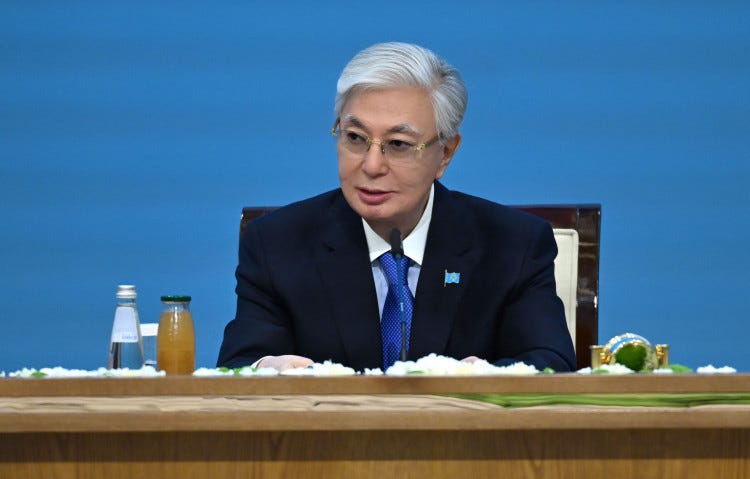
The landslide victory of Kazakh President Kassym-Jomart Tokayev’s party in legislative elections on Aug. 23 may give him a mandate to continue his reforms – and certainly his influence – in Kazakhstan possibly even after he leaves office. He has already appointed his associates as prime minister and vice president – who could be a possible successor.
Tokayev’s new Adilet party won 71.2 percent of the vote, beating six other parties.
The election came weeks after Kazakhstan changed from a dual-chamber parliament with a lower house and a Senate, to a single parliament, the Kurultai, on July 1. Under the new 2026 constitution, presidents will only be permitted to serve one seven-year term, unless they happen to be Tokayev, who will be allowed to seek election to another seven-year term after his current term ends in 2029 because it will be counted as his first term under the new constitution.
“The constitutional changes strengthen the power of the presidency and present several possible scenarios for succession. President Tokayev could use the results of the constitutional referendum as justification for a new seven-year term,” wrote Kate Mallinson, an associate fellow of Chatham House, in a report by the London think tank issued March 16.
“Or he could step down early and assume the position of vice president, with his successor installed as president. The latter would enable him to manage Kazakhstan’s complex foreign affairs without the pressure of day-to-day domestic duties,” Mallinson wrote.
But if the 73-year-old Tokayev serves an entire seven-year third term, he will be 83 when he steps down in 2036, and it’s anyone’s guess if he will remain active after he leaves office despite the fact that he has appointed close supporters as vice president and prime minister.
A long-time protégé of Tokayev, Erlan Karin, is the new vice president and Tokayev’s possible successor. Tokayev nominated Karin as vice president, and the Kurultai, dominated by Tokayev’s party, elected Karin as vice president by an overwhelming majority on Aug. 31. Under Kazakhstan’s new constitution, if the president voluntarily resigns or for some reason cannot continue his duties, presidential powers will pass to the vice president.
Kazakhstan previously had no vice president, but now its vice president has considerable powers. On Sep. 5, Kazakhstan’s presidential press service announced that Tokayev had signed a decree defining the powers of the vice president. Under the decree, the vice president submits strategic initiatives to the president on domestic and foreign policies, and ensures their implementation. Upon the president’s instruction, the vice president can represent him before the Kurultai, as well as in other domestic and international organizations.
Karin has worked for Tokayev in various capacities since the latter became president in 2019. Most recently he served as State Counsellor from July 2022 to August 2026, a key advisory role.
Also on Aug. 31, the Kurultai elected incumbent Prime Minister Oljas Bektenov for another term. Bektenov has also worked closely with Tokayev for several years and has served as prime minister since February 2024. Bektenov owes his career to Tokayev, said Temur Umarov, a fellow of the Carnegie Russia Eurasia Center in Berlin, in a report on July 22.
“By the end of 2026, Tokayev will have completely reshaped the political system to suit his own needs. At the same time, little will essentially change. The constitutional rewrite did not alter the fundamental reality of Kazakh politics: the president still controls all branches of government, and his powers are virtually unlimited,” Umarov wrote in the July 22 Carnegie report.
German Karimovich Nurbayev, a former Kazakh Supreme Court judge, told Asia Sentinel, “The election has opened a new institutional phase for Kazakhstan. From a rule-of-law perspective, the key test will be the consistent implementation of the announced reforms.”
“President Tokayev provided the political impetus for the administrative justice reform. Its lasting significance lies in the institutions it created: more effective judicial review, greater accountability of public authorities and stronger protection of individual rights,” said Nurbayev, who is currently Chairman of the Economic Court of the Commonwealth of Independent States (CIS), a pro-Russia body that includes Belarus, Russia and Kazakhstan.
Modern justice
“The establishment of a modern system of administrative justice was one of the major judicial reforms initiated under President Tokayev,” Nurbayev said.
Nurbayev cited legislation which took effect at the beginning of this year that transfers legal challenges to government actions from government bodies to administrative proceedings.
“Administrative justice seeks to protect individual rights while ensuring that public authorities act lawfully and in the public interest. Neither the interests of the state nor individual claims should be treated as automatically prevailing; the court must apply the law and the principle of proportionality,” Nurbayev said.
Tokayev’s legal reforms
After Tokayev succeeded Nursultan Nazarbayev, who ruled Kazakhstan as a vastly powerful authoritarian leader from 1991 to 2019, he took steps to erase the actions and memory of his one-time mentor from public life, according to the Carnegie report. Tokayev is now the last remaining senior figure from the country’s Soviet past, the report wrote.
“On the surface, there is no trace left of Nursultan Nazarbayev in Kazakhstan’s political system,” wrote the Carnegie report. “However, his legacy cannot be erased completely, since Nazarbayev’s protégé Tokayev remains at the heart of the regime.”
The Carnegie report notes that Tokayev did not go all the way in distancing himself from the previous ruler. Nazarbayev’s relatives, for example, were not imprisoned by the new leader. The former ruler lives in secluded retirement in the country.
Nurbayev defends the president and his legal reforms as transformative.
“On July 1, 2021, Kazakhstan’s Administrative Procedural and Process-Related Code entered into force. It introduced a new model for resolving disputes between individuals or legal entities and public authorities and established stronger judicial protection against unlawful administrative acts and actions,” said Nurbayev.
With this legislation, Kazakhstan established specialized administrative courts, while a Judicial Board for Administrative Cases was created within the Supreme Court.
Nurbayev served on the newly created Judicial Collegium for Administrative Cases from 2021 to 2025.
“In cases before the court, we reviewed administrative acts adopted by senior public officials, including ministers. Where the law required it, those acts were set aside, and the procedural enforcement measures provided by the Code were applied,” Nurbayev said.
“In a number of cases, the administrative courts protected the statutory social and housing rights of military personnel and required the competent authorities to provide benefits guaranteed by law,” Nurbayev revealed.
“When citizens see that an independent court can effectively review the actions of public authorities and provide a remedy… this strengthens confidence in both the judiciary and the state,” he added.
“The 2021 reform significantly strengthened and systematized judicial control over public administration. It gave the courts more effective procedural instruments and placed greater responsibility on public authorities to justify the legality of their decisions,” Nurbayev said.
“In that sense, effective administrative justice strengthens rather than weakens the state,” Nurbayev said.
In 2025, Nurbayev moved from Kazakhstan to Minsk, the capital of Belarus, to assume his current post as Chairman of the Economic Court of the CIS. He hopes to return home when his work in Minsk is finished.
“Tokayev wishes to imprint some key themes from his presidency on the political culture of Kazakhstan… The government claims that the new constitution will modernize and streamline the political system. But this brand of modernization, which is already in process, entails a move away from Western-led liberal economic models which emphasize privatization, deregulation and foreign investment,” Mallinson wrote in the Chatham House report.
Kazakhstan will likely move toward a more institutional, less personalist authoritarian system – similar to China, Mallinson argued. “Tokayev appears to admire the technocratic authoritarianism of China, where he served as counsellor to the Soviet ambassador in the late 1980s.”
Toh Han Shih is a Singaporean writer in Hong Kong and a regular contributor to Asia Sentinel.
Don't Miss:
-
Anwar Ibrahim: The Man Who Became the Compromise
-
The US is letting a convicted Bolsonaro spy chief stay in Florida. Brazil wants answers.
-
Rick Claypool on Pay to Play Corporate Crime Enforcement
-
Labaton Launches Whistleblower Practice with Former SEC Acting Chair Allison Herren Lee
-
Kremlin payment firm A7 has been pumping billions in ‘untraceable’ cash into global financial system