
 The story that rocked the world: Ten years of the Panama Papers, part 1
  France to try alleged Magnitsky Affair mastermind Dimitry Klyuev in absentia
  Canada revokes dozens of crypto firms’ registrations
 Ecuador’s President Daniel Noboa says that, two years in, his organized crime crackdown is entering a “new phase” that combines more of the same heavy-handed militarization at home with a new emphasis on international cooperation, specifically with the United States and Europe. But will this new phase be any better than the old one?
The revamping of old security measures like curfews and mass arrests of suspected gang collaborators are now being complemented with airstrikes backed by the United States and operations against transatlantic drug trafficking organizations in tandem with European agencies.
The measures come as Noboa faces pressure to respond to rising violence levels in Ecuador. His administration has captured the leaders of the country’s most powerful organized crime groups: the Lobos, Choneros, Tiguerones, and Chone Killers. But the arrests have produced power struggles that pushed the homicide rate to a record 50 per 100,000 residents in 2025. Ecuador was the most violent nation in Latin America for the second straight year.
More Mano Dura, More Problems?
On March 3, the US Southern Command announced it was conducting joint operations with Ecuador against “narco-terrorists.” The US government considers two Ecuadorian criminal groups — the Lobos and Choneros — to be “foreign terrorist organizations.” Days later, officials from both countries posted video of Ecuadorian forces conducting airstrikes on a structure in a forested area near a river.
Ecuador claimed the camp, located in the province of Sucumbíos near the border with Colombia, was a rest area used by Border Command leader Johnathan Alfredy Tole Collazos, alias “Mono Tole.” The Border Command, which was born in Colombia, is one of the many criminal groups overseeing cocaine trafficking routes and illegal mining in Ecuador’s border region. Locals speaking to the New York Times in the area, however, said the military struck a dairy farm.
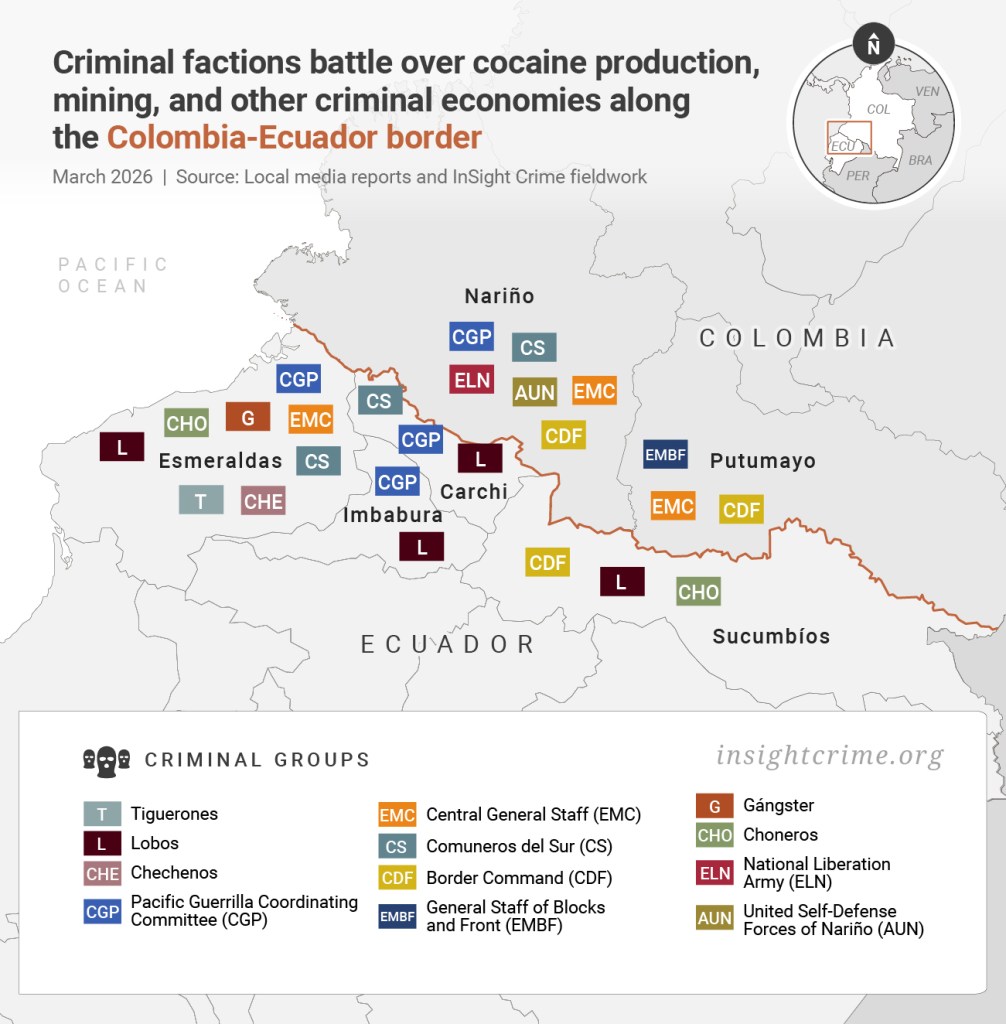
The bombing was a new escalation in the use of force in the region, and mirror attacks that have left at least 163 dead in US strikes against alleged drug traffickers in the Caribbean and Pacific, which began in September last year. But land strikes on Ecuador’s border promise few security gains.
“Hitting a camp in northern Ecuador in the remote regions does not change the security situation for the vast majority of Ecuadorians, who live in big urban centers,” James Bosworth, founder of political risk analysis firm Hxagon, told InSight Crime.
As the strikes were hitting, Noboa was in Miami for the inauguration of the “Shield of the Americas,” a “military coalition” led by United States President Donald Trump that seeks to “eradicate the criminal cartels.” Shortly after, Noboa’s government implemented a 15-day curfew in four provinces, saying it would “attack and destroy” criminal groups at night. Officials said United States security forces would be assisting but did not provide further details.
SEE ALSO: Elected for a Full Term, Ecuador’s Noboa Needs a Plan
Curfews and security operations are a constant in Ecuador. A study by the Ecuadorian Conflict Observatory (Observatorio Ecuatoriano de Conflictos) found that the coastal provinces of Manabí, Guayas, Los Ríos, and El Oro have been under a state of exception — a measure that allows the military to assist the police in anti-crime operations and suspends rights like protection from warrantless entry — for 82% of the first two years of Noboa’s presidency.
Security operations to combat organized crime have spawned conflict within and between groups as they adapt to the arrests of their leaders. What’s more, mass detentions — more than 2,000 people were taken into custody during the two-week-long March curfew — feed more people into a prison system that is a breeding ground and recruitment zone for crime groups.
Fernando Carrión, an Ecuadorian security expert, does not see any indication that the Noboa administration’s new offensive will impact criminal groups in the long run.
“[There could be] a sort of strategic withdrawal by criminal organizations to better understand how things are operating,” he told InSight Crime. “And then, once they understand that situation, my impression is that they will resume their activities with even greater force.”
Ecuador Is Not El Salvador
Many Ecuadorians support Noboa’s tough-on-crime measures. Faced with a drastic surge in crimes like homicide, extortion, and kidnappings, civilians have demanded immediate results from their government, favoring militarized approaches over long-term policy solutions.
“Citizens do not believe that the institutions of the state are capable of tackling organized crime, and that contributes to this idea that there may be a magical solution,” Sebastián Cutrona, criminology professor at Liverpool Hope University who studies security policy and public opinion, told InSight Crime.
Exacerbating this idea is the widely shared success narrative of the security model imposed by Salvadoran President Nayib Bukele, whose controversial crackdown on street gangs has converted the country from the region’s most violent to among the safest, effectively dismantling the once powerful MS13 and Barrio 18 gangs. But for Cutrona, there is little hope that similar measures will work in Ecuador.
“Unlike the case of El Salvador, here we are talking about drug trafficking organizations that have greater muscle, greater revenues, and therefore greater chances to confront the state,” he said.
A Hopeful Element of the New Phase?
The European Union’s cooperation with Ecuador has focused on dismantling the complex cocaine trafficking networks that connect Ecuador and Europe. This strategy may ultimately be more sustainable, and more damaging to criminal networks, than military force.
Ecuadorian police, working with European law enforcement agencies, arrested 43 people in early March linked to two cocaine trafficking networks involving the Lobos, Lagartos, and Albanian mafia groups. Combined, these networks allegedly conspired to traffic at least nine tons of cocaine from Ecuador to Europe through maritime shipping containers.
The European Union has also opened a new joint intelligence center with Ecuadorian security forces and announced investments in training and infrastructure in Ecuador’s maritime shipping ports. Cooperation of this type targets brokers and specialized nodes of the drug trafficking chain, as opposed to rank-and-file gang members rounded up in military operations in the streets.
SEE ALSO: The Pioneering Albanian Trafficker Who Took Ecuador’s Drug Trade By Storm
“Cocaine is not a nationally bound illegal market, so it requires a transnational [law enforcement] approach,” Cutrona said.
The United States is also on board with intelligence sharing and opened a Federal Bureau of Investigation (FBI) office in Ecuador on March 11. The FBI has already assisted in the investigation into the murder of presidential candidate Fernando Villavicencio in 2023, and US intelligence was reportedly key to the capture of Choneros leader Adolfo Macías Villamar, alias “Fito,” in 2025.
“We should want to see that sort of intelligence sharing, training, and prosecutions of crime,” Bosworth said of the FBI’s announcement. “That’s way better than dropping bombs on criminals and much more likely to succeed in the long term.”
Featured image: President Noboa meets with former US Homeland Security Secretary Kristi Noem in Manta, Ecuador, in November 2025. Credit: Associated Press (AP) / Alex Brandon

Don't Miss:
-
Iran says it has ‘will’ to end war, as Trump zigzags on escalation
-
Iran says will target Apple, Google and Meta if more of its leaders are killed
-
US top court rules against state ban on ‘conversion therapy’ for LGBTQ+ youth
-
Tai Po blaze hearing: property management worker unaware fire alarms deactivated
-
Philippines to rename disputed South China Sea islands to boost ‘sovereignty’