
 Michael Marx on Corporate Campaigns in the USA
  Losing language and culture in Xinjiang
  Manila’s EV ambitions confront economic and energy realities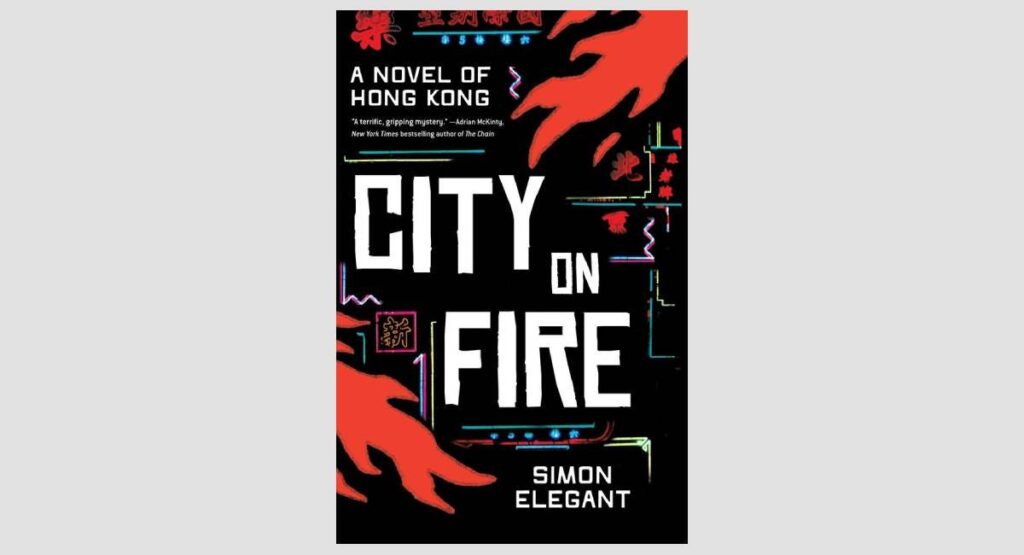
By: Anthony Spaeth
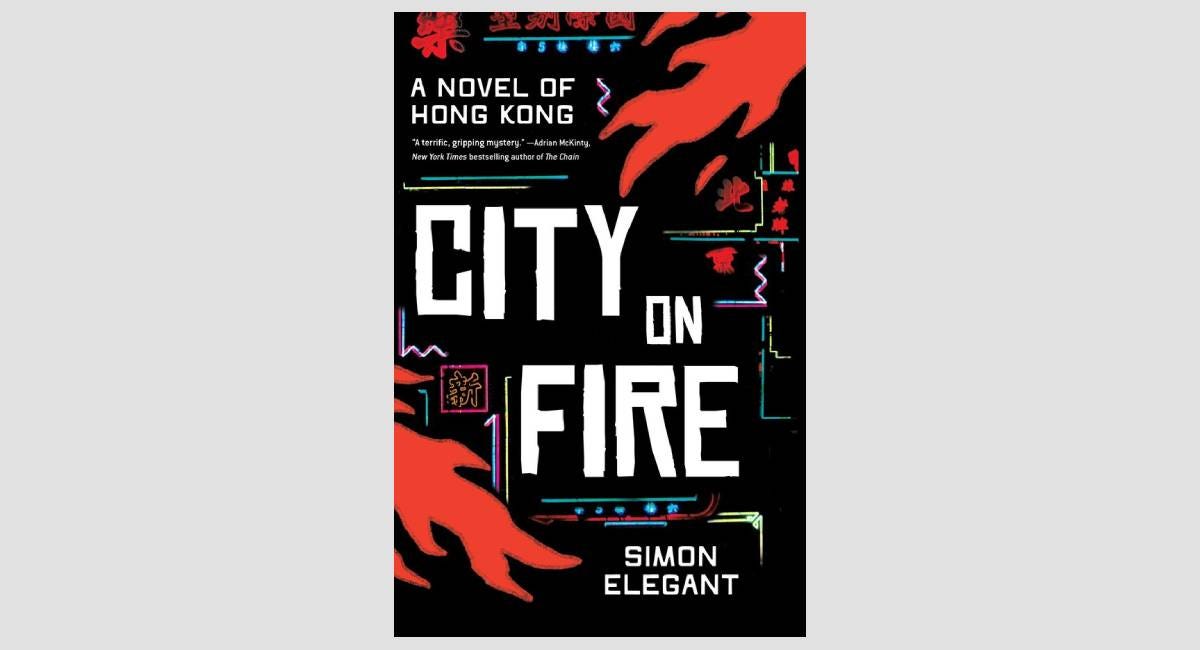
“There’s a storm coming,” Police Superintendent Killian Tong is warned in City on Fire, Simon Elegant’s third novel, “and Hong Kong will look very different when it’s over.”
Storm or fire? Whichever apocalypse one prefers, Hong Kong is well into it on the story’s first page.
It’s the summer of 2019. The pro-democracy Umbrella Movement, which got worldwide sympathy a few years earlier with images of middle-aged baldies and students fending off police water cannons with umbrellas from golf courses and 7-11s, has evolved into something more vicious and violent. The state response, especially through the new paramilitary Special Tactical Squad, is even worse. Little tragedies start occurring on a regular basis and it all seems headed to a big one like Tiananmen.
One little tragedy involved Killian, a second-generation British policeman. At a demonstration, a protester took a swing at him with a pole. Killian raised his pistol in the air but another protester pulled it down. The pistol discharged, killing the first protester.
He’s on administrative leave pending an investigation, dealing with guilt and PTSD with his dog in an abandoned police station on Deep Bay, which separates Hong Kong from the mainland city of Shenzhen. In the 1960s, desperate refugees swam across the shark-infested bay to flee to British Hong Kong, and Shenzhen was farmland.
“In the space of a few decades, the obscure Chinese county town had transformed itself into to Hong Kong’s upstart younger sibling,” Elegant writes. “Now it was daaigo, the elder brother. The boss, though most Hong Kongers hadn’t clocked that yet.”
It’s one of the quirks of action stories that when a character is suspended from duties, he reliably manages to get into major trouble, often of a highly significant nature.
A corpse has been found without head, limbs, or genitals in a landfill nearby. The force is stretched thin. “The cockroaches are going crazy tonight,” a colleague explains. “Demos everywhere.” Killian has to lead the murder investigation.
But there are two special circumstances. The murder must be kept secret, ostensibly to avoid inflaming a public that would assume it to be an extrajudicial killing by police. Secondly, it has to be solved before a major announcement about Hong Kong’s National Security Law.
While not exactly a spoiler, a thematic clue to this murder comes from where the body was discovered: on a landfill composed of garbage. “The detritus of urban life: doorless refrigerators; rusting air conditioners; kitchen cabinets covered in a thick layer of nicotine-brown grease from years of stir frying…” A scavenger on the site suffers from a boil on his shoulder and his t-shirt is “soaked with pus.” Killian’s squad car has garbage dumped on it, a sign of contempt for the “garbage police.”
It’s a city of slime. “The reek of decay hung in the air,” Elegant writes. Corruption, both private and public—ultimately at the very highest level—is the solution to the murder mystery.
As he cross-crosses Hong Kong investigating the murder, Killian is also dealing with a family crisis. His younger stepsister Jun has been radicalized and the authorities are watching her—along with everyone else. “There are already five, maybe six hundred thousand cameras,” a colleague explains to him. “In another year there’ll be a million…We have the whole city under surveillance. Every person who is considered a threat is tagged orange or red. A little rectangle appears above their heads when they show up on our screens. Red is for arrest immediately.”
Jun is flashing orange.
The siblings are trapped on ever-receding political positions—peaceful protests for democracy becoming anarchic violence, protecting and serving transforming into political oppression—and much of the tension comes from wondering how their conflict will be resolved.
Though on the opposite pole, Killian grows to appreciate the protesters.
“My generation would have said their only duty was to themselves and their families,” he muses. “It was then I realized how much Hong Kong had changed. It wasn’t the money-grubbing, materialist refugee city that was our default image of ourselves. Somehow, we’d become a people who were ready to fight for their freedoms. Ready to sacrifice.”
Jun does eventually have to make a sacrifice, though not the ultimate one.
Elegant’s first novel, A Chinese Wedding, was an exploration of a claustrophobic cross-cultural marriage in Hong Kong, where he was born and partly raised. His second, A Floating Life, was expansiveness itself. An invented picaresque memoir by Tang Dynasty poet Li Po, it offered the warp and weft of everything Chinese: smells, superstitions, Confucian conformism, mystical Taoism, brigandry, astrology, and how to trap songbirds. Not to mention classical poetic forms and viscous camel urine. Li Po embodies China’s Golden Age, and Elegant dragged him through the low of sloshing through pig feces to a vertiginous flight on the back of an eagle.
City on Fire is being marketed as a “taut thriller,” and Elegant takes to pulp conventions with gusto. Sentences chug along on a series of threes, like the book’s first: “Light flooded into the room and Killian bolted upright, heart hammering, gasping.” Bigwigs with dubious ethics flick specks of dust off bare, polished desktops. Frustration manifests itself familiarly—”Killian reached down and picked up his coffee cup, cradling it, then, without thinking, hurled it against the wall”—as does fear: “Jun felt the icy clutch of doubt on the back of her neck.” A first look at the book’s chief heavy tells all. “Rivulets of sweat ran down the side of his face and into his T-shirt, molding it around his bulging deltoid muscles. His eyes were small in that big, glistening head, flat, black shards.”
But the book’s subtitle is “A novel of Hong Kong,” and it works as a literary novel about a historical turning point told through characters whose futures depend on it. The Hong Kong portrayed in City on Fire is filthy and very dark, but ultimately not without hope. “It was going to be a long, long night,” Elegant writes. “But Hong Kong would survive. And thrive. And be free again. Maybe not this year, or the next. But one day soon.”