
 Donate to ICIJ
  Chelsea FC fined millions over secret payments under Abramovich ownership
  Nearly half of powerful .50-caliber ammo seized by Mexican government came from US Army plant, defense minister says
 In various parts of Mexico, local drug markets do not operate according to supply-and-demand logics alone. What is sold, how it is sold, how much it costs, where it is available, and even how it is consumed depend largely on the decisions of local criminal groups.
Retail drug markets are a relatively recent focus for Mexican criminal organizations. Traditionally, major trafficking groups concentrated on moving drugs to the United States, while local distribution was handled by smaller, loosely organized actors. But as large cartels fragmented over the past two decades, smaller cells consolidated territorial control and increasingly turned inward, focusing on localized criminal economies they could directly dominate.
For groups without the capacity to sustain large transnational operations, retail markets offered not only a stable and predictable source of revenue but also a means to assert authority over neighborhoods, regulate violence, limit state intrusion, and keep rivals at bay.
When fentanyl began spilling into local markets across northern Mexico around 2016, this criminal control became particularly visible. In some cities, criminal groups actively promoted the drug’s integration into retail markets, setting the conditions under which it could be sold and consumed. In others, they tightly restricted it, prioritizing safe passage to more profitable US markets or seeking to avoid the heightened scrutiny associated with rising overdoses.
In every case, fentanyl ultimately reached local markets. But the strategic decisions made by criminal groups directly shaped how users accessed the drug, with significant consequences for both public health and security.
As part of a year-long investigation, InSight Crime analyzed five trafficking hubs across northern Mexico where criminal groups have imposed distinct models of control over fentanyl markets.
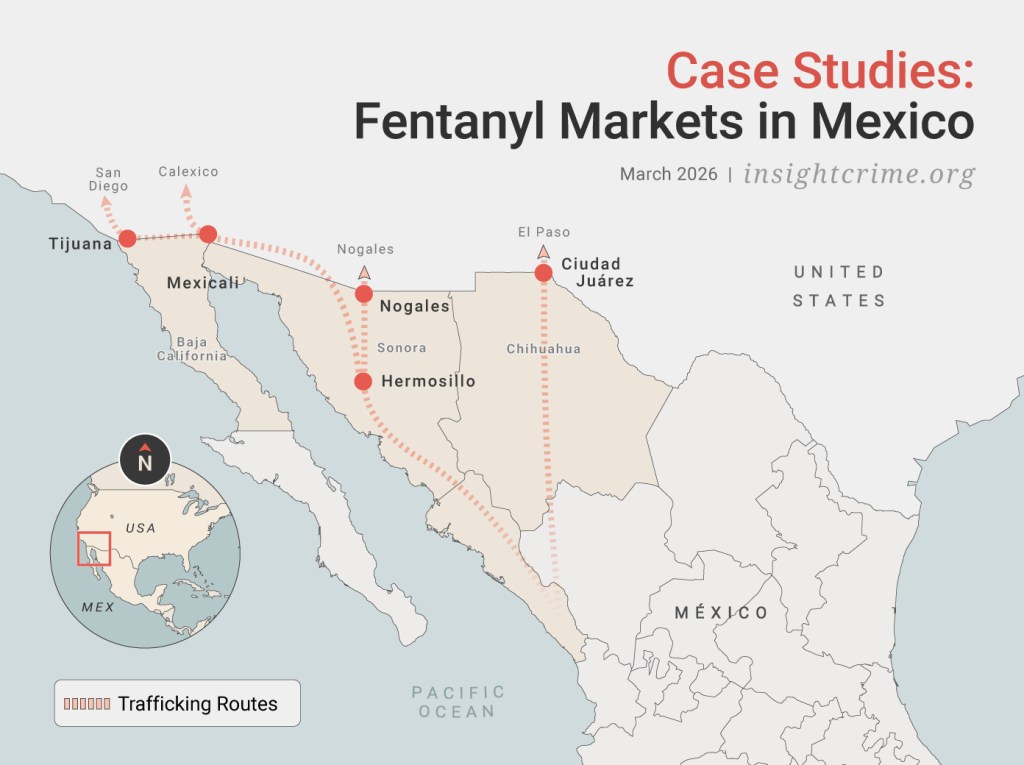
Mexicali, Baja California: Structured Criminal Monopoly
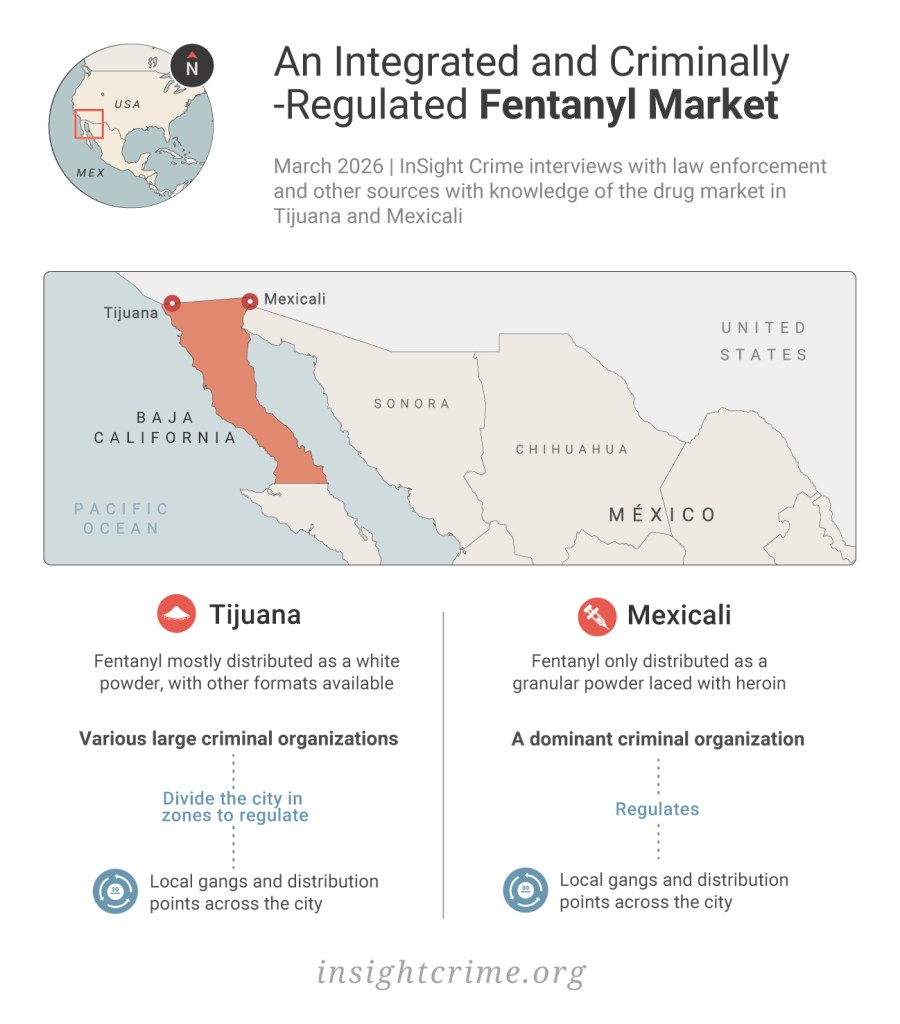
Located on the desert border with the Californian city of Calexico, Mexicali represents the most regulated and structured model of criminal control along Mexico’s northern border. The city has long been strategically important for organized crime due to the trafficking corridors that connect to the southern and western United States, as well as its industrial and agricultural sectors, which criminal groups have historically sought to exploit.
Over the past five years, the Rusos — an armed group of the Sinaloa Cartel associated with Ismael “El Mayo” Zambada’s faction, often referred to as the Mayiza — have consolidated their presence in the city and its surroundings. In rural areas, they have engaged in intense confrontations with factions associated with other Sinaloa Cartel networks, such as the Chapitos. In the urban area, however, they have established a hegemonic presence over criminal economies.
In the case of the drug market, this control functions as a monopoly, as the Rusos regulate all actors involved in drug distribution. Specifically, the group has divided the city into territories controlled by gangs, each managing one or more selling points known as “conectas,” which receive drugs from authorized distributors.
Doses are sold with standardized weights, packaged with distinctive seals, and offered at uniform prices throughout the city. This system prevents parallel resale markets and ensures that authorized distributors maintain their margins. It also functions as an internal surveillance mechanism: any unusual package or price signals that someone is operating outside the established rules.
SEE ALSO: How Fentanyl Was Introduced in Mexico’s Local Drug Markets
The Rusos have also established strict rules for fentanyl. It is sold only as an additive to black tar heroin. Counterfeit M30 pills, which were once trafficked into the city in large quantities in shipments destined for the United States, are now prohibited. Additionally, pipes used for smoking fentanyl-laced heroin can only be sold by accredited distributors, meaning most users inject the drug.
Controls also extend to drug purity, which the Rusos have adjusted according to their priorities. By 2023, most drug users knew that nearly all heroin doses sold in the city center contained fentanyl. But in early 2025, the group temporarily restricted the sale of heroin with high fentanyl concentrations. The reasons for this shift remain unclear, though some government sources suggested the Rusos sought to reduce scrutiny amid the sustained overdose rate in the city center, which is also critical for other illicit activities. Users quickly noticed the change, as their usual doses no longer alleviated withdrawal symptoms, and the market shifted toward the outskirts of the city.
“It’s very hard for drug users to obtain exactly what they are looking for because organized crime has everything so tightly controlled,” said a former drug user who spoke to InSight Crime in Mexicali and who asked to remain anonymous due to security concerns. “Buying from the wrong place can cost you your life.”
Tijuana, Baja California: Violent Criminal Oligopoly
Tijuana, the largest city on Mexico’s northern border, has long been contested by various criminal actors seeking to exploit its numerous illicit economies, as well as its heavily trafficked border crossing into San Diego, California.
The local drug consumption market has historically been large and has often mirrored trends seen in California. As a result, Tijuana was one of the first places in Mexico where fentanyl consumption was detected.
Today, control of the local drug market is divided among factions linked to Los Chapitos and the Mayiza of the Sinaloa Cartel, the Jalisco New Generation Cartel (Cartel Jalisco Nueva Generación – CJNG), and remnants of the Arellano Félix Cartel (Cartel Arellano Félix – CAF).
Similar to Mexicali, these factions have established strict rules for distribution. Drug sales are channeled exclusively through authorized conectas and gangs, with packages sealed using distinctive colors linked to each criminal group. This system creates invisible boundaries between factions, restricting consumers from crossing them and preventing purchases from unauthorized distributors.
The impact of these rules on the fentanyl market is mixed. On one hand, competition among different actors makes the market more open than in Mexicali, allowing fentanyl to be sold in different forms that cater to user preferences. While it is primarily sold as white powder, it has also been identified in colored powders, mixed with black tar heroin, or sold in counterfeit M30 pills.
On the other hand, the market is extremely violent. Crossing invisible borders and moving across neighborhoods involves significant risks for both distributors and users. Tijuana consistently records some of the highest homicide rates in the country. Law enforcement authorities in the city who spoke to InSight Crime estimate that around 70% of killings are related to the enforcement of rules governing the local drug market.
Nogales, Sonora: Clandestine Market Under a Criminal Duopoly
The city of Nogales — which borders the Arizona city of the same name — is a key trafficking point into the United States and has historically been used by Sinaloa Cartel-affiliated factions because it is directly connected by highways to their drug production zones. In 2024, US Customs and Border Protection (CBP) reported that Nogales was one of the most commonly used border crossings for fentanyl trafficking, accounting for roughly half of the seizures recorded along the southwest border.
Within the city, train tracks run north to south, creating a natural boundary between two criminal factions. On the west side, the Salazar — a criminal group with a strong presence in Sonora that was once closely linked to the Sinaloa Cartel — dominates. Meanwhile, the eastern side is controlled by factions still connected to the Sinaloa Cartel, including the Chapitos and groups associated with the Mayiza.
The two sides oversee different segments of the local drug market. The Salazar focus primarily on methamphetamine, while Sinaloa Cartel networks prioritize the retail distribution of cocaine, marijuana, heroin, and benzodiazepines. Although there is no formal gang structure in the city, drug sales are limited to distributors authorized by these criminal groups.
Both factions strictly restrict local fentanyl sales, reportedly going as far as killing or disappearing distributors who defy these rules. Still, fentanyl has entered the local market through actors connected to international trafficking networks that use the Nogales crossing. However, they must operate clandestinely and maintain closed networks with trusted consumers in specific neighborhoods. Fentanyl use therefore occurs primarily in private spaces, away from the open “dealers’ corners” where other drugs are sold.
SEE ALSO: How Criminal Decisions Over the Drug Market Impact Public Health in Northern Mexico
“The first time I tried fentanyl was because a friend who makes clavos [the compartments in vehicles used to hide illegal drugs] was asked to transport a fentanyl load,” said a fentanyl user interviewed in Nogales. “But he didn’t have authorization to sell it in Nogales, so he only gave it to people he trusted.”
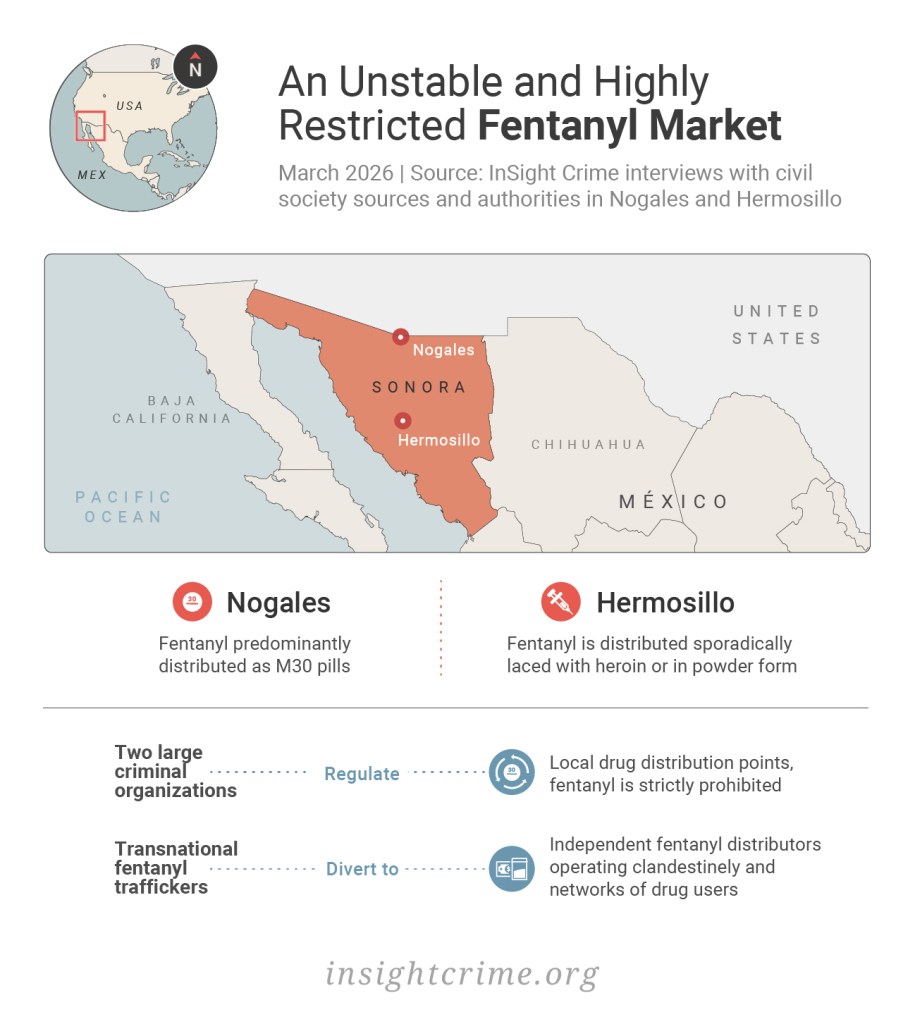
Hermosillo, Sonora: Discreet Distribution Amid a Fragile Criminal Truce
Although it is not directly located on the border, the Sonoran capital of Hermosillo has historically been an opioid consumption hotspot and has also developed a fentanyl market.
As in Nogales, the city has long been influenced by factions affiliated with the Sinaloa Cartel, and drug distribution is largely controlled by groups linked to the Salazar and the Chapitos.
Instead of dividing the city by drug type, these factions sell similar substances but organize their operations through “plazas” distributed across different neighborhoods.
The distribution system follows strict rules: doses and prices are standardized, and packages are sealed to identify authorized sellers. As in Mexicali, the sale of pipes used for smoking drugs is controlled by organized crime, meaning consumption mostly occurs through injection.
For decades, the two factions maintained a form of pax narca that kept violence relatively low in Hermosillo, a key point along the route connecting Sinaloa’s production hubs to the Nogales border. This informal truce included restrictions on the consumption of certain drugs — such as heroin and fentanyl — that could attract authorities’ attention, or calentar la plaza (“heat up the plaza”) due to their impacts on public health. As a result, these substances were historically distributed discreetly through closed networks linking consumers with producers and distributors from Sinaloa.
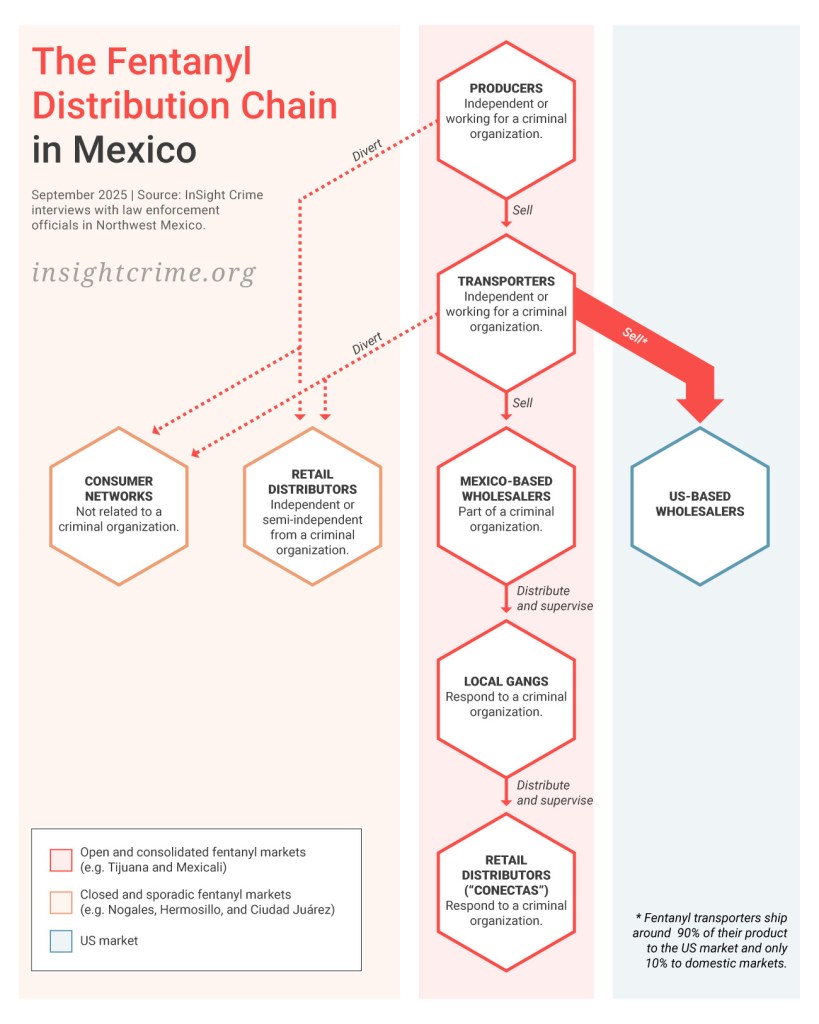
In Hermosillo, fentanyl has appeared in different forms depending on user preferences. Some users — particularly those with experience in the United States — seek counterfeit M30 pills. Others who are more accustomed to heroin prefer heroin mixed with fentanyl, while those seeking greater potency opt for fentanyl in powder form. However, supply is sporadic, and the market operates with a low profile, making it difficult for outsiders to access.
Beginning in the second half of 2024, the relationship between the Salazar and the Chapitos fractured. The resulting conflict triggered an increase in executions and disappearances of drug distributors and users as criminal groups sought to reinforce control and solidify their territorial presence, according to sources consulted by InSight Crime in the city.
This has also affected the fentanyl market, making its distribution more difficult. For example, in June 2025, some users told InSight Crime that there had been a temporary fentanyl shortage in the city following the murder of one of the distributors.
Ciudad Juárez, Chihuahua: Total Criminal Prohibition
Ciudad Juárez, located on the border with the Texan city of El Paso, represents the most restrictive fentanyl market among the cities analyzed.
These dynamics reflect the city’s criminal structure. Historically, Juárez has been divided — and frequently contested — among factions linked to the former Juárez Cartel and groups allied with the Sinaloa Cartel. Each faction controls specific drugs, establishing invisible boundaries that divide their territories.
Unlike in other cities, mechanisms such as standardized doses, prices, or distinctive packaging seals are not commonly used. Instead, factions focus primarily on preventing the sale of substances they do not authorize.
Splinter groups of the Juárez Cartel, including La Línea and La Empresa, along with gangs such as Barrio Azteca, have long controlled heroin distribution in the northern and central parts of the city, sourcing it from Chihuahua’s mountainous regions. Networks once linked to the Sinaloa Cartel — including the Mexicles and Artistas Asesinos — focus on cocaine and, more recently, methamphetamine produced in Sinaloa, selling it primarily in the city’s outskirts.
Fentanyl, however, has been tightly restricted.
“Criminal groups do not agree with fentanyl being distributed in the city,” regional prosecutor Carlos Salas told InSight Crime in September 2024.
According to additional testimonies, La Línea is the primary enforcer of this ban. The sale of fentanyl — also largely produced in Sinaloa — is often interpreted as a sign of ties to Sinaloa Cartel networks. Rival factions have likewise refrained from incorporating it into their repertoire, with some dealers who spoke to InSight Crime suggesting this is partly to avoid the surge in overdoses seen in other cities.
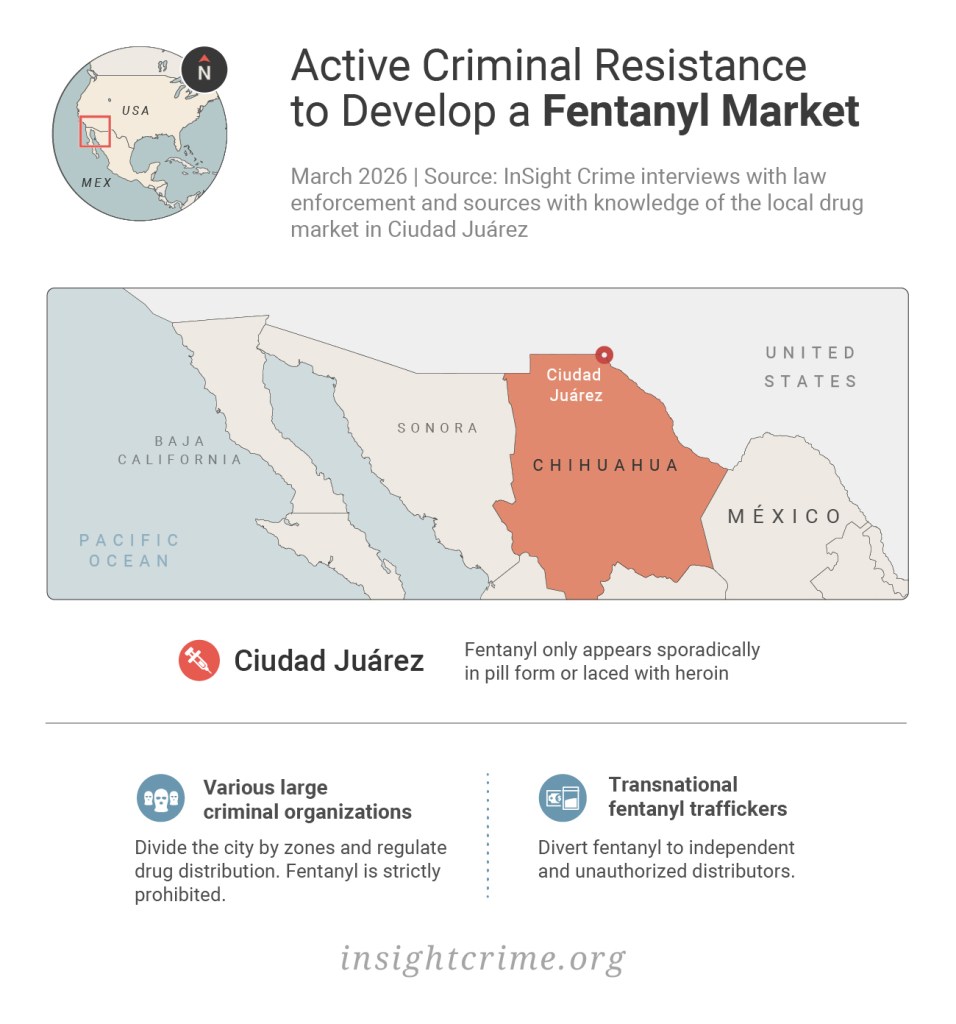
In practice, fentanyl’s presence in Juárez remains sporadic and its distribution clandestine, even though the city is a major trafficking hub for shipments destined for the United States. Only a small number of vendors connected to international trafficking networks offer it locally, usually in counterfeit M30 pills or mixed with other substances.
Several people consulted by InSight Crime in the area indicated that while it is possible to obtain these drugs, admitting to their use or sale carries significant risks due to constant surveillance by criminal actors.
*Angélica Ospina, Steven Dudley, Mike LaSusa, Cecilia Farfán, and Bianca Acuña contributed to reporting for this investigation.


Don't Miss:
-
Mayito Flaco and Ivan Archivaldo Meet Up?
-
How Fentanyl Was Introduced in Mexico’s Local Drug Markets
-
How Criminal Decisions Over the Drug Market Impact Public Health in Northern Mexico
-
CJNG Hitman Commander Killed in Shootout in El Alpuyequito, Colima
-
Kristel León Galaz, Wife of Güero Reyna, Is Arrested