
 Rick Claypool on Pay to Play Corporate Crime Enforcement
  Labaton Launches Whistleblower Practice with Former SEC Acting Chair Allison Herren Lee
  Kremlin payment firm A7 has been pumping billions in ‘untraceable’ cash into global financial system

Colombia will hold presidential elections on May 31 amid a resurgence of organized crime-related violence that promises to impact the direction the country’s security strategy will take moving forward.
The election of President Gustavo Petro four years ago brought significant changes to Colombia’s security policy and fight against organized crime. His flagship “Total Peace” policy, for example, sought to negotiate with armed groups in an attempt to rein in rising violence.
His anti-drug strategy also initially diverged from traditional approaches that sought to target the weakest links of the trafficking chain. His administration focused on the more sophisticated parts of the international drug trade linked to transnational crime groups and money laundering.
However, the implementation of that strategy faced several challenges, including a lack of coordination, the adaptability of crime groups, and constant pressure to show results. In this context, the ongoing evolution of the county’s criminal dynamics presents a number of challenges for the next administration.
A Fortified Criminal Landscape
Colombia’s criminal groups have grown increasingly stronger over the last four years and are actively battling each other in several strategic regions.
In the framework of Total Peace, dissident factions of the former Revolutionary Armed Forces of Colombia (Fuerzas Armadas Revolucionarias de Colombia – FARC) continued to fragment. While they initially joined forces at the start of Petro’s term to appear stronger in the face of government negotiations, they soon broke apart. In 2024, this led to significant divisions and the creation of new cells like the General Staff of Blocks and Front (Estado Mayor de Bloques y Frente – EMBF) and the National Coordinator of the Bolivarian Army (Coordinadora Nacional del Ejército Bolivariano – CNEB).
“They are smaller groups that adapt well to sustained military operations,” said Glaeldys González, an analyst for the Andes region at the International Crisis Group. “They are more flexible and difficult to combat.”
Criminal fragmentation also impacted the National Liberation Army (Ejército de Liberación Nacional – ELN), which saw a splinter group form called the Comuneros del Sur form in the southwest department of Nariño in 2024. While that faction has continued negotiating with the government, the ELN broke off peace talks.
SEE ALSO: GameChangers 2025: Colombia’s Total Peace Remains in Pieces
These groups have also increased their military capacity and territorial control. Between 2018 and 2025, the ranks of the country’s main armed groups more than doubled from around 13,000 fighters to upwards of 27,000, according to a report from the Conflict Responses Foundation, a non-governmental group. The Gaitanist Self-Defense Forces of Colombia (Autodefensas Gaitanistas de Colombia – AGC), also known as the Gaitanistas or the Gulf Clan, grew the most, followed by the EMBF and a federation of former FARC rebels called the Central General Staff (Estado Mayor Central – EMC).
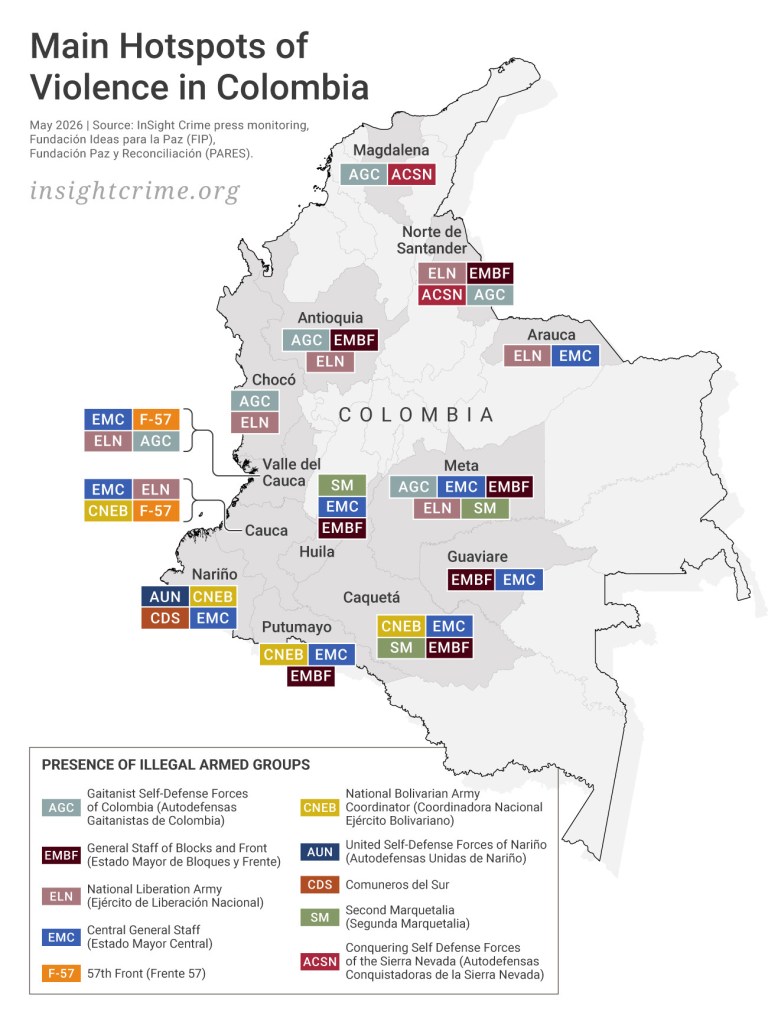
The incoming administration will have to manage more than 10 different regions currently engulfed by criminal conflicts, especially the departments of Valle del Cauca, Cauca, Nariño, Putumayo, Huila, Meta, Chocó, Antioquia, Bolívar, Norte de Santander, Magdalena, Arauca, and Guaviare.
“There needs to be a strategic prioritization depending on the capacities or the threat that these groups present to focus resources on those spaces where communities are caught in the middle,” González told InSight Crime.
Social Control and Criminal Pressure Hit Local Communities
An uptick in territorial disputes and attempts to impose greater control over local communities has been the main consequence of the fragmentation of Colombia’s armed groups.
The Catatumbo region on the Colombia-Venezuela border is the clearest example of this. Since January 2025, more than 100,000 people have been displaced amid ongoing clashes between crime groups as part of an unprecedented humanitarian crisis.
Since then, communities have been victims of confinement, massacres, and targeted killings amid constant fighting between the ELN and the 33rd Front of FARC dissidents, which operates under the umbrella of the EMBF.
This dynamic can also be seen elsewhere in Colombia. Increased confrontations and constant threats from criminal groups have led to an evolution in the relationship between these groups and local communities. While they previously had a degree of legitimacy within communities, today they use force to impose social control and leave no room for negotiation, according to several international organizations monitoring this situation.
Technological advancements like the use of drones have changed the rules of the game and brought new fears and dangers for civilians. Drones are used by armed groups to surveil communities, but in the departments of Cauca, Valle del Cauca, and Nariño, they also pack drones with explosives to attack security forces. However, the civilian population has often borne the brunt of these attacks.
A Cocaine Boom and Record Gold Prices
Colombia is the world’s top cocaine producer, and despite just being one part of that global trafficking chain, the country’s armed groups are reaping huge profits.
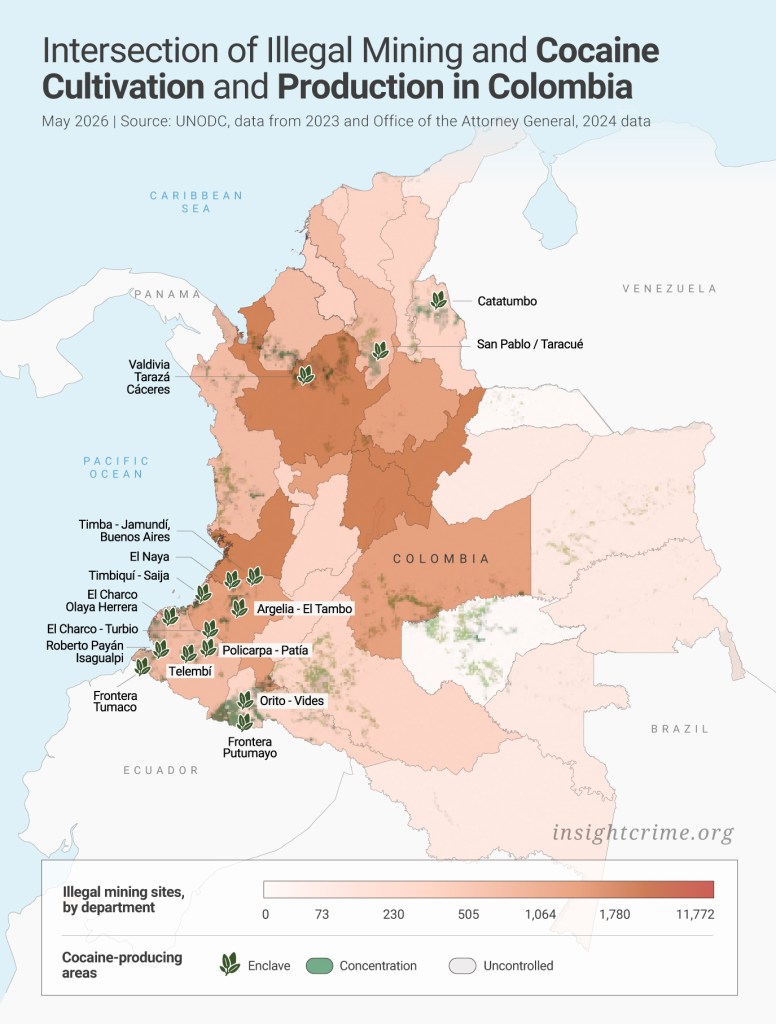
The Petro administration made a point of intercepting drug shipments and destroying processing labs and other infrastructure used to produce the drug. However, coca cultivation continued to grow from 253,000 hectares in 2023 to 262,000 in 2024, according to the latest available data. Potential cocaine production also rose from 2,664 metric tons in 2023 to more than 3,000 in 2024, according to United Nations data cited by the newspaper El País.
But while cocaine trafficking continues bringing in record profits for crime groups, illicit earnings from the illegal gold trade are not far behind. Record gold prices have led groups like the Gaitanistas, ELN, and FARC dissidents to expand their involvement in illegal mining in Chocó, the Bajo Cauca region of Antioquia, and much of the Amazon. In these areas, criminal groups extort money from both legal and illegal miners in exchange for protection, supplies, and help evading law enforcement.
In addition to cocaine and illegal gold, extortion and kidnapping have continued rising and represent important income streams that help sustain organized crime groups.
A Weakened Military Force
In recent years, the operational capacity of Colombia’s armed forces has continued declining due to several factors.
On the one hand, Petro’s arrival to the presidency in 2022 came with a security force purge that saw dozens of high-ranking officers removed. While some were due to alleged ties to organized crime, others were ousted for no apparent reason. Between 2022 and 2024, 355 police officers were removed. In 2025, the Colombian National Police had its lowest number of officers in 15 years, with just over 680 across the ranks of general, colonel, and lieutenant colonel. The same thing happened in the army: between February and April 2026, 49 colonels and majors were let go.
The size of Colombia’s security force has been declining for years. And although it remains within the international standard of 300 active members per 100,000 inhabitants, between 2008 and 2024, the number decreased by 25.8% from 682 to 506, according to data from the Ideas for Peace Foundation.
Purging the highest levels of the security forces has directly impacted their operational capabilities. High-ranking officers are responsible for planning complex operations, such as those involving military and police intelligence used to target transnational criminal operations. While recruitment drives continue, operational deficiencies continue as the void left by the departure of top officers is proving increasingly difficult to fill.
“Regardless of who assumes the presidency, they will have to confront this imbalance between criminal groups and security forces,” said González from the International Crisis Group. “We are talking about an overstretched force, working at the limit of its capacity. Whoever comes in will have to figure out how to restore this balance.”
An Uncertain US Relationship
The United States has long been Colombia’s main ally in the fight against drug trafficking and organized crime, but that relationship reached its lowest point last year.
Differences between Petro and US President Donald Trump regarding security cooperation came to a head when the United States added Colombia to its list of countries it deemed to be failing to cooperate in the fight against drug trafficking. The US Treasury Department later sanctioned Petro and several members of his family and Interior Minister Armando Benedetti.
Although tensions eased after a meeting between both presidents in February 2026, security cooperation with the United States remains a key issue ahead of the presidential election.
“We’re talking about a government that’s going to inherit almost 30,000 members of armed groups,” said Gerson Arias, a research associate at the Ideas for Peace Foundation. “Whether from the left or the right, there has to be a significant push to rebuild the security strategy, and that means talking with the United States.”
SEE ALSO: Winner of Colombia-Ecuador Trade War Could Be Organized Crime
The next government will have to define cooperation strategies in a context where Trump exerts outsized influence on regional security dynamics. In this context, the relationship that Colombia establishes with the United States could also shape security coordination with countries like Ecuador and Venezuela, key players in the fight against organized crime.
Featured image: InSight Crime Deisgn Team


Don't Miss:
-
A Total of 13 Mass Graves Have Been Found in Viesca Containing the Charred Remains of Men and Women
-
Jorge Luis Zambrano, alias “Rasquiña”
-
El Taliban Fell In Mazatlán… And What He Confessed Ties Everything Together
-
Inside the Camp at the Heart of Honduras’ Garífuna Land Struggle
-
This Is How the MataZetas Captured and Executed the Zetas