
 Trump administration gave firm with ties to ballroom donor the green light to do business with a sanctioned Russian bank
  Claire Sylvia on the Constitutionality of the False Claims Act
  School shootings in the Philippines put gun access under scrutiny
 By: Khanh Vu Duc
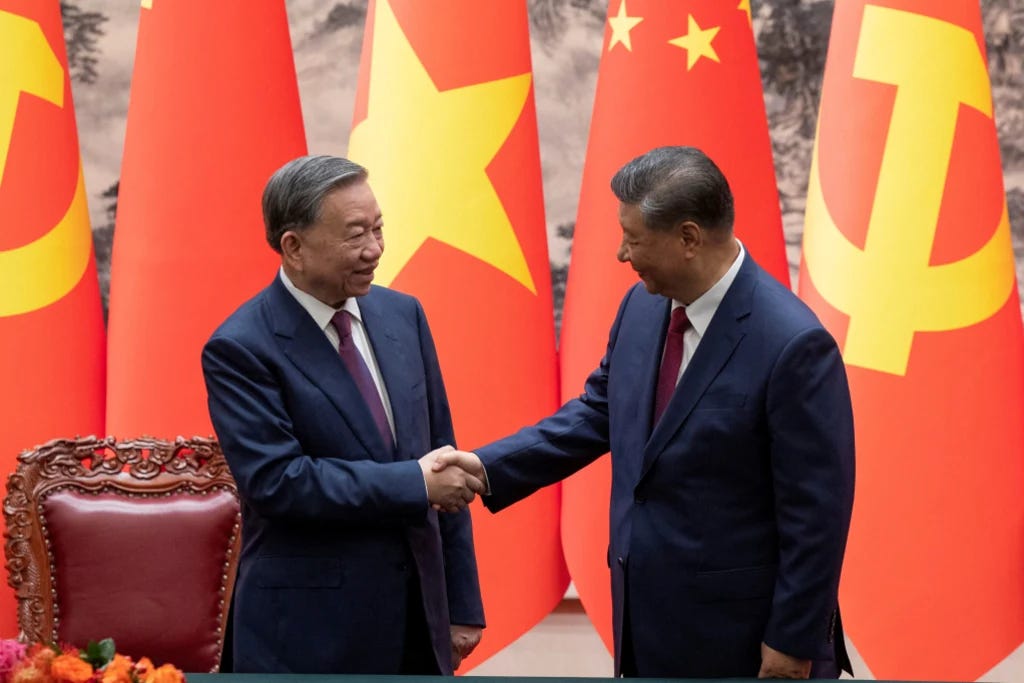
Hanoi is calling it “new momentum.” As General Secretary and President Tô Lâm arrives in Beijing this week for his first overseas trip after consolidating the top two leadership posts, Vietnamese state media are framing the visit as a triumph of prudent diplomacy. They speak of record bilateral trade reaching US$256 billion in 2025, surging Chinese investment in electronics and electric vehicles, booming tourism, and maritime differences that are supposedly “properly controlled.” In the official narrative, Vietnam is wisely deepening ties with its giant neighbor while cleverly balancing with the West in a fractured world.
This comforting story serves the regime’s domestic needs, but it masks a dangerous reality. Far from creating durable momentum, the visit risks accelerating Vietnam’s structural absorption into China’s orbit at the worst possible moment, precisely when Washington is cracking down on supply-chain circumvention and recalibrating its Indo-Pacific strategy.
The Economic Illusion
Vietnamese officials proudly cite headline trade figures and new Chinese investments. Yet these numbers conceal a fragile asymmetry. Vietnam’s recent growth has relied heavily on exports to the United States, which account for more than 30 percent of its total outbound shipments. A significant portion of those exports consists of Chinese-origin components lightly processed or relabeled in Vietnam — the classic transshipment model.
Even after the US Supreme Court struck down many IEEPA-based reciprocal tariffs on February 20, 2026, American enforcement against circumvention remains aggressive. Customs and Border Protection, Section 301 investigations, and rules-of-origin scrutiny continue to target goods suspected of bypassing higher duties on Chinese products. Similar probes are intensifying in the EU, Canada, and Australia. Penalties for confirmed transshipment can still reach 40 percent under alternative authorities.
If agreements signed in Beijing this week deepen integration into Chinese upstream supply chains — through expanded joint ventures, shared technology standards, or new connectivity projects — Vietnam will be perceived less as an independent manufacturing hub and more as a convenient backdoor for Chinese goods. The consequences would be immediate and painful: stricter inspections, canceled orders, lost market share in the West, and a sharp slowdown in export-driven growth. The very engine that has powered Vietnam’s impressive GDP gains could stall, leaving the country more dependent on Beijing than ever.
Short-term gains in infrastructure or tourism cannot offset this structural vulnerability. Hanoi is betting that deeper economic ties with China will deliver technological upgrading and sustained growth. The evidence suggests the opposite: greater reliance on Chinese inputs risks locking Vietnam into the lower tiers of regional value chains dominated by its northern neighbor.
The Strategic Signal
The optics of the visit compound the risk. Coming immediately after Tô Lâm’s consolidation of party and state power in a configuration reminiscent of Xi Jinping’s model, the warm “comrade and brother” framing in Beijing sends a clear message. In Washington, Tokyo, Canberra, and Brussels, it will be read not as sophisticated bamboo diplomacy but as narrowing strategic autonomy.
Nowhere are the stakes higher than in the South China Sea. Hanoi insists disputes are being “properly controlled,” yet Chinese coast guard and maritime militia vessels continue to harass Vietnamese fishermen and obstruct energy exploration activities. Any new agreements that emphasize bilateral management over firm adherence to the United Nations Convention on the Law of the Sea (UNCLOS 1982) and multilateral pressure risk being interpreted as tacit acquiescence. This directly threatens Vietnam’s sovereign rights, fisheries resources, and potential hydrocarbon reserves — assets vital to its energy security and coastal economy.
In the broader context of America’s “maximum pressure” campaign under the VIC framework (Venezuela–Iran–Cuba), such signaling is especially ill-timed. As the United States and its partners actively friend-shore critical supply chains away from China, Vietnam’s attractiveness as a diversified, rules-based alternative diminishes if it appears to be tilting too far toward Beijing.
The Domestic Trade-Off
At home, the visit also serves a clear political purpose: legitimizing recent power centralization. But genuine long-term stability requires more than decisive leadership at the top. It demands robust internal feedback mechanisms capable of detecting and correcting policy errors before they become structural traps. Concentrated authority may speed up decisions, but it often narrows debate and weakens the very institutional resilience a middle power needs when navigating a giant neighbor.
History offers sobering lessons for countries in Vietnam’s position. Over-reliance on a single dominant partner rarely produces sustainable autonomy. Vietnam’s own “bamboo diplomacy” earned international respect precisely because it preserved flexibility and avoided visible over-dependence.
None of this means Vietnam should shun pragmatic engagement with China. Trade and cooperation in non-sensitive areas can and should continue. The issue is the terms and safeguards. Real “new momentum” would require verifiable technology transfer rather than assembly-line dependence, strict compliance with rules of origin to protect Western market access, unambiguous public commitment to UNCLOS, and accelerated diversification of both economic and security partnerships.
If this week’s summit deepens structural integration without parallel safeguards, the celebrated “new momentum” may prove illusory — and costly. The bamboo that has bent without breaking for decades risks becoming entangled in China’s web.
Western policymakers should continue to engage Vietnam as a pivotal middle power in Asia’s supply-chain realignment and maritime balance. But they must do so with clear eyes. Partnership cannot be taken for granted. It must be earned through transparency, compliance, and credible strategic independence.
Hanoi may celebrate another successful summit. The real test will be whether Vietnam emerges stronger and more autonomous — or quietly more constrained.
Khanh Vu Duc is a frequent contributor to Asia Sentinel. He is a lawyer and part-time law professor at the University of Ottawa who researches on Vietnamese politics, international relations, and international law.
Don't Miss:
-
Trump administration gave firm with ties to ballroom donor the green light to do business with a sanctioned Russian bank
-
Claire Sylvia on the Constitutionality of the False Claims Act
-
School shootings in the Philippines put gun access under scrutiny
-
Statement on missing ICIJ journalist Micah Reddy
-
TRANSCRIPT: ‘China Retains Levers for Long-Term Territorial Ambitions’