
 From Iran to China: An Emerging Trans-Central Asian Corridor
  New documents show how a retail chain’s sales practices helped put guns on US streets
  Singapore a battleground of commodities fraud lawsuits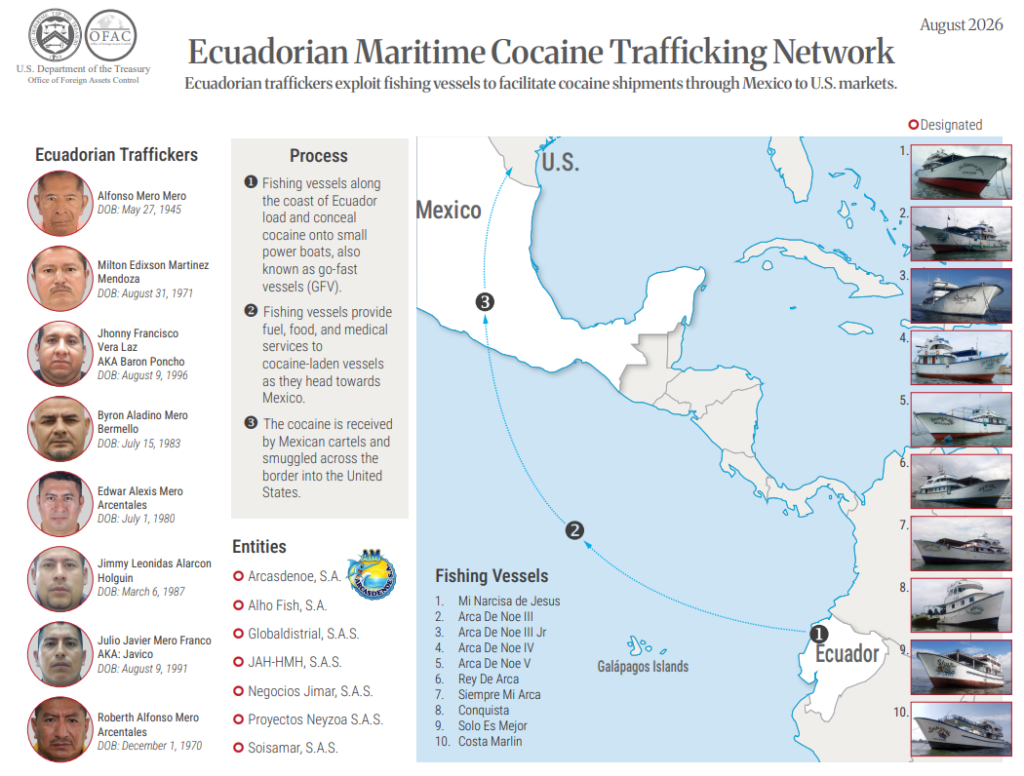
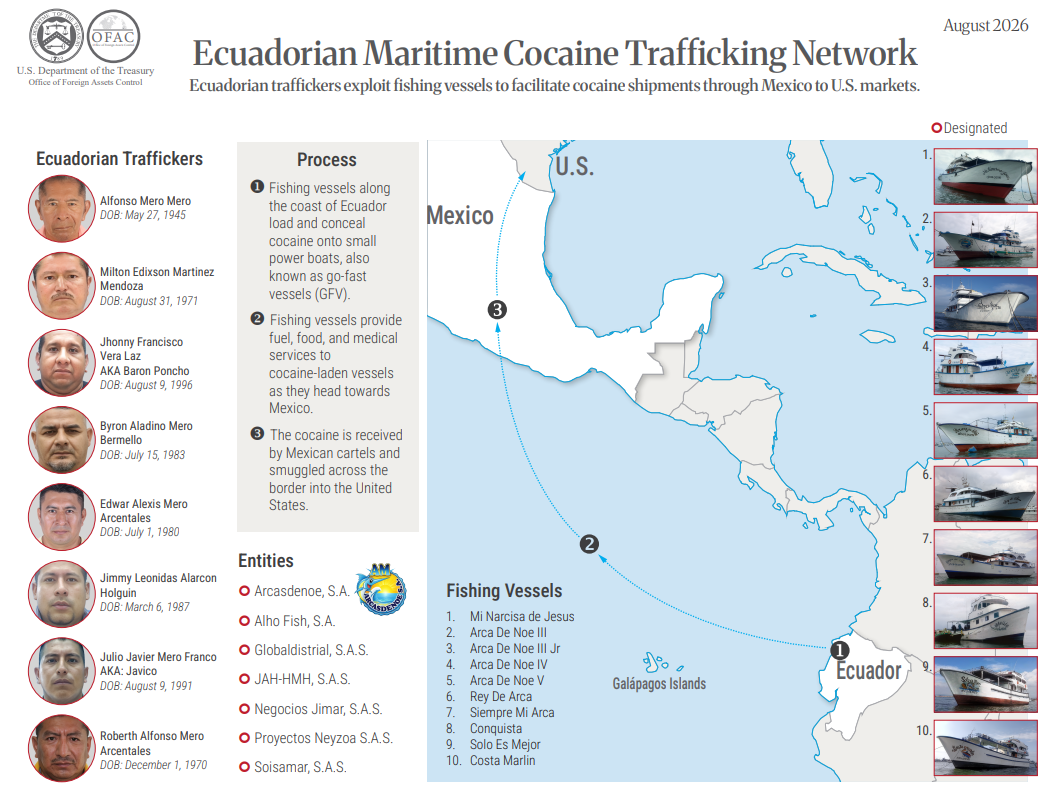
On August 20, 2026, the U.S. Department of the Treasury’s Office of Foreign Assets Control (OFAC) targeted an Ecuador-based cocaine trafficking network comprising 15 individuals and entities and identified 10 Ecuador-based fishing vessels allegedly used to support cocaine trafficking operations. According to U.S. authorities, these vessels use government-subsidized fuel to provide refueling, food, and medical services to cocaine-laden vessels at coordinated locations across the Eastern Pacific Ocean (EPAC), providing logistical support along one of the primary maritime corridors used to move cocaine from South and Central America toward Mexico and the United States.
According to U.S. authorities, the criminal network operates under the cover of legitimate fishing businesses based in Ecuador, using fishing vessels to support and transfer cocaine to small powerboats—known as go-fast vessels—that transit north through the Eastern Pacific Ocean (EPAC) toward the United States. Payments to crew members have reportedly surged, with participants now receiving between $15,000 and $40,000 per shipment, demonstrating the increasing economic incentives used to recruit civilians and integrate legitimate maritime personnel into criminal logistics.
The sanctions form part of a broader U.S. effort to disrupt cocaine trafficking through the Eastern Pacific by attacking both the financial and operational infrastructure supporting maritime trafficking. While OFAC targets the individuals, companies, and assets facilitating these networks, the U.S. Coast Guard has conducted Operation Pacific Viper, deploying aircraft and tactical teams to interdict, seize, and disrupt cocaine shipments at sea. According to U.S. authorities, as of June 2026, the operation had seized more than 225,000 pounds (approximately 112 tons) of cocaine in the EPAC.
The Importance of Ecuador for Cocaine Trafficking
Ecuador’s geographic position between Colombia and Peru, two of South America’s largest cocaine-producing countries, combined with its four major ports—Guayaquil, Manta, Puerto Bolívar, and Esmeraldas—has made the country a strategic hub for cocaine shipments moving through the Eastern Pacific Ocean toward the United States and Europe. Its geographic location within these international trafficking routes has also created opportunities for major Mexican criminal organizations involved in cocaine distribution, particularly CJNG and the Sinaloa Cartel, to establish relationships with Ecuadorian criminal organizations.
This situation has contributed to the fragmentation of one of Ecuador’s major criminal organizations, Los Choneros, from which an Ecuador-based splinter group known as Los Lobos emerged. Each group has aligned itself with a major Mexican drug cartel: Los Choneros with the Sinaloa Cartel and Los Lobos with CJNG. These competing alliances have connected Ecuadorian criminal groups to broader transnational trafficking networks and intensified competition over ports, trafficking corridors, and local territory, contributing to levels of violence increasingly comparable to those seen in some regions of Mexico.
Pressure, Disruption, and Adaptation
Ecuador remains a key transit hub for cocaine trafficking networks supplying global markets, with cocaine seizures at sea rising to 124 tons, compared with 99.4 tons in 2025. The increase demonstrates the enormous scale of cocaine moving through Ecuadorian maritime routes, although higher seizures do not necessarily indicate a decline in trafficking itself; they may reflect stronger interdiction efforts, increased cocaine flows, or both.
The sanctions also come amid broader counternarcotics developments involving Mexico and the United States, including a major security operation by Mexican forces in Michoacán, home to the strategic port of Lázaro Cárdenas; Security Secretary Omar García Harfuch’s visit to the United States; and the beginning of the U.S. midterm election campaign. While these events are not necessarily part of a single coordinated campaign, together they illustrate how pressure is being applied on multiple fronts to weaken Mexican criminal organizations. With cocaine representing a major source of illicit revenue, alongside proceeds generated through activities such as huachicol, these actions suggest an effort to economically disrupt criminal organizations by targeting multiple revenue streams.
These developments also carry a political dimension. The U.S. government has an incentive to demonstrate that increased pressure on cocaine-producing and transit countries in Latin America is disrupting drug flows toward the United States, particularly as the country approaches its midterm elections. At the same time, the Mexican government faces pressure to demonstrate tangible results against major criminal organizations and the financial networks that support them, particularly CJNG and networks involved in huachicol. The growing number of operations, arrests, sanctions, and seizures therefore makes the pressure currently being applied against CJNG increasingly visible.
However, increased seizures and sanctions do not necessarily translate into a permanent reduction in cocaine flows into the United States. Maritime trafficking networks have historically adapted to pressure from different governments by changing departure points, transit routes, vessels, and logistical partners. Pressure on Ecuador’s Eastern Pacific networks could therefore disrupt existing routes while simultaneously encouraging traffickers to develop alternative corridors elsewhere in the region.
Sources: ofac.treasury.gov – home.treasury.gov – state.gov – insightcrime.org

Don't Miss:
-
John Lee promises ‘high-quality’ experience for Apec finance meeting guests
-
John Lee urges public to tune in to Legco debate on city’s 5-year plan, policy address
-
Hong Kong prepares reforms, accountability measures ahead of Tai Po fire report
-
Turkmenistan grows its arsenal of Chinese air defences as Russia’s role shrinks
-
India sizes up US F-35 stealth jets in landmark first on home turf