
 New documents show how a retail chain’s sales practices helped put guns on US streets
  Singapore a battleground of commodities fraud lawsuits
  From Propagandist to Criminal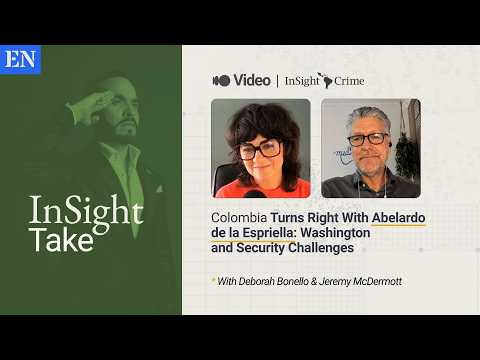
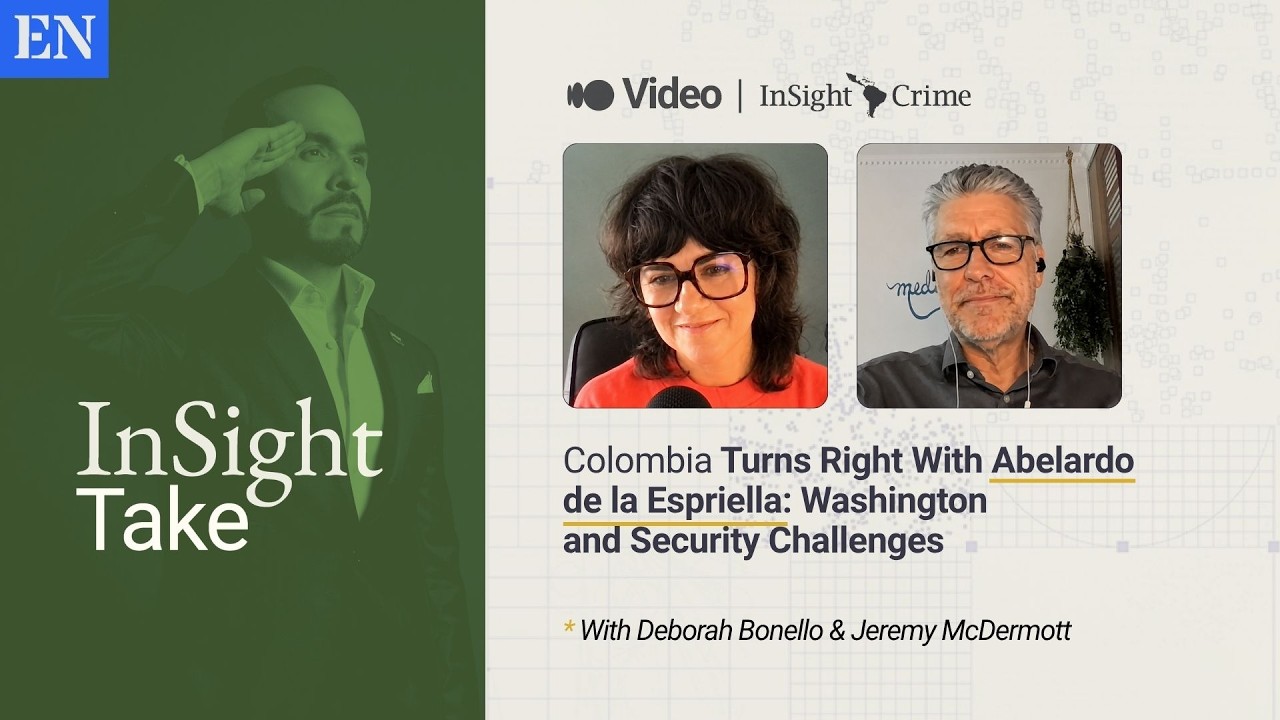
The winner of Colombia’s presidential elections, Abelardo de la Espriella, promised to stop negotiating with guerrilla armies and to unleash the country’s experienced security forces against criminal groups there during his political campaign. But will the Trump-aligned president-elect keep his promises when he takes office in August? And will his plan help, or hinder, the country’s organized crime panorama?
Transcript
Deborah: [00:00:00] Colombia has elected Abelardo de la Espriella, a hard-line, Trump aligned candidate, as its next president, set to take office in August. He’s promised to end negotiations with armed groups, rebuild the security forces, eradicate coca, construct mega prisons and take the fight directly to Colombia’s illegal armed actors.
Deborah: [00:00:23] But campaign promises are one thing. Colombia’s complex security reality is something else. I’m Deborah Bonello, and I’m joined this week on the insight take by our co-director Jeremy McDermott, who has lived in Colombia for almost 30 years, to talk about the country that Abelardo will inherit, what he has actually proposed and what pressure Washington will put on him. Are Colombia’s peace accords now in danger, and are we looking at another Ecuador or something even more complicated? Colombia has some of the most sophisticated security forces in Latin America, decades of counterinsurgency experience and a long history of cooperation with Washington. But it’s also the principal producer of cocaine, and this feeds guerrilla groups and powerful drug trafficking networks, alongside illegal gold production and other criminal economies. And conflict has been continuous for more than six decades.
SEE ALSO: Our Criminal Profile of Colombia
[00:01:22] Let me ask you first, Jerry, Abelardo has promised a security offensive, but what is he actually facing when he takes office?
Jeremy: [00:01:32] Deborah, it’s arguably the most complex security panorama in the Americas. Colombia has not seen peace since 1964. First, it’s the Marxist rebels inspired by Cuba that took up arms against the state, and then they’re joined by right wing paramilitary groups. And then, of course, we’ve got the the the different drug trafficking organizations woven amongst them and independent. And the state has sometimes been little more than a spectator to the violence. So many of these groups still exist today in some form or another, be they Marxist, guerrilla or right-wing paramilitaries. They’re all funded by illegal economies which are booming and headed, of course, by the cocaine trade.
Jeremy: [00:02:23] Let’s have a quick snapshot of where we are now and the current Colombian president, Gustavo Petro. He’s a former guerrilla, and during his almost four years now in office, we’ve seen the security situation worsen. Although to be fair, that started under his predecessor, Ivan Duque. But over the last few years, President Petro has sought to negotiate with all the different illegal groups in what he called his total peace plan – Paz Total. The result? The different criminal syndicates have grown in strength. They’ve taken advantage of of not only the peace dialog, but the ceasefires that came with it. The cocaine trade has continued to grow, providing funding for this criminal expansion. To give you an idea in numbers terms, when Gustavo Petro took office in 2022, there were roughly 15,000 members of the different illegal armed groups around the country. At the end of last year, that number, according to the most reliable estimates based on security force intelligence, was 27,000. That’s a growth of more than 60%. That is the current panorama.
Deborah: [00:03:47] Yeah. So is that the major threat that Abelardo has to deal with or talk talk us through what he’s looking at now.
Jeremy: [00:03:55] I think we always have to start with the booming cocaine trade because it underpins all the kind of criminal infrastructure, even though many of Colombia’s drug trafficking organizations have diversified into gold, human smuggling, human trafficking, extortion, etc., etc., it’s cocaine that underwrites everything. As far as the groups he faces, perhaps the most powerful at the moment are the Gaitanistas, also known as the Gulf Cartel. Their roots go all the way back to the Medellin cartel, Deb so you see their stock. They number around 10,000. Now, they’re a pure drug trafficking organization although they claim a political facade. They’re dominant in the northern part of the country, particularly the Caribbean coast and of course, all the departure points for drug trafficking that comes from that. And they’re pushing down Colombia’s Pacific coast quite aggressively.
Jeremy: [00:05:03] Their nearest rivals are the National Liberation Army, or the ELN. About 6000 strong. This is a battle hardened Marxist rebel group. They date all the way back to 1964 with their founding. Their greatest strength is along the Colombia-Venezuela border and actually within Venezuela as well, which is a separate issue altogether, although their status in Venezuela may be under question a bit after the abduction of former president, former Venezuelan President Nicolas Maduro.
Jeremy: [00:05:43] Next on Colombia’s list are the dissidents from the once mighty Revolutionary Armed Forces of Colombia, the FARC, another Marxist group that signed a peace deal in 2016 and demobilized in 2017. But what happened is it atomized into different dissident groups, roughly four or a wee bit more. And between them they number up to 9000 fighters. And then, of course, we’ve got innumerable smaller drug trafficking organizations, street gangs and specialized criminal groups like those that run drug laboratories or build semi-submersibles and narco subs. So I think what the last 60 years of civil conflict has shown us is, first of all, there’s no one size fits all strategy for tackling all of these different groups and the criminal economies that feed them. The other thing it teaches us is that the purely militarized approach has not worked in the past. The greatest advances in security over the last 60 years have been made with a stick and carrot approach, a military pressure combined with negotiation. And that’s led to the demilitarization and demobilization of several guerrilla groups in. In 1991, the paramilitaries of the United Self-Defense Forces of Colombia in 2006, and then, of course, the FARC in 2017. So that that has been how we’ve got significant successes up to date.
Deborah: [00:07:30] And so is Abelardo going to continue with that, or what is he proposing to do when he takes office in August?
Jeremy: [00:07:39] Well, perhaps the first thing to say, Deb, is that there wasn’t a hugely detailed manifesto from Abelardo, much less a detailed security document, unlike his opponent, Ivan Cepeda, who produced 120 pages of different bits and pieces. For Abelardo, it seems a little bit more than a list of soundbites: No peace negotiations. Strengthening of the security forces which are to be unleashed against all the illegal groups. The creation of a search bloc like that which first appeared in the hunt for Pablo Escobar back in the 80s and 90s. But this is directed against extortion. And then the building of a series of mega prisons in the style of President Bukele in El Salvador, and then a very ambitious coca eradication problem to tackle the booming cocaine trade. That’s what we know. That’s what he’s listed.
Deborah: [00:08:51] So some of this is different Petro’s government, but is it new for Columbia and does it form a coherent security strategy?
Jeremy: [00:09:01] None of those elements we just mentioned are new. All of these strategies is laid out. They’ve been done before and they’ve been done before in tandem. The United States helped Colombia build a new generation of prisons or update existing ones. Now maybe they don’t count as mega prisons in the El Salvador style, but that may be because that violates standards about how much space each prisoner should get amongst a variety of other international norms. Coca eradication has long been a central strut of government policy, and Gustavo Petro was the exception on this one. Almost every president, certainly since the 2000s has had one form of eradication or other as a centerpiece of the strategy. So that’s not new.
Jeremy: [00:09:56] What has changed is that pre 2015, Deb, most of the eradication was carried out by planes, spray planes, you know, these crop dusters that could cover huge areas of ground, but of course the glyphosate chemicals, they spat out killed everything. And that was ruled as illegal by the Constitutional Court in 2015. So Colombia then moved to eradicate manual eradication, which is a lot slower, a lot more expensive, takes a lot more time.
[00:10:31] What Abelardo is proposing is it seems to use drones, which, you know, just fly just above the coca and, you know, perhaps we’ll be able to cover certainly a lot more ground than manual eradication. So sure, it’s a cohesive strategy of things that have been employed before. And it is a plan that’s in tandem with the messaging coming out of Washington at the moment. But perhaps the biggest question is where’s the money for all of this going to come from? Colombia has a significant fiscal hole which has hamstrung President Petro and many of his initiatives. And all of this is going to clearly require new resources. Abelardo has promised to slash the government by 40%, whatever that means. So maybe there will be some some money in there. But of course, the security forces count as part of a government, right, o I’m not entirely sure how he’s planning to turn this into reality.
Deborah: [00:11:41] Well, I want to pick up on the Washington angle. And, you know, we’ve seen a rocky few years between Colombia and the Trump administration. And now with the missile strikes on go-fast boats allegedly carrying drugs as well as the stated killing of the head of Aragua, Nino Guerrero, in Venezuela by the US and Venezuela that we talked about on last week’s InSight Take, is support from the United States going to be forthcoming. And could that make a difference to to the finance issue and the general kind of standard of the security response there.
Jeremy: [00:12:20] As we’ve talked about before, Deb, President Trump has radically changed the US approach to drug policy. He’s put war back into the war on drugs. He’s fuzed it with the war on terror and made the military the lead agency. And so it seems pretty clear that Abelardo directly tapped into this during his campaign, and he was rewarded with with President Trump publicly supporting his candidacy. But you’ve got to remember that since 1999, and the announcement of Plan Colombia, Colombia has been receiving billions of dollars in US aid.
Deborah: [00:12:59] That’s right.
Jeremy: [00:12:59] And that aid was actually cut last year by President Trump. Now, some of that came back online and some more may come back online, maybe even bring it up to the previous levels of last year. But are we expecting President Trump to sign over, you know, tens, hundreds of millions of dollars to Colombia? I’m not sure that is hugely likely. And so I doubt that even if the funding came up to last year’s, you know, levels or what were slated before the cuts, I don’t think it’s going to be enough to move the dial in terms of of resources and spending. Another thing, you know, you mentioned the bombings, be it the boats, many of which come from Colombian waters, or be it the bombardment of Nino Guerrero, you know, in on land. Colombia’s been doing this for years, and I suspect US intelligence has played an important role in these bombings, which go back several administrations. But as President Petro found out, when you bomb, particularly a dissident guerrilla camp, or a guerrilla camp in Colombia, you’re going to hit minors, as they systematically recruit minors. And we saw this in November 2025, where Pedro authorized a strike on a guerrilla camp in Guaviare, in the south of the country, and when the authorities moved in after the strike, they pulled out 20 bodies, of which seven were minors, you know. This obviously had enormous political blowback and implications. So Abelardo will almost certainly sign up for Trump’s security initiative for the region, which is called Shield of the Americas. He launched it in March this year. It’s designed to align Latin American and Caribbean countries with the US counterdrug and counter-terror strategy, which as we’ve said, is pretty much militarized and give us targets to bomb, but it also has migration aspects, which I’ve got a feeling the Colombian president elect might not be that enthusiastic about. So to sum up the US has been deeply involved in Colombia for the last more than 20 years, and it’s been steering an enormous amount of money into the country, which was cut under President Trump. So I don’t think that having a more friendly president to Washington is going to suddenly unleash unprecedented amounts of money for Abelardo to spend.
Deborah: [00:16:21] And there is an obvious comparison here with Ecuador. And of course, over the last decade, we’ve seen drug related violence and trafficking explode there. And President Daniel Noboa has embraced a militarized strategy with strong support from the United States. Are we looking at another situation like that in Colombia?
Jeremy: [00:16:48] There seemed to be similarities in the rhetoric. You know, war, terrorists, exceptional measures, prisons. The security cooperation, unleashing the military. Colombia’s not Ecuador. Colombia’s security forces are amongst the most capable in the Americas, perhaps the most capable in Latin America and the Caribbean. They’ve got decades of experience in counter insurgency, jungle warfare, all arms combined operations, intelligence, fusion, special ops, air mobility, and of course, the joint operations in a variety of forms with different US agencies. Ecuador’s got nothing like that kind of experience or capacity. And while it’s still relatively early days for for President Noboa, his strategy so far seems to have fragmented some of the bigger Ecuadorian crime groups that we cover, like the Choneros and the Lobos.
Jeremy: [00:17:45] But it’s done nothing to reduce the violence, nor does it seem to really dent drug trafficking through the country. Indeed, as you remember in our annual homicide roundup that we published earlier in the year, Ecuador registered record levels of homicides. It’s one of the most dangerous places in the region now. Over 50 homicides per 100,000 of the population for 2025, up from 8 in 2020. So, you know, there are some hard facts about a militarized approach. Colombia is likely to adopt the rhetoric because Abelardo has been using it on the campaign trail. We’re already there. Unleashing the military appears likely. What we need to drill down on what exactly that means. We’ve also got to remember that the Colombian military has a very spotty human rights record but I’m not sure how much that will worry Abelardo, nore actually Washington under the current administration. And there does seem to be this mindset not just from Abelardo, but from the United States and obviously reflected in places like Ecuador, that criminality can be bombed out of existence. In Colombia, that wasn’t true during the height of the civil conflict when we moved to thousands of guerrillas uniting in actions. And we had thousands of paramilitaries fighting for territory. That’s just not the case today. Well, first of all, the military approach didn’t work then. And today we don’t have those massive illegal armies uniformed in a war of positions. And the Gaitanistas, you know, the most powerful group, they live amongst the civilian population. They seldom wear uniforms. And even with ELN camps, as we’ve seen in Venezuela during field research in December last year when there was a threat of US missile strikes in Venezuela, as you remember, the USS Gerald Ford and this enormous American flotilla of ships stationed itself off the off the coast of Venezuela.
Jeremy: [00:20:01] And the Colombian guerrillas immediately broke down their camps in Venezuela and disappeared into the civilian population. They’re not stupid. They see the writing on the wall and they act accordingly. What’s this going to do? It’s going to strengthen criminal governance. And by this we mean where illegal groups take over certain roles of the state in area they dominate, like security, like justice, like taxation through extortion. And one of the issues that’s bedeviled Colombia all the way through its history since independence has been the fact that several parts of the country have never really had state presence. Especially the southern and eastern jungles, which have historically been under guerrilla influence. And the only state presence that people in those areas have seen has been repression, which has pushed the local population into the hands of the illegal actors. And you know, when we talk about how random bombings that might involve civilian casualties, you kind of see a rinse and repeat of previous errors.
Deborah: [00:21:18] Yes, yes. And talking about the civilian population, what do you think are going to be the the official targets of bombardments and direct military action?
Jeremy: [00:21:29] Well, we’ve got the example of the go fast boats already. And many of them have come out of Colombian waters. So that would continue perhaps step up. The drug laboratories. There’s two types of drug laboratories, as you know, Deb. One of the so-called cocinas, or kitchens, that lie alongside the coca fields, that’s where they take the harvested coca leaves and they turn them into coca base. And these are basically a shack with a with a concrete floor where they strim the coca leaves and there are drums of petrol and some chemicals which they use to precipitate the alkaloid and they turn that white slush into coca base. Then there’s the next stage. To set up a cocina or a kitchen that’s a few hundred bucks, Deb. This is not a major infrastructure investment.
[00:22:24] The next stage of the crystallizing labs, which produce the crystallized cocaine. They’re a bit more sophisticated. There’s more chemical washes. You’ve got the micro the microwave ovens. But these are mobile these days as well. They tend to be erected in a place where a lot of coca base has been gathered. They will process that, turn it into cocaine, they dismantle the lab, and then they move to another area where there’s coca base waiting for them to to transform. So, you know, this isn’t also permanent and easy targets to find.
Jeremy: [00:22:57] And even assuming you can find all of these kitchens and all of these labs, which they clearly can’t, what are you going to launch? A thousand missiles at all of these with countless civilian casualties? I mean, the Colombian public wants a hard line on crime, but I don’t think it’s going to stomach strikes, missile strikes or bomb or, or dropping bombs on, on various different types of drug infrastructure that will kill hundreds and likely civilians amongst them. Another aspect of the drug trade, of course, the shipyards that build the Semi-submersibles and the drug subs, they’re also in the jungle, usually in the mangroves along along the coast. They’re not permanent structures. They’re temporary structures. They build the fiberglass or occasionally the metal, semi-subs or even fully submersibles. They’re launched and then, you know, the shipyard gets dismantled. If the Colombian security forces knew where they were, they’d already be hitting them with heliborne troops, so it’s not like, hey, we know where they all are, all we got to do is take them out. And then, of course, there are the so-called high-value targets like Guerrero that we talked about last week of Aragua. What are they going to do if they think they’re going to be targeted in missile strikes? They’re going to set up in remote hamlets or villages in the knowledge that even a hardline president cannot kill Colombian civilians with impunity.
Jeremy: [00:24:32] What’s been more effective in Colombia is this integrated whole of state approach that Columbia, with US backing, has actually been very effective at. It’s not just the military pressure and the actions against the leadership and the inner circle. The legal offensives against the proceeds of crime and money laundering are, the expropriation of assets, extradition, of course, but it’s been combined with social work and economic investment in the areas of criminal influence, bringing not just the hard and repressive face of the state, but health and education and roads, etc.. And guess what? You know, history has shown that even the most powerful criminal forces in the Americas and indeed arguably in the world, have taken that deal. The paramilitaries demobilized 30,000 fighters, Deb. The FARC more than 13,000 fighters. And so this is where rhetoric meets reality. And we’re actually going to find there are a very limited number of targets for a purely militarized approach, and if they start hitting them, organized crime will adapt accordingly and move them yet closer to civilian dwellings. And if there’s no chance of a negotiated solution, do armed groups and criminal groups just pack up and go home? It’s never happened yet in Colombia, especially while the criminal economies remain intact. And undermining them is more than just trying to eradicate every coca bush you can find.
SEE ALSO: GameChangers 2025: Colombia’s Total Peace Remains in Pieces
Deborah: [00:26:08] Right. And Abelardo hasn’t just promised a hard line security strategy and upping eradication. He’s also threatened Colombia’s peace architecture right? Past and present. So are Colombia’s peace accords, which were signed ten years ago. Is that over?
Jeremy: [00:26:27] There are several different aspects to the peace dialogs that Abelardo campaigned on. The main one was the present strategy of Gustavo Petro. You know, we’ve talked about this Total Peace, or Paz Total, which apart from a couple of small demobilizations and the handover of some weapons, has achieved very little. And it doesn’t have a major legal framework. And so I think Paz Total is dead or mortally wounded. And Abelardo said he doesn’t want to negotiate with criminal groups. And everybody’s a criminal group. He doesn’t recognize that Colombia is in a civil conflict, and that guerrillas or others might have any kind of belligerent status as laid out under international law. So talks with ELN, FARC, dissident factions, etc., would likely, those that are still ongoing will likely be frozen or reduced or terminated.
[00:27:30] You mentioned the the 2016 agreement with the FARC. That’s a different gig altogether. This isn’t about the president. This has legal, institutional and constitutional weight. Agreements were signed. Commitments were made about around transitional justice, reintegration, political participation, victims rights, etc., etc.. And it’s underwritten by the international community. Now, that doesn’t mean that Abelardo can’t damage it or undermine it. He can starve it of government funding that much of it is still funded by the international community, but nowhere near all. And the architecture is protected by the courts. He can’t dismantle that. But what he can do is hamper and undermine its workings. And that’s the danger. The accord may survive legally, but he’ll hollow it out politically and practically. And of course, this will further weaken the chances of any future negotiations as it becomes clear that, you know, that a new president arrives opposed to any signed agreements. Everything could be changed, or at least fundamentally undermined, and that means that who’s really going to negotiate in earnest if it can all be ripped up in the future?
Deborah: [00:28:51] Well, finally, Jerry, let’s give Abelardo the benefit of the doubt for a moment. Now, what, in your view, would a serious and effective security strategy look like under his presidency?
Jeremy: [00:29:06] Let’s be glass half full and look at the improvements he could make. The security forces at the moment are demoralized. Most were not that happy serving under a former guerrilla to start with, particularly one who made his career on on criticizing them. His political career. And one of the first things he did when he did come to power was to fire dozens of generals from the army and the police, and decades of experience in leadership were lost. Then the military were afraid that even if they did take the initiative and, you know, undertook operations that resulted in deaths, they would be investigated because Petro made this political career denouncing security force abuses and human rights violations. Then Petro tied one of their hands behind their backs with the Total Peace process and a series of ceasefire agreements that meant they couldn’t, you know, fight against, illegal actors. And these ceasefire agreements were abused, actually, Deb, almost without exception, by the warring factions, which must also have been pretty dispiriting for the security forces. So they’re definitely going to heave a huge sigh of relief as Petro departs the political stage. They’ve been promised more resources, political backing and a freer hand. And all of this will be welcome if it results in more motivated and resourced security forces acting in a kind of professional and measured way they’ve shown they can act. Pressure on the armed groups will become a reality. This, of course, hopefully will not come at the cost of human rights abuses and civilian casualties, and this is where, you know, we have the flip side of the coin, ok? BUt we’ll we’ll keep the glass half full, Deb, and the security forces have learned their lessons and they’re the most capable in the region. They’re not going to make the same human rights mistakes that they made before. The United States comes back online, as we’ve already discussed as a reliable partner, and opens the purse strings. Well, okay, that last bit, even with a glass half full, Deb is not really in Abelardo’s hands. And President Trump has made unpredictable unpredictability pretty much a cornerstone of his policy.
[00:31:26] But glass half full and the US delivers intelligence and resources that perhaps can move the dial. The issue of the prisons, I’m not really sure what more prisons is going to do in terms of changing the dynamics on the ground, or even the criminal dynamics, per se. And if Colombia incarcerated the same percentage of its population there that Bukele has done in El Salvador, then we’re going to have more than a million Colombians behind bars.
Deborah: [00:31:55] Nearly 2% of the population, I think, in El Salvador.
Jeremy: [00:32:00] And I think we’ve got to take a step back. And one we’ve got to remember, when I arrived in the country, Deb, in ’97, there was a real fear that Colombia was going to fall to Marxist guerrillas, or that the civil conflict would turn the entire country into an endless war zone. Registered kidnapings were at 20 a day. Massacres were commonplace. Half of the country was a no-go area for the state. Look at Colombia today. The country’s got super capable security forces, an effective judiciary. But it was really strong civil society, a free press, that ensured the country never stopped being a functioning democracy. Occasionally flawed. And there were times, I remember where hundreds of thousands, even millions of people took to the streets protesting against guerrilla atrocities called the No Mas, the No More movement, and it forced change. And it was this combination of military, legal, social, economic and political actions that pulled Colombia back from the brink and propelled it to where it is today, with yet another free election that we just saw. Razor sharp, razor thin margin between the two candidates, but no one’s doubting that Abelardo is going to take office and will be able to exercise his office without problem. So if he allows the Colombians to do their thing, protects democracy, civil society continues to strengthen the institutions of the state, then this hiccup in security progress that we’ve seen over the last six years will correct itself, and Colombia will continue its upward trajectory.
Deborah: [00:33:51] Well, it’s definitely one to watch. And of course, Colombia is one of our biggest and strongest areas of coverage. In August, Abelardo will take office and there are high hopes and pressing challenges. And will of course be watching all of those on the criminal fronts every step of the way. To those watching and reading, please don’t miss all of our profiles and analysis and investigations into the groups and dynamics and issues that we’ve talked about today. And you can find all of that on InSightCrime.org. That’s enough from us today. And Jerry, thanks very much for joining us.
Jeremy: [00:34:30] Thanks a lot, Deb.
Don't Miss:
-
Former American Idol singer Caleb Flynn sentenced to life in prison for wife’s murder
-
Bogota mayor presses Chinese-led consortium for more metro workers as auditors flag delays
-
ICC unseals arrest warrants for 4 Taliban leaders wanted on gender persecution charges
-
Quebec votes in provincial election as separatist surge poses test for Canada’s PM Carney
-
“Here, We Confront Drug Traffickers Daily… And The U.S.?”