
 New documents show how a retail chain’s sales practices helped put guns on US streets
  Singapore a battleground of commodities fraud lawsuits
  From Propagandist to Criminal
 America has a hidden justice system.
In that system, decisions are made in secret and judges are paid for by the corporations that are being sued.
Workers and consumers usually lose before these secret arbitration panels. And when they lose, they cannot appeal. And they cannot turn to real courts for help.
They are trapped in this system when they sign on to a streaming service or a job. They are unknowingly signing on to a secret justice system called forced arbitration. Through its secrecy and corruption, forced arbitration helps companies cheat their workers, helps banks deceive their customers, and helps predators act with impunity.
If companies and the very powerful often seem beyond the reach of the law, it’s because they are, and forced arbitration is the reason.
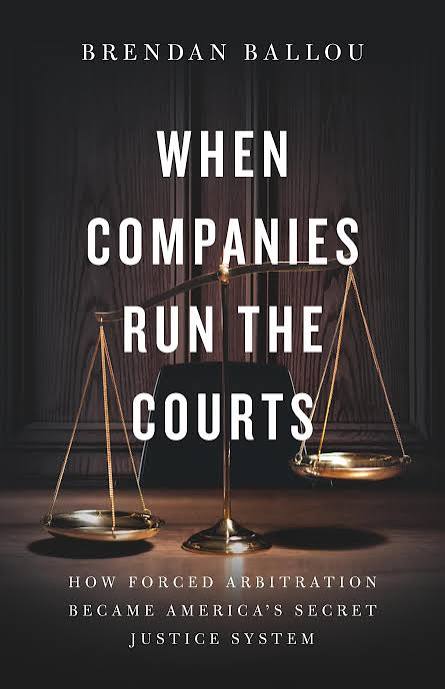
Brendan Ballou has now written an expose of this hidden justice system – When Companies Run the Courts: How Forced Arbitration Became America’s Secret Justice System (PublicAffairs, 2026).
A former federal prosecution, Brendan Ballou is CEO of the Public Integrity Project.
How did you come to write this book?
“I wanted to explain how our legal system favors big companies over regular people. I wanted to tell that story through this specific issue of forced arbitration,” Ballou told Corporate Crime Reporter in an interview last week. “I felt that if I could do that, I could explain how the legal system can bend toward the very powerful.”
If I want to sue a company for negligence, I will go to my local courthouse, go before a judge or a civil jury. If you looked at the ballpark of such civil lawsuits, how does it now compare to the ballpark of forced arbitration cases?
“At least in some years, there are more arbitration cases filed before large arbitration providers than there are civil cases in the entire civil court system,” Ballou said. “By some measures, it’s eclipsing the federal court system. But that actually understates the issue in a lot of ways. The problem isn’t just that people are getting forced into arbitration. It’s that forced arbitration kills cases entirely. People who should be bringing cases in one venue or another are unable to do so entirely because forced arbitration makes it fundamentally unfair and fundamentally unaffordable.”
When did forced arbitration begin?
“This is a story that began in the 1980s. There was this idea that we were facing a litigation explosion in the United States, a wave of frivolous cases that was bankrupting companies. But the evidence doesn’t match the story. And it’s not clear if that litigation explosion even happened.”
“Litigation in the United States is pretty much in line with litigation in most other countries. And yet that story was so powerful and pushed by such powerful interests, that there was a real effort in the courts, primarily by conservative judges, to push consumers and employees out of the court system.”
“And forced arbitration was the leading way to do that, in particular by making legally binding arbitration agreements between companies and consumers and employees – and by making those contracts of adhesion – those click to accept contracts that you sign every day – binding for forced arbitration as well.”
“The other thing that happened was that the Supreme Court reinterpreted the laws to allow people to be forced into individual arbitration. That means they could not bring a class action or a class like proceeding in arbitration.”
“That meant that suddenly, people who would normally join a class action where companies were stealing tens or hundreds or a few thousand dollars for lots of people, each person would now have to bring those cases individually.”
“That made bringing these cases unaffordable for all but the most expensive and deadly harms. So what we have is a Supreme Court that has reinterpreted the law to make arbitration pervasive in a way that was never intended to be.”
You also tell stories of individuals with serious injury cases who have been forced into arbitration.
“We tell the story of Jeffrey Piccolo. He and his wife went to Disney World. She had allergies and had to be careful about what she ate. According to a subsequent lawsuit, they were given repeated assurances from a restaurant that it was safe for her to eat at the restaurant. But it wasn’t.”
“She had an allergic reaction, went into anaphylactic shock and died. When Piccolo tried to sue Disney for wrongful death, Disney sought to move Piccolo into arbitration because, they said, among other things, that he had signed an arbitration agreement when he signed up for Disney Plus several years earlier.”
“It is remarkable that somebody can be compelled into arbitration simply because they had signed up for a streaming service. And Disney compelled Piccolo into arbitration for the death of his wife. And yet the law was very clear that this was the case.”
“Disney eventually backed off because of such overwhelmingly bad publicity nationally. They eventually returned to litigation and as far as I know, the case is still ongoing.”
“There are other cases. I start the book with the case of Jane Doe. She was a worker on a cruise ship. She was allegedly raped by one of her co-workers. She was forced to arbitrate her sexual assault case and to do so in the Phillippines because she had signed a forced arbitration agreement. We don’t know the outcome of the case.”
Are these arbitration settlements not public?
“Arbitration is overwhelmingly secret. The proceedings are secret. You can’t walk in or dial into an arbitration proceeding. The written decisions are not published. Typically, you can’t see what the judge ruled or why. And often, you can’t talk about the result of the arbitration.”
“So in a very literal sense, this is a secret form of justice.”
What about the constitutional right to a jury trial?
“There have been constitutional challenges but they have been unsuccessful. The Supreme Court has made it clear that you can contract away your right to a jury trial. I don’t necessarily agree with that decision. The Supreme Court says that arbitration agreements, no matter how unfair, even if they are unconscionable, will be enforced according to their terms.”
“The conservative justices have been absolutely adamant that forced arbitration is enforceable.”
You compare the outcomes in small claims courts, where consumers win up to 90 percent of the time, with these arbitration firms, where it’s down to 20 percent to 30 percent.
“The basic challenge that you have is one side is paying for the services and is appearing before these firms more than the other side.”
If I have a gripe in a small town in West Virginia against a local firm and I go down to small claims court, which is about ten miles away from me, my case will likely get removed to an arbitration panel?
“Yes. Forced arbitration is overwhelming and all encompassing. Eighty percent of Fortune 500 companies use forced arbitration with their customers and employees. Sixty million private employees have their employment governed by forced arbitration agreements.”
“All of this suggests that there is a good chance that the other side is going to compel you into forced arbitration. And they have enormous control over the process.”
Would forced arbitration force me into an arbitration panel in a big city far away?
“It depends, but it’s entirely possible. There was a case before the Supreme Court where a forced arbitration agreement was found enforceable. It was a dispute with a Subway shop in Montana. And as I recall, the arbitration was forced in Connecticut. This was back in the 1990s, when travel was a little trickier. And we were talking before about the Jane Doe case, where she was forced into arbitration in the Philippines.”
“Having arrangements that require a huge cost for just participating is certainly a strategy and one that the Supreme Court found to be permissible.”
[For the complete q/a format Interview with Brendan Ballou, see 40 Corporate Crime Reporter 25(14), June 22, 2026, print edition only.]
Don't Miss:
-
New documents show how a retail chain’s sales practices helped put guns on US streets
-
Singapore a battleground of commodities fraud lawsuits
-
From Propagandist to Criminal
-
On Indonesia’s fires, El Nino’s impact on the power sector, and other stories | Asia Sentinel Stories of the Week
-
WATCH: Inside the China Capital investigation — a live panel