
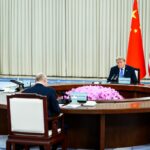
 Trump Enjoyed His Asian Spectacle. He Came Home Empty-Handed
 Medical device makers have gotten worse at disclosing when their products harm people, new study finds. The FDA let them.
 Anatomy of a Chinese loanbook
Three solid-state battery developers across China and the US are moving towards initial public offerings (IPOs), as geopolitical tensions and elevated oil prices fuel demand for more energy-efficient technologies.
Qingtao (Kunshan) Energy Development Group became the latest to join the queue, filing for a Hong Kong listing on April 8.
Earlier, Beijing WeLion New Energy began the pre-listing tutoring process ahead of a planned application to the Shenzhen Stock Exchange, while US-based Factorial Energy said it intended to go public via a special purpose acquisition company (SPAC) merger, which features a listed shell company set up for acquisitions.
Advertisement
Solid-state batteries, widely viewed as a potential successor to conventional lithium-ion technology, replace the liquid electrolyte with a solid material. This reduces fire risk while offering higher energy density and longer driving range.
Yet significant hurdles remain. High production costs and the technical challenge of maintaining stable contact between solid layers during repeated charge cycles have so far limited large-scale commercialisation.
Advertisement
Founded in 2016, Qingtao focuses on deploying solid-state batteries in electric vehicles (EVs) and energy storage systems (ESS). It was the world’s largest producer of solid-liquid hybrid and all-solid-state batteries by shipment volume in 2025, according to its prospectus, citing Frost & Sullivan.


Don't Miss:
-
FBI Most Wanted “Chapo Isidro,” Leader of BLO/Guasave Cartel Arrested in Sinaloa, “El Musico” Possibly Killed
-
DEA’s #FugitiveFriday asks for tips on “El Tano” García Corrales, found dead in Sinaloa in 2024
-
Mocorito, Sinaloa: “El Pagador” and “El Chendo” of La FEA, arrested again 15 months after walking free
-
Zapopan: Marines arrest “El Topo,” alleged Los Deltas leader linked to journalist’s kidnapping; three gunmen killed
-
Open Position: English Language Editor