
 Statement on missing ICIJ journalist Micah Reddy
  TRANSCRIPT: ‘China Retains Levers for Long-Term Territorial Ambitions’
  On Indonesia’s new oligarchy, China’s state bank, and other stories | Asia Sentinel Stories of the Week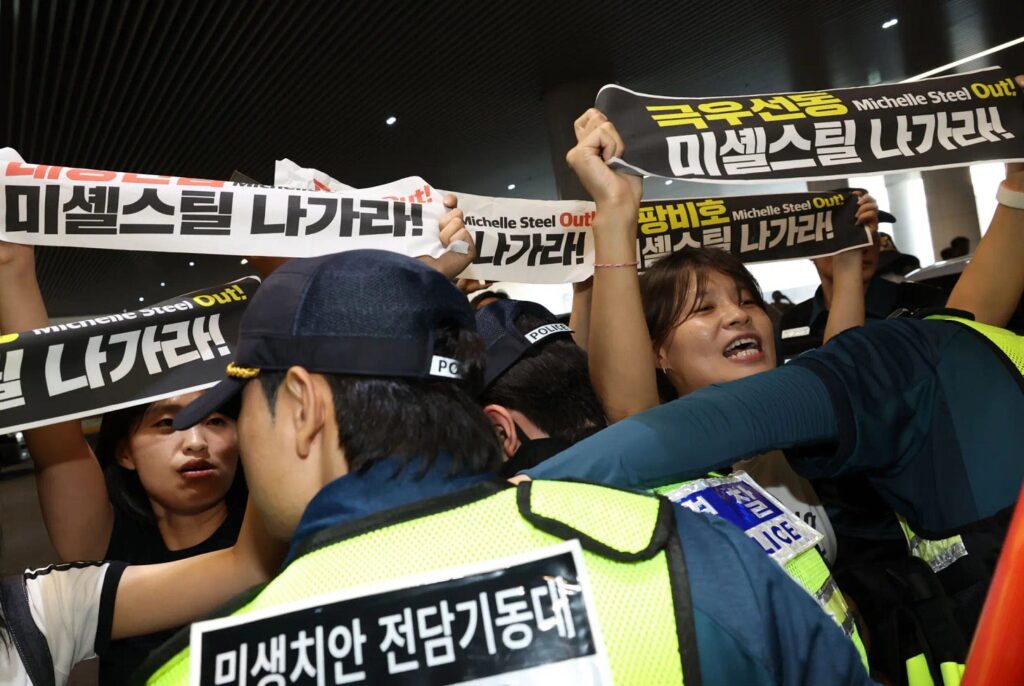
By: Shim Jae Hoon
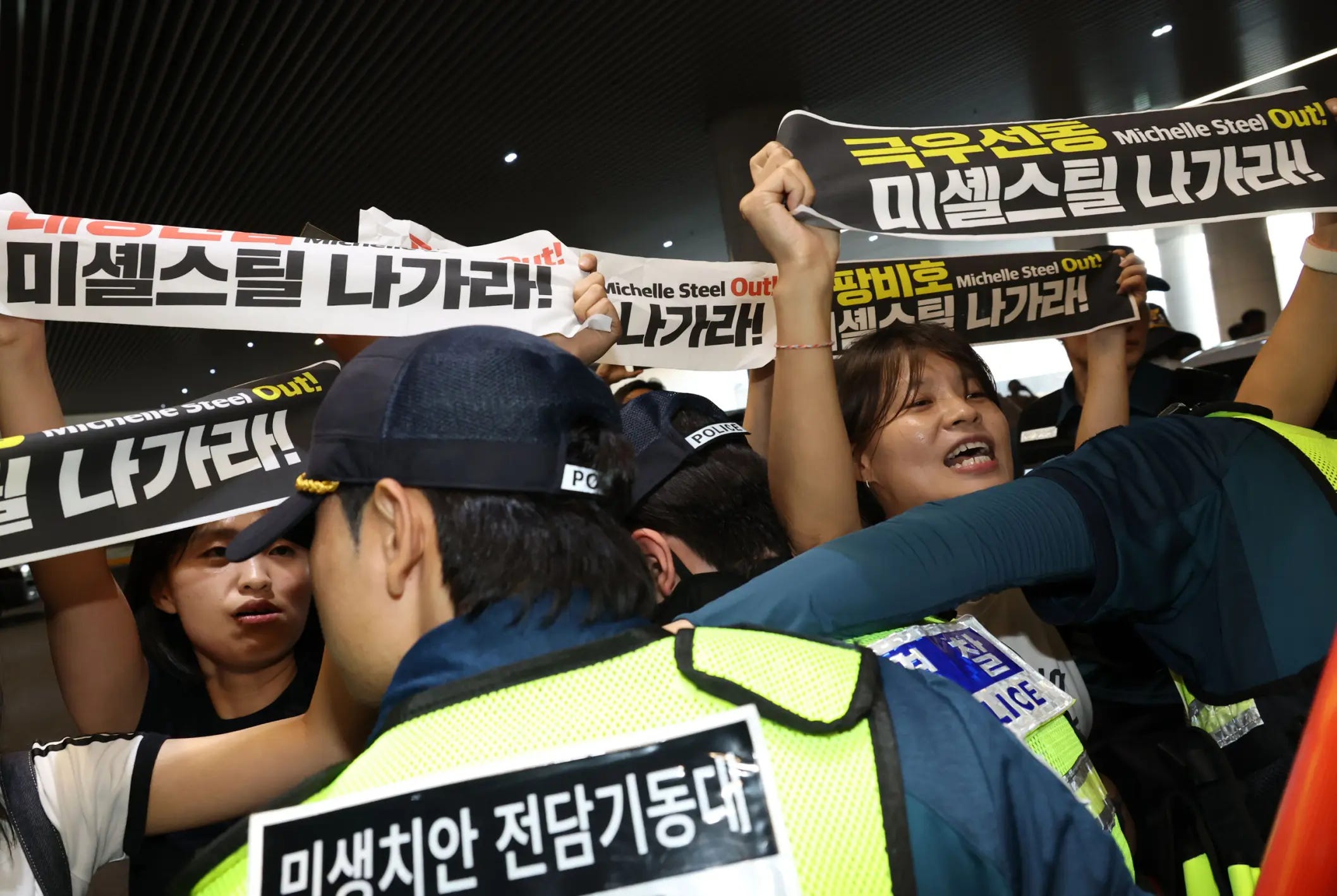
From security ties to trade and business relations, the US-South Korean alliance, long hailed as iron-clad and most successful in East Asia for decades, is coming under exceptional stress, threatening the whole fabric of their long-term relations. In a worrisome sign that surfaced on July 30, the newly arriving US ambassador to Seoul, Michelle Steel, a Korean-born former Republican congresswoman from California, was greeted at Incheon airport by angry Korean picketers yelling, “Ultra-right-winger, Go Home!”
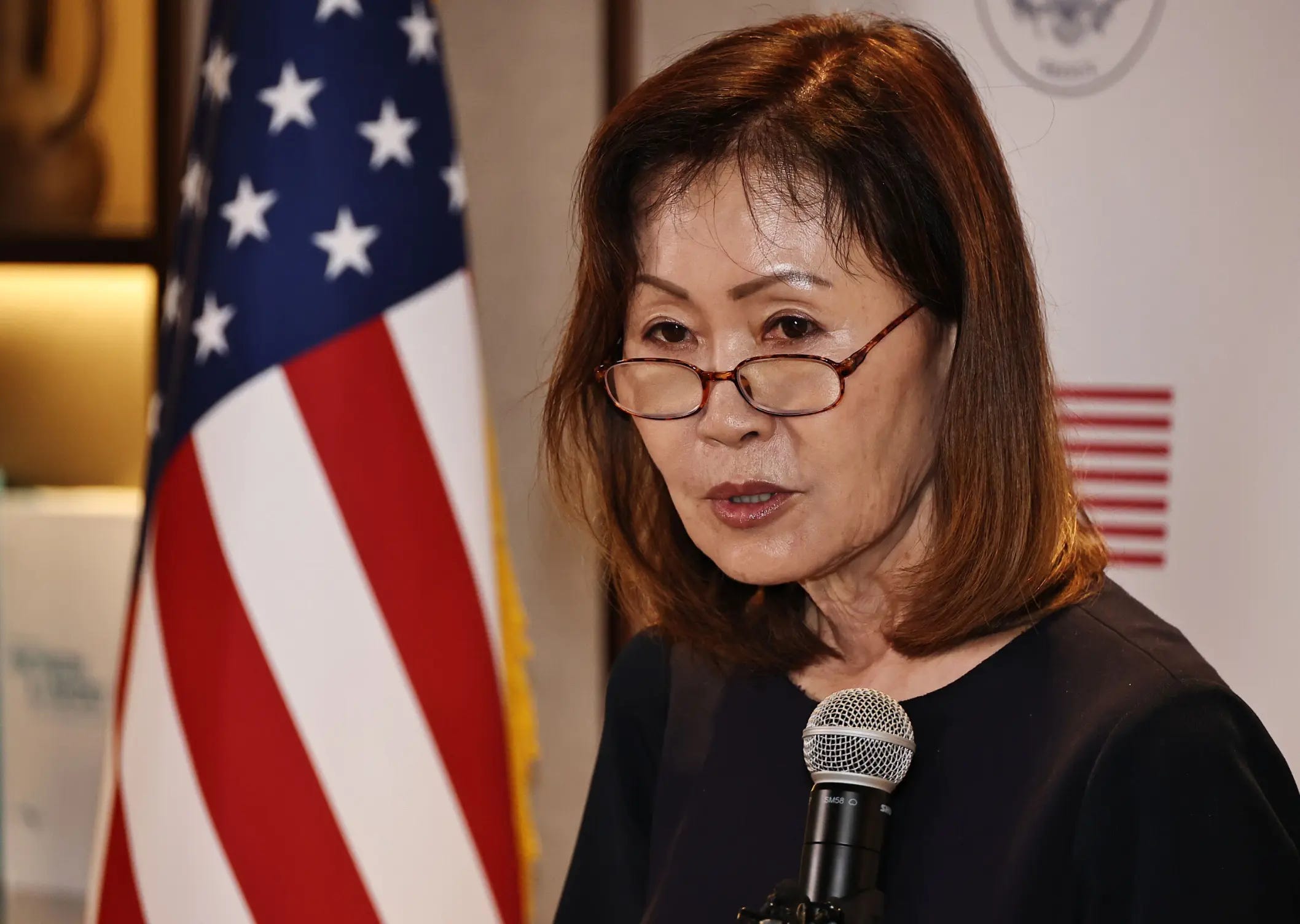
It was an unprecedented show of hostility towards an American ambassador arriving to take the post in the history of the Korea-US alliance, especially someone known to be an influential politician close to the incumbent President of the United States. As if she had an early premonition of less-than-exuberant reception waiting for her in Seoul, where she happened to have been born a daughter of a refugee family fleeing North Korea in the 1950-53 Korean War, Steel responded calmly before a crowd of reporters: ‘I was born in Seoul,’ she said before a microphone in perfect Korean but added calmly, ‘today I represent the United States. A thousand emotions cross my mind.’
That amounted to an understatement, given the tough challenges facing bilateral relations, ranging from security ties to the Trump administration’s tariffs and US demand for a hefty business investment from Seoul. Despite periodic assurances that bilateral problems such as tariffs and investments were coming under control, evidence indicates they are getting worse rather than better.
The latest issue bedeviling the Washington-Seoul ties is a strenuous protest over Seoul’s regulators imposing a stiff fine of US$422 million on the US e-commerce firm Coupang, which has been blamed for failing to plug its data leaks of 33 million South Korean customers. A Chinese employee working for the company has been under suspicion of leaking the data, but he has fled to China.
While a number of US congressional members, from both Democratic and Republican sides, have protested the fine as excessively large, discriminatory and unjustified, the Lee Jae Myung government has defended its punitive action as justifiable, citing the enormous size of personal data leaked. The company, although doing business in Korea, is registered in Washington DC. It is owned and operated by Korean Americans with a reputation for wide lobbying activities in Washington D.C. where the amount of fine has so inflamed the Congressional members that they are urging the Trump administration to respond with its own reprisal.
In Seoul, legislators belonging to President Lee’s center-left Democratic Party have in turn faced domestic criticisms for mishandling the Coupang affair with what some critics regarded as emotional outbursts, holding hearings of Coupang executives where screaming and finger-pointing at Coupang’s American executives caused alarm, prompting emotional backlash in Washington that US businessmen were being intimidated and harassed.
But the tumultuous hearings only intensified the worsening ties with the Trump administration over a raft of issues troubling the two sides, ranging from tariffs to investment to political issues.
In Seoul, the Lee administration remains troubled over the Trump administration’s unilateral slapping of 15% tariffs on Korean exports, despite Seoul’s pledge to make annual capital investments worth US$20 billion annually for a ten-year period, prompting serious concern that it could affect the nation’s foreign exchange holdings. On top of that, Seoul has had to pledge commercial investments totaling US$150 billion in the US shipbuilding sector, with the Trump administration yet unsure if it can find enough American industrial workers to take over building ships at US shipyards.
South Korea itself is in short supply of requisite shipbuilding labor force, so that it now trains a workforce from other parts of Asia to operate its shipbuilding sector. Nor would it be easy to find and send Korean workers to the US, after the last episode of US immigration officials in Georgia raiding a Korean factory site where they rounded up Korean engineers working on a Korea-invested project. Chained and handcuffed, they were dumped on an aircraft bound for Seoul, causing a national uproar in the country.
On the security level, Seoul keeps pressing for acquisition of wartime operational command authority now held by the United Nations Command under a US four-star army general. The Lee government wants a South Korean general to hold the wartime command control, who will also command 28,000 US ground forces here if another war breaks out. Although Washington has placed peacetime operational control under Korean leadership, it remains unlikely the US will place its troops under command control of a Korean general in time of war. Not only do the two armies possess different kinds of armaments, but never in US history has the US allowed its soldiers to be commanded in war under another country’s flag.
Some significant chasm also appears to be surfacing over the all-important issue of how to deal with North Korea’s nuclear threat. While Washington remains committed to pressing the North to accept a CVID formula (Complete, Verifiable, Irreversible Denuclearization), the Lee government has recently moved in favor of accepting the “freeze” formula, with Seoul’s Unification Minister Chung Dong Young suggesting that Washington and Seoul should seek a breakthrough by recognizing the current nuclear weapons stock held by the Kim Jong Un regime as a condition of stopping him adding more nuclear weapons. Chung is pressing Washington to start a process of dialogue on the basis of recognizing Kim’s nuclear status quo, even as he keeps adding more bombs on top of about 50 bombs he is understood to possess already.
These differences covering security and economic relations are substantial enough to underscore their different interests, irrespective of Seoul’s pursuit of a more assertive stance in their bilateral relations. Moreover, there are indications that the Trump administration remains skeptical of President Lee’s center-left platforms, especially as his popularity at home appears to be waning in recent months. As Lee’s political base erodes, it will be less tempting for Washington to agree to Lee’s more assertive control over their combined military strength at a time of rising nuclear challenges from North Korea. That means Ambassador Steel’s job in Seoul would not deviate much from her predecessor’s.
Don't Miss:
-
Statement on missing ICIJ journalist Micah Reddy
-
TRANSCRIPT: ‘China Retains Levers for Long-Term Territorial Ambitions’
-
On Indonesia’s new oligarchy, China’s state bank, and other stories | Asia Sentinel Stories of the Week
-
‘Tinder Swindler’s’ plan for a dating app sparks industry backlash
-
US prosecutors accuse Huawei of ‘far-reaching criminal scheme’ spanning decades