
 Sarah Anderson on the Twenty Largest Low Wage Employers
  Rachel Brewster on the Rise of Global FCPA Settlements
  Phillips 66 to Pay $8 Million Gets Prosecution Deferred No Monitor No Finding of Guilt No Corporate Probation No Press Release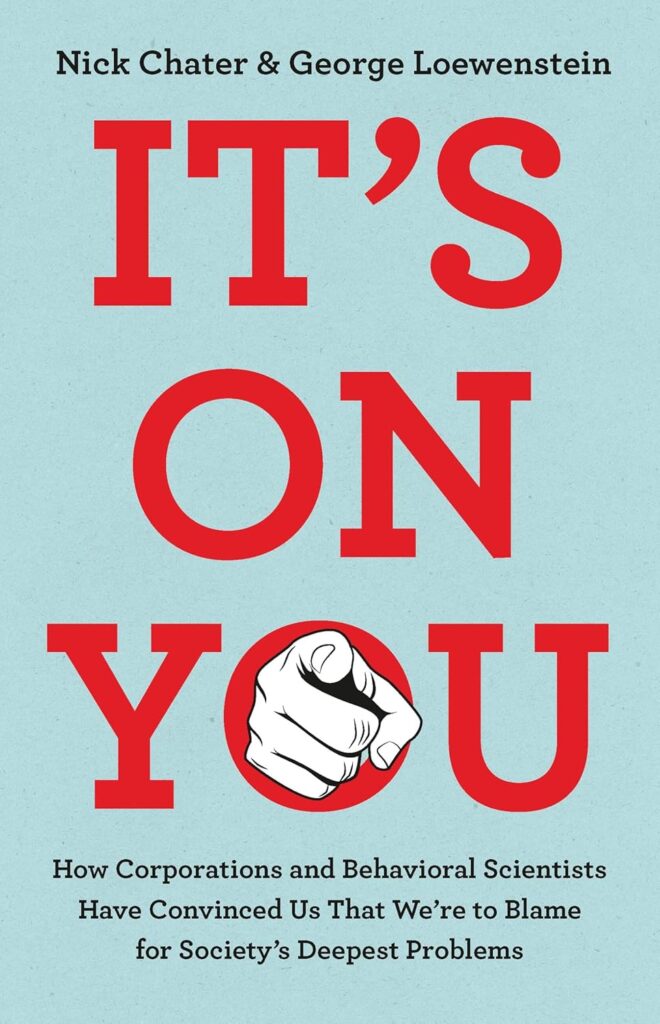
Two decades ago, behavioral economists began pushing the idea that nudging individuals to do the right thing could help transform society.

The hope was that governments could deploy a new approach to addressing society’s deepest challenges – gently, but cleverly, nudging people to make choices for their own good and the good of the planet.
The nudge movement was born. The bible of the movement – Nudge: Improving Decisions About Health, Wealth, and Happiness by two Chicago school academics – Richard H. Thaler and Cass R. Sunstein.
But now come two behavioral scientists – Nick Chater and George Loewenstein – to show that it was all quite convenient – and false.
They have written a rebuttal to Nudge. It’s a book titled – It’s On You: How the Rich and Powerful Have Convinced Us That We’re to Blame for Society’s Deepest Problems (Hatchette, 2026).
Chater and Lowenstein argue that nudges rarely work, and divert us from policies that do.
Being nudged to switch to green energy doesn’t cut carbon, and it distracts from the real challenge of building a low-carbon economy.
Chater and Lowenstein show how powerful corporations have repeatedly used a clever sleight of hand: blaming individuals for social problems, with behavioral economics an unwitting accomplice, while lobbying against the systemic changes that could actually help.
They argue that rather than trying to “fix” the victims of bad policies, real progress requires rewriting the social and economic rulebook for the common good.
You say in your book that you and George were part of this burgeoning nudge movement. How did the realization come about that something was not right?
“George and I actually met on the advisory board of the Behavioral Insights Team in London,” Chater told Corporate Crime Reporter in an interview last week. “That was the first of the 150 to 200 Behavioral Insight Teams around the world now. Our job was to think how individual behavior could make the world better.”
“We were struggling really hard to find things that worked and finding out that they just don’t work. George did quite a lot of working on trying to get people to exercise more and eat more healthfully. I spent quite a bit of time on how to persuade people to burn less carbon. The truth is, we were bashing our heads against this problem. We thought we just needed to keep at it.”
“That process of trying and failing was one source of the disenchantment. The other source was looking at the field as a whole and realizing it was not just us. I had high hopes for calorie labeling. But it makes almost no difference at all.”
“Everywhere you look, these efforts don’t seem to work.”
It wasn’t clear from your book – was the nudge movement a creation of the corporate lobbyists to distract public policy makers away from structural changes? So for example, instead of a government sponsored structural change like a public health campaign prohibiting junk food ads and encouraging people not to eat junk foods – nudging people to exercise instead?
“I don’t think it was. The nudge movement was a pretty well intentioned, politically pretty centrist type of movement, trying to circumvent some of the real challenges of making really big systemic changes. Trying to change regulations on food or packaging or fossil fuels – all of these changes tend to require big political programs. And there is enormous lobbying on the corporate side to stop that kind of regulation. And it’s very difficult to break through.”
“Many people on the nudge agenda were probably thinking – trying to do these big legislative reforms is really difficult. Politics is pretty deadlocked. There is a lot of money pushing in the wrong direction. But maybe we can circumvent that process by focusing directly on individuals and helping people to do the things that are best for their own benefit and for the environment at large.”
“Unfortunately, looking back, it seems that what we were actually doing was amplifying the sense of individual responsibility in a way that was unhelpful. From a corporate point of view, it was important that we were stressing the importance of individual change. Individual change doesn’t work very well. And second, it pulls public attention away from the structural changes that need to be made to get change.”
“George Lowenstein and I were quite idealistic about the possibility of nudges being for good. I don’t think there was much of a hand from commercial forces in propagating the ideas initially. It just turns out that we were aligned with what we now think of as the wrong side.”
In the United States, the campaign to demonize government action was centered at the University of Chicago. These conservative economists, led by Milton Friedman, campaigned against broad public policy solutions, what you call structural solutions, to these problems. You would expect that a similar thread would come from the people who created the nudge movement.
“I totally agree. In fact, George’s viewpoint is quite interesting in this regard. He was at the University of Chicago quite early in his career. Another economist there was George Stigler. He was also very anti-government and pro unfettered market. But the unfettered market story works only if consumers are omniscient and make perfect choices, and can see any snake oil offer for what it is. We are limited creatures with limited knowledge and limited willpower. But the Chicago school assumption is that everybody knows exactly what they want to do and if there is perfect information and under these extreme conditions, it should all work out. And it doesn’t work out.”
“Many people in behavioral economics saw themselves as opposed to the Chicago School. But many people ended up aligning themselves with the individualism of the Chicago School through the back door. We took the critique of the Chicago School that people are not perfectly smart and prudent – that they would have to be to make that vision of the world work. And we thought – we need to help people behave in a more rational way. We need to put calorie labels on their food. We need to make it easier for them to make the right decisions.”
“That’s like saying – the free market story doesn’t really work because these are imperfect people. And we said – okay, we will try to nudge the people so they won’t make the mistakes they made before. And then the market should work better. We were betting on the idea that a pure market solution could work.”
“But now we are saying – the most important social problems exist because there are structural failures in the system.”
In your book, you say these are the two ways to address it – the I solution – focus on the individual. And the S solution – focus on the system.
“Yes. So with obesity for example we say – people are eating too much. We are looking at it through the I frame. And that is blocking our ability to perceive the systemic problems like lots of new foods which offer cheap energy made with corn syrup with a huge marketing campaign.”
“So these frames are in competition with each other. And human psychology itself has a fundamental I frame bias. We are social creatures adapted to a world of small social groups with local interactions with other people. We tend to think as individuals. We are not very good at thinking about systems and gigantic social forces that operate across the whole society over a period of decades.”
“So the I frame and S frame are in competition. But in principle, they can be harnessed together. It’s possible to push on both levers at once. But if we are thinking of one we tend to forget about the other.”
“The case of tobacco is illustrative. It does involve pushing at both the individual and regulatory levels. There has been increased taxation on smoking, there are bans on smoking in public places. Cigarette advertising has been rolled back. There are limits to cigarette sponsorship of sporting events.”
“You have all of this regulation and legislation. But at the same time, there has been a massive effort to help individual people to stop smoking and to find it less appealing. There have been public health campaigns targeting the individual. And the real win was the efforts to make smoking less appealing on the individual level. But those have been amplified by large scale legislative changes. The S frame changes did the work.”
You would think that such an S campaign would work on obesity.
“It could, but the measures will be more difficult politically. With cigarettes, taxation was a big lever. But were you to increase taxes on food, that would be quite dramatic and very unpopular. In the short term, that would hit many low income people. Not everyone needs to smoke, but everyone needs to eat.”
Put aside the taxation. What about a massive public health campaign and prohibiting junk food ads?
“If you could match up the scale of the public health campaign with the food industry ads, that could potentially be quite powerful. Normally, public health campaigns are dwarfed by the vast resources on the other side.”
“I still think that the most effective strategy would be to change the formulation of the products in the first place. In the UK, for certain kinds of prepared foods, there have been mandated reductions in salt and sugar in those meals. It was quite a big reduction and it has happened gradually.”
One of the chapters in your book looks at health care. Medicare for All would be one major structural change. Is that the kind of structural change when it comes to health care?
“It is. The United States is an outlier when it comes to health care. The key outcome is to find a system that delivers health care which is free at the point of use. That involves some kind of very large systematic change which allows risk sharing across the entire population. That is being achieved in most developed countries.”
“But in the United States, healthcare has taken a different path. And it’s very difficult to change because the industry as it is wants to keep things the way they are. Health care costs per person are on the order of one and a half to two times higher than other developed countries and outcomes are worse in the United States.”
“It’s a difficult political deadlock to break. The current situation is not beneficial to the citizens in the United States, but it is beneficial to the health care and insurance companies.”
In your book, you point out the oil giant BP created this idea of the individual’s carbon footprint, pushing the idea that you and I are responsible for the climate disaster. And at the same time, the oil industry is here in Washington lobbying to stop structural changes such as caps on fossil fuel emissions.
But because of the Chicago school propaganda, individuals do think it’s their fault because they drive a gas guzzling car, or that they don’t have a pension when they get older.
“Because of what we say is the I frame bias, it’s easy for us to be lured by the propaganda. And we might look at our neighbor and say – well that person is not obese and I am so it must be my fault. It’s very easy to fall into this trap because we see variation at the individual level but we don’t see variation that occurs across national boundaries.”
“There has been an enormous amount of propaganda from many commercial organizations funding libertarian aligned think tanks. There has been a twin strategy. One is attacking government as an inevitably corrupt and baleful influence that can only make our lives more difficult. Ronald Reagan famously said that the most terrifying words in the English language are – I’m from the government and I’m here to help.”
“George Stigler of the Chicago school stressed that governments are bad because they are captured by corporate interests. That’s often true of course. But the obvious solution to that would be to keep money out of politics, stop revolving doors and clean up government. But the Chicago school reaction was – no, you just have to clear government out of the way.”
“That’s one line of rhetoric. The other is a pro individual responsibility. Government is bad. Individuals are responsible for their own lives, helping each other live better lives. There is a communitarian sense that we individuals can help each, but that would be one individual at a time. Any time there are rules and regulations from organizations, that is demonized. And that’s no accident. Corporations are very well aware that the power of disorganized individuals is minimal. And they are also very well aware that the real action is in changing the rules of the game. So they make sure there are no international fossil fuel agreements. And they make sure they roll back funding or approval of renewable energy sources.”
“So the trick is portraying governments as very bad while manipulating government actions. And at the same time portraying the individual as the source of salvation, knowing full well that the individuals can do very little on their own.”
[For the complete q/a format Interview with Nick Chater, 40 Corporate Crime Reporter 13(12), March 30, 2026, print edition only.]
Don't Miss:
-
Sarah Anderson on the Twenty Largest Low Wage Employers
-
Rachel Brewster on the Rise of Global FCPA Settlements
-
Phillips 66 to Pay $8 Million Gets Prosecution Deferred No Monitor No Finding of Guilt No Corporate Probation No Press Release
-
Kaleb Byars on the Double Standard in the Sentencing Guidelines
-
UN Reports Detail Unjust Access to Justice for Women and Girls