
 ICIJ’s investigations into systemic failures highlighted in 2025 annual report
  Judge orders Nazi-looted Modigliani linked to Panama Papers be returned to heirs
  Ten years after the Panama Papers, enablers and tax cheats are still being brought to justice
 The grainy black and white footage shows a small boat traveling at speed on the high seas off the coast of Venezuela. Suddenly, the boat explodes, engulfed in white flame. The video is less than 30 seconds long, but it signaled the birth of a new, more aggressive chapter in the United States’ “war on drugs.”
The September 2025 US military operation was a precision strike meant to destroy the vessel and kill those on board: 11 crew members the US labeled “narcoterrorists,” despite providing no solid evidence to back up those claims. While some survived the initial blast, they were killed with a second missile while clinging to the side of the burning boat.
It was the type of attack usually reserved for times of war. Only this was not traditional warfare but a militarized campaign aimed at disrupting drug trafficking in the Caribbean. And while analysts were left to debate the legality of the intervention, the strike sent a message that left little room for misinterpretation: The United States would no longer be bound by the established anti-narcotics playbook, rooted in multilateral cooperation, investigative procedure, due process, and the rule of law.
Instead, it would unleash its military might.
The Caribbean was the testing ground for this new approach. Additional strikes on suspected drug vessels followed the first, killing 61 people in the region as of April 2. The United States also deployed a massive flotilla—including around 15,000 troops and the world’s largest warship—to the Caribbean seas in a show of force that culminated in January with the nighttime capture of Venezuela’s then-President Nicolás Maduro, whom Washington has charged with drug trafficking and “narco-terrorism.”
The snatching of Maduro marked the peak of the pressure campaign, and by mid-February the United States had redirected the flotilla’s main assets—and the world’s attention—to the Middle East. But the Caribbean strikes were just the beginning of a radical new phase in US anti-drug policy. And the tactics seem here to stay.
Since then, the United States has kept up sporadic strikes against suspected drug boats in the Caribbean while also expanding the bombing campaign to the Pacific. It also provided operational support when Ecuador launched air raids on what it said were drug camps in the Colombian border region, although reporting by the New York Times suggested they actually hit a dairy farm. Then, in March, US President Donald Trump announced the formation of the “Shield of the Americas,” a new coalition of governments in Latin America and the Caribbean that share a vision of combating drug trafficking with force.
The military-first approach Trump and his regional allies now seem fixed on has raised important questions about the rule of law and respect for human rights. But there are also questions over whether this strategy is effective in disrupting drug flows. And the campaign in the Caribbean offers some early clues.
SEE ALSO: What Does the Exit of Vladimir Padrino López Mean for Organized Crime in Venezuela?
InSight Crime has closely monitored the region’s drug dynamics since the first US strike, drawing from our on-the-ground reporting from Venezuela and several Caribbean islands. With the bulk of the US flotilla now gone, we take stock of what has happened so far and what lessons can be gleaned from the first salvos of this new phase of the drug war.
US Airstrikes Have Disrupted Specific Drug Routes, but Overall Trafficking Has Not Stopped
The threat of lethal airstrikes has proven a powerful deterrent to drug trafficking in some areas, raising the stakes for criminal groups that previously viewed seizures and arrests as the worst-case scenario.
Not long after the strikes began, drug traffickers largely ceased using go-fast boats to move cocaine from the Venezuelan coast to nearby Caribbean islands—a common transit route for cocaine shipments originating in Colombia.
Sources in dispatch points on Venezuela’s coast told InSight Crime that drug trafficking had ground to a halt, with some traffickers fleeing the area entirely. Disrupted routes included the maritime stretch between the northern state of Falcón and the islands of Aruba, Curaçao, and Bonaire, as well as waters between the eastern state of Sucre and Trinidad and Tobago. These islands serve as staging points for cocaine shipments bound for international markets, although the cocaine that passes through them usually goes to Europe rather than the United States.
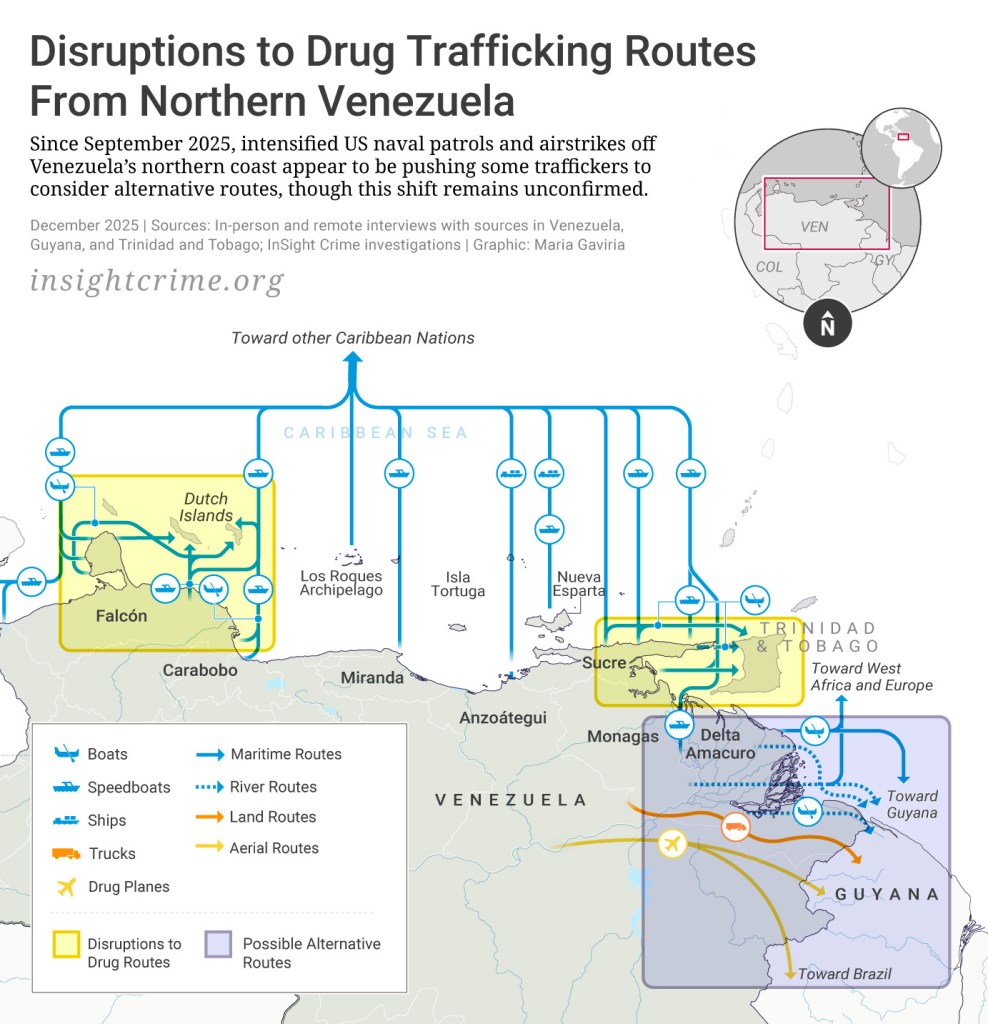
However, because these disruptions were limited to a handful of smuggling corridors and mostly wrought havoc among go-fast boats, they did not prevent traffickers from moving cocaine by other means.
Speaking at the height of the US bombing campaign in October last year, a senior customs source in Trinidad and Tobago, speaking to InSight Crime on condition of anonymity, said that “overall flows remain steady,” adding drug shipments had been “diverted to less patrolled sea lanes, more isolated beaches, or via land transshipment points in small island nations.”
There is also evidence that the US pressure in the Caribbean drove a rise in alternative routes through Venezuelan territory and beyond. In Guyana, bordering Venezuela, authorities reported an uptick in the number of unregistered flights passing through the country’s airspace following the onset of US strikes. This suggests a potential eastward shift toward Brazil, from where cocaine can be shipped around the world hidden on cargo ships.
SEE ALSO: Amid US Strikes, Booming Guyana Could Become Drug Trafficking Hub
Traffickers have also looked south to the Amazon, where they are increasingly using river and air routes that move drugs from the Colombian departments of Vichada and Guainía through Venezuela and towards Brazil and Guyana, according to an investigation by Amazon Underworld. There has also been a rise in the use of cargo vessels to move drugs along rivers connecting Venezuela’s Amazonas state to illegal airstrips and semi-submersible launch points further north, according to a local journalist and an Indigenous leader residing in the area, who both requested to remain anonymous for security reasons.
Traffickers may also be exploiting more discreet forms of transport, such as private yachts, which can crisscross Caribbean islands while blending in with tourism traffic. Other alternatives to go-fast boats include fishing vessels and inter-island ferries that can hop between islands while carrying concealed cargo.
The strikes could also fuel the use of semi-submersible vessels, which are less vulnerable to aerial attacks. In February, authorities in Suriname discovered a site used to construct these so-called “narco subs.” Authorities in Venezuela and Guyana have previously identified clandestine shipyards in coastal waterways leading to the Atlantic Ocean.
At the same time, the US focus on striking go-fast boats has not meaningfully impacted drug flows through the commercial ports that serve as the Caribbean’s main chokepoints for high-volume cocaine shipments. Concealment within legitimate cargo remains the main method for reaching consumer markets in the United States, Europe, and beyond, with traffickers routing loads through ports in countries like the Dominican Republic. These routes do not depend on go-fast boats sent from Venezuela, as the cocaine arrives at the ports from a broad range of destinations, often on other container ships.
Attacking Drug Boats Has Done Little To Disrupt Broader Criminal Networks
The US has justified its use of lethal strikes by claiming its targets were members of “narcoterrorist” groups engaged in a war with the United States. But this framing does not reflect the reality on the ground.
High-level traffickers rarely coordinate, much less pilot, the go-fast boats that transport drugs through the Caribbean. The criminal organizations operating at dispatch points are usually mid-level logistics networks contracted to move cocaine on a deal-by-deal basis. These groups recruit boat crews locally, often from local fishing communities.
Eliminating these actors will likely do little to disrupt the operations of larger drug trafficking organizations (DTOs), as these groups can rebuild or reroute their supply lines by hiring other logistics networks in areas outside the zones where the US military is operating. The brokers that coordinate these networks of suppliers and service providers commonly operate under a veil of legality far from the maritime corridors targeted by US strikes.
The US Intervention in Venezuela Has Not Altered the Country’s Role in the Cocaine Trade
Though the audacious capture of Maduro in Venezuela removed a figure long accused by US authorities of facilitating drug trafficking, the country’s broader criminal ecosystem remains largely intact.
Maduro presided over a system of hybrid criminal governance that granted high-ranking officials access to criminal rents—including from drug trafficking—in return for their loyalty while allowing low-ranking officials to supplement their meager salaries with bribes or by participating in criminal activities. The state’s dependency on underworld funds to maintain power turned corruption networks into key partners for cocaine traffickers.
The Trump administration has so far shown limited appetite for a wholesale government overhaul that would address this systemic corruption. Washington instead appears willing to work with elements of the existing power structure so long as the interim government aligns with its core demands.
Prominent officials linked to the drug trade have remained in their posts following Maduro’s ouster. This includes Interior Minister Diosdado Cabello, an enduring political heavyweight who has recently represented the government in meetings with US officials, despite the Department of Justice accusing him of conspiring with Maduro to traffic cocaine.
Maduro’s successor, Delcy Rodríguez, has also drawn scrutiny from US law enforcement agencies, with the Drug Enforcement Administration (DEA) reportedly identifying her as a “priority target” over suspected links to drug trafficking networks.
The most high-profile figure to be dismissed in a post-Maduro reshuffle was Vladimir Padrino López, the longtime defense minister who US officials have accused of ties to military-linked trafficking networks often referred to as the Cartel of the Suns. His successor, however, faces US sanctions for human rights abuses and has been linked to Cabello’s political network—a sign that Rodríguez’s government feels limited pressure to thoroughly purge its ranks.
Even if the US does push harder for Venezuela to clamp down on drug trafficking, doing so would likely require a near-complete overhaul of the country’s security forces, including the removal of corrupt leadership at the local, regional, and national levels, plus significant salary increases for the rank and file. This would demand both political will and resources, both of which are in short supply.
Washington’s Military-First Strategy Could Fracture the Broader Anti-Drug Coalition It Once Led
For governments that cooperate closely with the United States on counter-narcotics efforts, the lethal strikes present a delicate balancing challenge. Many are eager to maintain strong security ties with Washington but may be wary of association with military operations that bypass international legal norms and due process.
Over time, these tensions could erode trust with partners that have historically shared vital intelligence with US authorities.
One of the clearest fractures to emerge is with Colombia, the world’s largest cocaine producer and a longtime US ally on anti-narcotics. The strikes sparked friction with Colombian President Gustavo Petro, who described them as an “act of tyranny” during an interview with the BBC in September 2025. He later ordered an end to intelligence sharing with the US security agencies over human rights concerns, though cooperation appears to be continuing in some form.
In Mexico, home to sophisticated DTOs responsible for trafficking large volumes of cocaine and fentanyl into the United States, the government has condemned the Caribbean strikes, citing established rules governing counter-narcotics operations in international waters. President Claudia Sheinbaum has also rejected proposals floated by the Trump administration to conduct US operations on Mexican soil, warning that “there will be no invasion.”
SEE ALSO: From Airstrikes to Cooperation: Will the ‘New Phase’ of Ecuador’s Drug War Deliver?
Concerns have also emerged among some European partners. Senior Dutch intelligence officials told the newspaper Volkskrant in October 2025 that the Netherlands would withhold certain intelligence from the United States following the strikes, citing concerns about how the information might be used. The following month, CNN reported that the United Kingdom had stopped sharing intelligence related to suspected drug boats, though British authorities have not publicly confirmed this.
The creation of the US-led “Shield of the Americas,” a 2026 security initiative aimed at coordinating military action against drug networks, may deepen these divisions. The coalition excludes major regional players such as Colombia, Mexico, and Brazil, raising questions about whether the initiative could create a two-tiered system that stifles cooperation within the regional anti-drug coalition.
Traffickers Will Reactivate Disrupted Routes Whenever Us Presence Declines
Though the US strikes have continued to target suspected drug boats in the Caribbean, the redeployment of key naval assets to the Middle East and elsewhere will likely create space for traffickers to revive routes that fell quiet at the height of the pressure campaign.
To be clear, these routes were never fully extinguished; the ongoing strikes suggest criminal groups never stopped probing the go-fast corridor.
But as it expands its militarized anti-narcotics operations into the Pacific, the United States may soon confront the impossibility of sustaining an effective military deterrent covering all trafficking routes and transport methods at once. Spreading military presence over multiple trafficking regions—the Pacific, the Caribbean, and Central America—promises to create weak links, as intense pressure in one smuggling corridor simply pushes traffickers to redirect drug flows into another.
For drug trafficking networks that operate across land, air, and sea, adaptation is not an exception, it is part of the business model.
*Sara García, Henry Shuldiner, Sean Doherty, Beatriz Vicent, and Cassia Jefferson contributed research to this report.


Don't Miss:
-
Iran war: Russia and China veto UN resolution to reopen Strait of Hormuz
-
Nasa’s Artemis crew snaps historic Earthset photo on way home from moon
-
Why Cocaine Keeps Flowing Through the Caribbean: A Visual Guide
-
Hong Kong doctor axed for posting resuscitation photo faces Medical Council case
-
Ostrich escapes animal cafe, sprints down Thai highway