
 Bhutan’s ‘Mindfulness City’ to Link to India by Rail
  Cracks in the Sand: Gulf Monarchies’ Economic and Geopolitical Peril
  Shipping Containers: New Threat Multiplier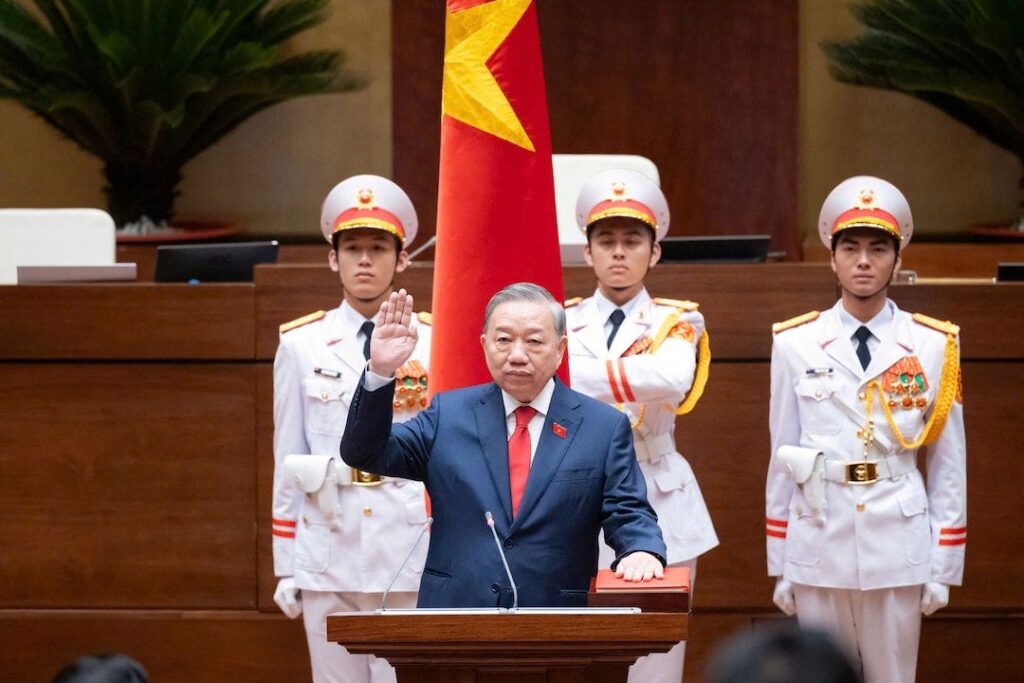
By: Khanh Vu Duc
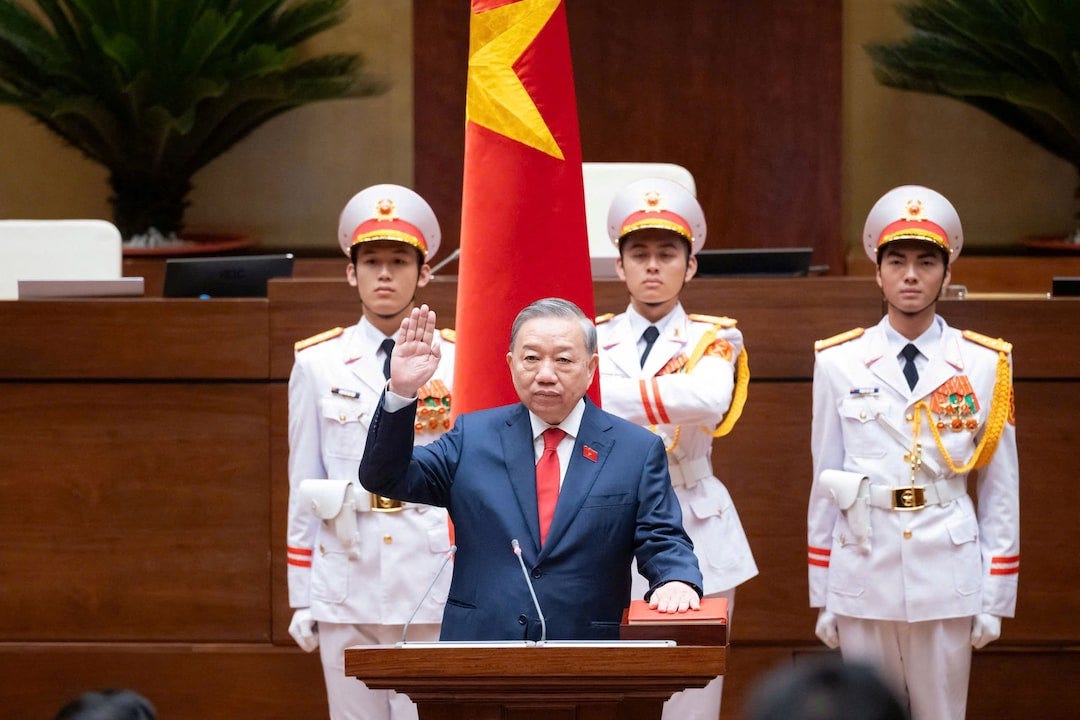
Vietnam has formally merged its two highest offices, elevating Communist Party General Secretary Tô Lâm to the presidency by unanimous agreement in parliament on April 7. The move breaks decades of tradition separating party and state leadership, concentrating authority in a single figure for the first time in modern Vietnamese history.
Analysts view the consolidation as both a practical adaptation to governance realities and a structural test of institutional resilience in a tightly controlled one-party state, raising questions about efficiency, accountability, and the balance between rapid decision-making and sustainable checks on power. The consolidation reflects an enduring paradox in Vietnam’s political system: the gap between formal separation of powers and actual authority. While the constitution maintains distinct roles for the General Secretary and President, decision-making has long been concentrated in a small, interconnected core of leaders.
“This is not simply a ceremonial alignment,” an AP report notes. “It formalizes a center of authority that has already exercised wide influence behind the scenes.”
Strategic Implications
The rise of Tô Lâm, formerly Minister of Public Security, was bolstered by anti-corruption campaigns and an emphasis on stability. His dual role now merges party guidance with the operational powers of the state presidency.
Regional analysts note parallels with China’s model, where the General Secretary simultaneously serves as President, allowing unified policy direction and decisive action in economic and security matters.
For Vietnam, a mid-sized economy navigating ambitious modernization goals amid complex geopolitics, the consolidation may offer operational advantages.
Policy coherence is expected to improve, decision-making may accelerate, and foreign partners can more easily identify a single interlocutor at the apex of power.
At the same time, the concentration of authority highlights the tension between efficiency and accountability in the absence of independent judicial oversight or robust parliamentary checks.
Comparative Perspective
Vietnam’s experiment can be contrasted with international governance models:
-
United States: Presidential system with strong separation of powers, legislative oversight, and independent judiciary, at least prior to Donald Trump.
-
France: Semi-presidential, balancing executive power between president and prime minister, moderated by parliament.
-
Westminster (UK, Japan, Canada): Prime minister leads government; ceremonial head of state ensures procedural legitimacy; collective cabinet responsibility tempers unilateral authority.
-
China: One-party system with general secretary, president, and Central Military Commission chair combined to centralize policy authority.
-
Vietnam (pre-2026): Dual leadership roles, with the president largely ceremonial and authority centered in the Politburo.
-
Vietnam (post-2026): Unified executive under Tô Lâm that retains party primacy but channels executive authority through a single president, resembling a hybrid of China’s one-party president and elements of semi-presidential governance. Such a model, if institutionalized, represents a novel form of “socialist presidentialism,” designed to reduce policy lag and clarify leadership for domestic governance and international diplomacy.
Risks and Checks
Historical and comparative experience suggests that consolidation can increase efficiency while amplifying risks. Without independent institutions to enforce checks, decision-making may become personalized rather than institutionalized.
Observers caution that the durability of such a model depends on whether parallel mechanisms — internal party discipline, state auditing, and controlled civic oversight — are strengthened to match the expansion of executive power. Official statements accompanying Tô Lâm’s oath stressed economic growth, social stability and national unity. Yet signaling priorities publicly is not equivalent to creating structural accountability.
Foreign Policy Signals
Externally, the consolidation sends a clear signal: Hanoi now speaks with a single, identifiable voice. This may reassure investors and regional partners seeking stability, but could prompt caution among Western governments accustomed to governance with clearer separations of power.
Managing relationships with China, the United States, and ASEAN partners will test the executive’s capacity to balance assertive domestic authority with nuanced diplomacy.
Looking Ahead
Vietnam’s formalization of the dual role under Tô Lâm will be closely watched for how it shapes policy execution, political discipline, and foreign relations.
Scholars of comparative constitutional law may see this as a living experiment in hybrid governance, where a socialist one-party system tests presidential-style authority.
Success may hinge less on individual capacity than on whether Vietnam can pair concentrated leadership with credible institutional checks, creating a governance architecture capable of decisive action without undermining accountability.
For now, the historic vote marks a turning point: an apex of authority that is highly visible and deeply intertwined with the party’s ideological mandate.
Whether it evolves into a lasting institutional reform or a temporary personalization of power will define Vietnam’s political trajectory in the coming decade.
Khanh Vu Duc is a frequent contributor to Asia Sentinel. He is a lawyer and part-time law professor at the University of Ottawa who researches on Vietnamese politics, international relations, and international law.