
 New documents show how a retail chain’s sales practices helped put guns on US streets
  Singapore a battleground of commodities fraud lawsuits
  From Propagandist to Criminal
The tip about the illegal mining camp came at the beginning of March 2026. The informant didn’t know how big the site was, or how many people worked there, but gave the exact location: a remote section of the Corcovado National Park, a protected area in southern Costa Rica.
A couple of weeks later, a team of eight park rangers set out from the Patos outpost before dawn at 2 a.m. to make the 10 kilometer trek to the site.
The rangers, who work under the National System of Conservation Areas (Sistema Nacional de Areas de Conservación – SINAC), face an uphill battle combating illegal mining in Costa Rica’s protected reserves. The drug transport networks that use the remote beaches and jungle paths here to smuggle cocaine are also using these illegal mines to launder their cash profits.
Costa Rica is at the center of the booming global cocaine business. It has an integral role as a transshipment point to consumer markets in the United States and Europe, and local transport networks are a crucial part of that trafficking chain.
But as cocaine trafficking oozes into other criminal economies like illegal mining inside Corcovado, it’s become increasingly complicated for the park rangers to protect its natural resources amid a lack of resources and operational support.
A Paradise of Cocaine and Gold
Some 35 kilometers from the Patos outpost inside Corcovado, Puerto Jiménez is the largest town on Costa Rica’s Osa Peninsula, bordered by the Golfo Dulce. The town was a former gold mining hotspot before a 2010 mining ban. It now attracts thousands of tourists each year who want to venture into Corcovado, one of the world’s most biodiverse reserves, to see monkeys, scarlet macaws, jaguars, and pumas.
It also brings illegal miners, poachers, loggers, and drug runners.
Authorities seized a total of 46.5 tons of cocaine in 2025, a more than 70% increase from the 27 tons seized throughout 2024, according to official data. Near the end of August 2025, Costa Rica’s coast guard closed in on an unregistered go-fast boat as it barreled down the Puerto Jiménez coast. They intercepted two Costa Ricans and two Colombians on board and seized 1.6 tons of cocaine. A few months later, a twin-engine aircraft loaded with more than 300 kilograms of cocaine crashed off the coast of Puerto Jiménez.
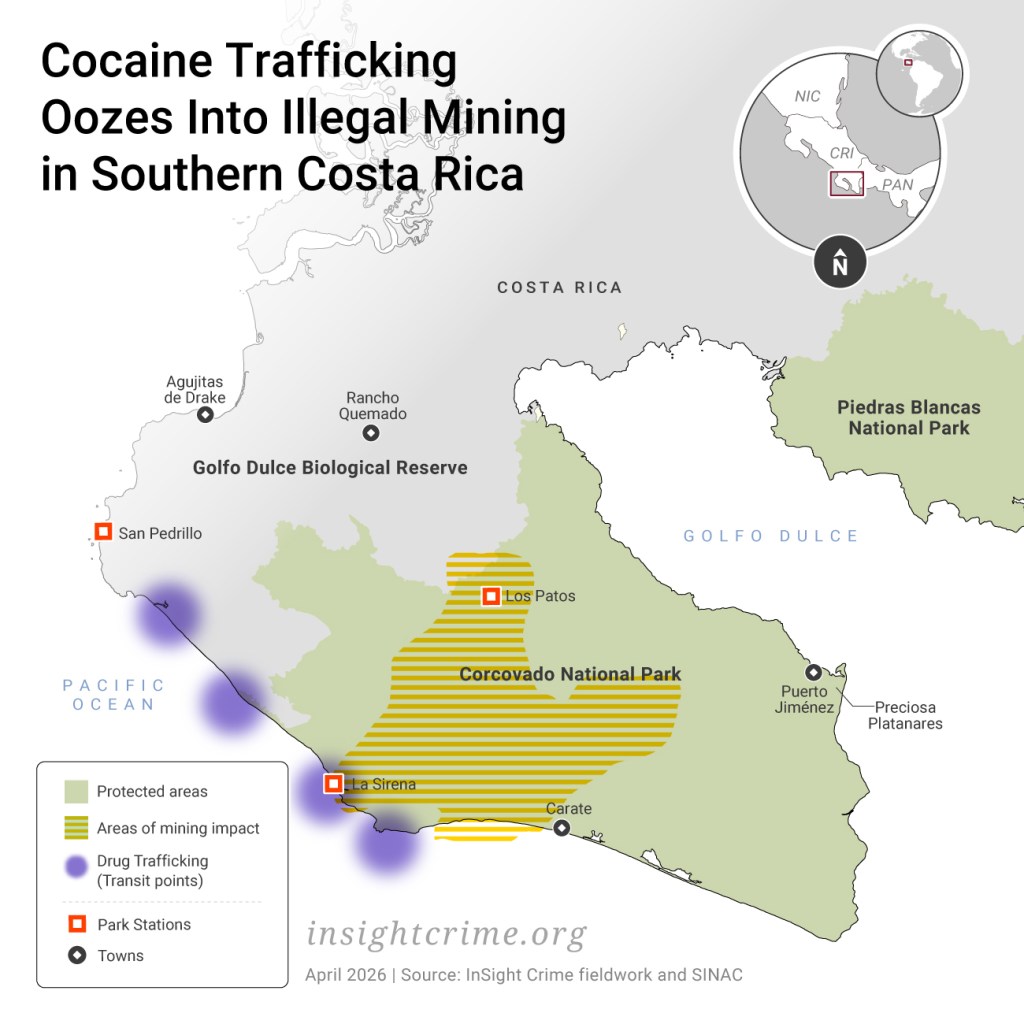
Last year, Costa Rican authorities uncovered the so-called South Caribbean Cartel, the country’s first transnational trafficking group. Relying heavily on transport networks that offload cocaine on remote beaches along the coast of Puerto Jiménez, the group’s cocaine would then be transported to warehouses for export or distribution throughout the rest of the country.
SEE ALSO: What’s Behind Costa Rica’s ‘First’ Transnational Criminal Organization?
More cocaine means more money to launder. During 2025, financial authorities flagged $700 million in suspicious funds that entered the banking system. The use of illegal mining for some of that laundering, according to the park rangers and a non-governmental organization working in the area, who requested anonymity for security reasons, is evident in the mines themselves and the equipment illegal miners are using.
Artisanal miners are now equipped with metal detectors and satellite phones, according to photos the park rangers showed InSight Crime. The miners come mostly from low socio-economic backgrounds and use illegal mining as a source of income due to the lack of formal employment opportunities in the area, they explained. They don’t have the funds to pay for expensive equipment or a surveillance team.
“It’s narco money,” said one of the rangers. “We know of at least two individuals in the area who are involved in the drug trade and financing illegal mining activity.”
In recent years, Costa Rica’s anti-drug institute has also noted the influx of drug proceeds into illegal mining operations in Corcovado. This has made the fight to protect the reserve’s ecosystem much more difficult, as conservation operations have evolved from targeting artisanal miners to confronting illegal mining operations with powerful financial backers.
Lack of Resources
The budget for forest rangers has not matched cocaine proceeds flowing into illegal mining operations.
The annual budget for SINAC dropped 40% for the fourth consecutive year in 2025, according to an annual report from a team of independent investigators that evaluates Costa Rica’s social, economic, political, and environmental performance.
As a result, forest rangers are now dedicating fewer hours to patrolling Corcovado. The head of SINAC even warned of a possible shutdown by the middle of 2026 if the lack of funding for its administrative and operational functions is not properly addressed.
“It’s extremely difficult,” one park ranger working in Corcovado told InSight Crime. “The conditions are quite complex, and the current budget is extremely low relative to the number of tasks, responsibilities, and functions that SINAC performs.”
The force has resorted to forging private sector partnerships to receive funding from non-governmental organizations focused on conservation, which helps them acquire food, equipment, and other logistical support needed to carry out these operations.
So it was that by the last week of March 2026, the park force in Corcovado had gathered enough resources to finally hit the illegal mining camp.
The Fight Continues
As the eight park rangers disappeared into the darkness to follow the Rincón River to the illegal mining site, a mix of excitement and worry washed over the others who stayed at the operating base in Patos.
The resources they gathered from a local NGO provided enough food for the operation, but the park rangers do not have a functioning communication system in place. While the illegal miners are outfitted with satellite phones and a network of lookouts, the park rangers at the base can’t know how their colleagues’ operation went until they return to base.
If all went well, the group was expected to return by around midday, hopefully with the illegal miners detained and their equipment seized. But by 1 p.m., there was still no sign of the eight park rangers.
The other rangers waited anxiously, their gaze fixed on a clearing in the brush. Twenty minutes later, one of the park rangers thought he heard something and told everyone standing out front to be quiet. In the distance, the sticky, sucking sound of boots sinking into and then pulling out of mud started to grow louder.
Swinging a pair of keys in his hand, the leader of the group emerged from a narrow path, followed by the seven other park rangers and three detainees in handcuffs. The rangers also carried a sifting pans used to separate the gold from dirt and gravel, a steel rod, and two shovels.
After getting back to the base, the rangers read the three men their rights and called the local prosecutor’s office. The forest rangers filled out the necessary paperwork, and they took a minute to shake hands and pat each other on the back to celebrate the victory. But as the price of gold continues to reach record highs, they knew the fight was far from over.

Don't Miss:
-
Former American Idol singer Caleb Flynn sentenced to life in prison for wife’s murder
-
Bogota mayor presses Chinese-led consortium for more metro workers as auditors flag delays
-
ICC unseals arrest warrants for 4 Taliban leaders wanted on gender persecution charges
-
Quebec votes in provincial election as separatist surge poses test for Canada’s PM Carney
-
“Here, We Confront Drug Traffickers Daily… And The U.S.?”