
 Canada revokes dozens of crypto firms’ registrations
  Questions swirl around US plans for record $15B Prince Group crypto seizure
  Donate to ICIJ
A few days after Carnival in Brazil in 2025, one of the country’s premier samba schools, Salgueiro, issued a blistering critique on Instagram of the Rio de Janeiro judges. Salgueiro is a perennial top finisher, so its fall to seventh in the annual parade hit the school hard.
“To the crooks on duty, we issue a warning: Salgueiro will not be intimidated by this gang of thieves that is trying to destroy Carnival, going after those who are clean,” it read. “Salgueiro, together with other samba schools, will work for a Carnival that is transparent, clean, and fair, out of respect for Carnival and for all lovers of the celebration.”
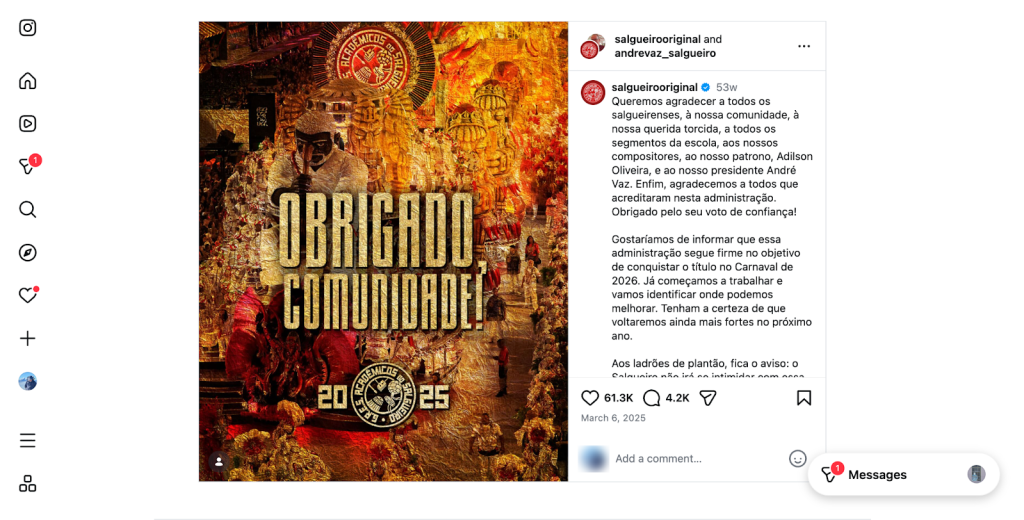
At the top of Salgueiro’s post was a message of gratitude for the school’s top financial patron, Adilson Oliveira Coutinho Filho. Oliveira, better known as “Adilsinho,” is a legendary bicheiro, the name Brazilians use to describe those who control informal lotteries in neighborhoods around the city.
The lotteries, referred to as Jogo do Bicho, are not just a way to make money. They are an avenue to political and social power in Rio, especially as it relates to the famous samba schools, which have long been the domain of the bicheiros.
The problem was that Adilsinho, who played professional soccer for a time, was also an accused criminal. On at least four occasions, authorities investigated him for crimes ranging from murder to expand his bicheiro business, to peddling contraband cigarettes with a mafia that operated in 11 Brazilian states.
For a time, he seemed untouchable. He beat each of the charges. And for his 51st birthday in 2021, in the middle of the pandemic, he invited 500 guests to celebrate with him at the iconic Copacabana Palace. On the invite, he reportedly referred to himself as “The Godfather” (O Poderoso Chefão).
But by the time Carnival came around again this year, things were heating up for Adilsinho on another, arguably more dangerous front. The missive issued by his samba school in 2025 had left bad blood among the leaders of the schools, and prior to this year’s huge parade, Salgueiro issued another statement, which further infuriated its most important players.
This one said the school had complete confidence in the judges. While there was no mention of Adilsinho, who had reportedly distanced himself from the school, many people interpreted the message as a veiled threat from the man himself that the judges better not relegate Salgueiro a second year in a row.
Six days later, Adilsinho was in handcuffs. The incredible carnivalesque turn seemed to send the message that contraband cigarettes, and even murder, were okay. But that challenging the Carnival hierarchy would not be tolerated.
Born Into the Jogo de Bicho Business
Adilsinho was born into a Jogo do Bicho clan in Duque de Caxias, a municipality in the metropolitan area of Rio de Janeiro. His father was a bicheiro who ran a network of lotteries all over the city. Over time, they got rich and moved to Rio’s high-end neighborhood of Leblon.
From an early age, Adilsinho was involved in his family’s operations. The lottery works like any other: Bicheiros sell tickets through street vendors, bars, kiosks, and newspaper stands. Many also manage slot machines and other low-grade gambling machines.
Adilsinho was a good bicheiro, and expanded his family’s criminal grip. He allegedly defrauded slot machines and perfected ways to make gambling more appealing by increasing the frequency of awards and reducing the amount paid to gamblers to guarantee a minimum profit. He also won more territory, which for bicheiros, is crucial. More city blocks equals more lottery tickets sold.
SEE ALSO: Corruption Case Exposes Influence of Brazilian Animal Game Boss
Beginning in the 2000s, Adilsinho also expanded his business to other Brazilian states, sometimes at gunpoint. According to Brazilian prosecutors, he orchestrated the murder of the owner of an online gambling company in the northeastern state of Maranhão. And in 2023, the police accused his cigarette mafia of killing a legitimate cigarette distributor in Rio as part of a plan to eliminate competitors and establish dominance over the supply chain.
At some point, prosecutors say he also began manufacturing contraband cigarettes in Paraguay, which his network then trafficked and sold in Brazil. To facilitate the trade, he bribed Paraguayan and Brazilian authorities. He also allegedly used slave labor: In 2022, authorities rescued some 70 Paraguayans working in slave-like conditions in Adilsinho’s clandestine cigarette factories.
The Samba Squabble
In 2022, Adilsinho made a phone call to a close relative. The two talked about a lot of things, including the leadership of Carnival.
Carnival is run by the Independent Samba School League (Liga Independente de Escolas de Samba, or LIESA, as they refer to it in Brazil). LIESA was created in 1984 by a group of prominent bicheiros. Ostensibly the leaders sought to professionalize and manage the samba school parades that are the heart of Brazil’s Carnival. But in practice, it was a way to launder their image and bolster their political and social power.
“[LIESA] is the public face of the [Jogo do Bicho] leadership. It is the legitimate face that consolidated the upper echelon’s political power,” Rômulo Labronici, Ph.D. in Anthropology from Fluminense Federal University (Universidade Federal Fluminense – UFF) and a Jogo do Bicho expert, told InSight Crime.
Labronici said the bicheiros used this political power to gain top cover. He noted that leaders of LIESA met with politicians who later paved the way for the construction of Rio’s Sambódromo, the famous 80,000-seat stadium where the parade takes place and arguably the most important symbol of the gray market the bicheiros represent.
For his part, at the time Adilsinho did not manage a samba school, but he felt LIESA was being bullied by two powerhouse schools. And during the call, he blasted these leaders as criminals who had disrespected the traditional Carnival leadership.
“It’s over. It’s in the past! It’s a whole new generation now!” he told his relative. “They’re all crooks! Total scoundrels! They sweet-talk us, but they just want to call the shots! The old guard is long gone.”
He also revealed his next move, telling his relative that he was in talks to take over a samba school. In time, he would.
By then, as part of their investigations, police were intercepting Adilsinho’s calls, and, after the transcript of this one was leaked to the press, a scandal erupted. His relationship with LIESA was scarred forever.
In response, Adilsinho changed tact, expanding into the territory of another bicheiro clan, which had long financed Salgueiro, a powerhouse samba school in its own right. Salgueiro had a long and bloody history. Beginning in 2004, a number of Salgueiro patrons had been murdered, but by 2024, Adilsinho, with the help of two other bicheiros in territory that he had usurped, gained control of the school.
Then came Carnival 2025. And after Salgueiro finished seventh, Adilsinho smelled something fishy in the judges’ decision, and his school issued that blistering missive on Instagram. It might have been, in hindsight, the beginning of the end for him.
Featured image: A float pictured at Brazil’s annual Carnival celebration in Rio de Janeiro. Credit: InSight Crime/Liza Schmidt.

Don't Miss:
-
Two Police Officers Gunned Down in Villa Juárez, San Luis Potosi
-
Supreme Court justices lean towards Trump in asylum-processing case
-
Minnesota sues government for access to evidence in 3 shooting deaths by federal officers
-
Judge allows Brazil’s Bolsonaro to serve 27-year sentence at home due to ill health
-
Trump’s approval hits new 36% low as fuel prices surge amid Iran war, poll finds