
 From Iran to China: An Emerging Trans-Central Asian Corridor
  New documents show how a retail chain’s sales practices helped put guns on US streets
  Singapore a battleground of commodities fraud lawsuits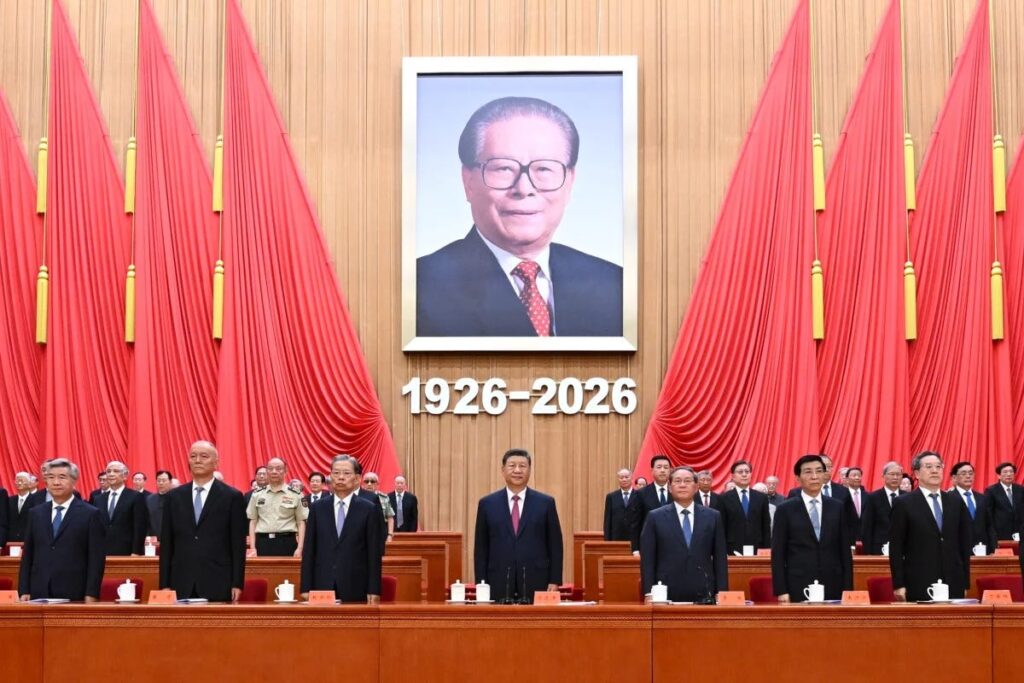
Chinese President Xi Jinping, who faces enemies on many fronts, needs all the friends he can get as he seeks a fourth term. This is why Xi is handing out exceptional honors to two late Chinese leaders, President Jiang Zemin and Prime Minister Zhu Rongji, analysts told Asia Sentinel.
“The fact that Xi has been forced to adopt high-profile functions to honor Zhu and Jiang shows the limits of Xi’s powers,” Willy Lam, a veteran Hong Kong journalist and senior fellow at the Jamestown Foundation, told Asia Sentinel. “It is possible that Xi might merely be giving lip service to Zhu and Jiang to placate still-powerful CCP (Chinese Communist Party) members loyal to Zhu and Jiang.”
Zhu, hailed in state media as “an outstanding leader,” was cremated in Beijing on Aug. 18. The Chinese flag in Tiananmen Square in Beijing was flown at half-mast while tight security sealed off the area.
The tight security likely reflects the Chinese government’s fear that the death of Zhu, who is liked by many Chinese for his economic reforms, might spark demonstrations. The death of another Chinese leader, Hu Yaobang, in April 1989 led to the protests in Tiananmen Square that ended in carnage on June 4, 1989.
The official hagiography of Jiang in particular now approaches idolatry.
A silver coin bearing Jiang’s face will be issued, the People’s Bank of China announced on Aug.14. China’s postal service issued stamps on Aug. 17 commemorating Jiang. With the support of the Chinese government, a book of articles on foreign diplomacy by Jiang has been distributed throughout the nation, state media reported on Aug. 17.
“Xi has to honor both of them to mitigate conflict. Xi probably seeks a fourth term as general secretary and president and he must build public and party support,” an ex-banker told Asia Sentinel.
Getting ready for term 4
Xi will chair a meeting in Beijing in October at which analysts believe he will seek endorsement for a fourth term. Xi already broke a rule laid down by the late leader Deng Xiaoping that Chinese presidents should not serve more than two five-year terms. His power may be creating unease.
“He has amassed too much power, so everybody is against such an upstart. He broke the 10-year tenure rule and went after other princelings for corruption, so he alienated himself from the princelings. Not only did he not protect their interests, but actually moved their cheese away from them,” a Malaysian analyst told Asia Sentinel.
“Xi has enemies aplenty and everywhere. So he needs some sort of allies,” said the analyst, who declined to be named. “Apparently, Xi needs to bolster himself with the help of the Jiang faction nowadays, hence all the olive branches to the Jiang faction.”
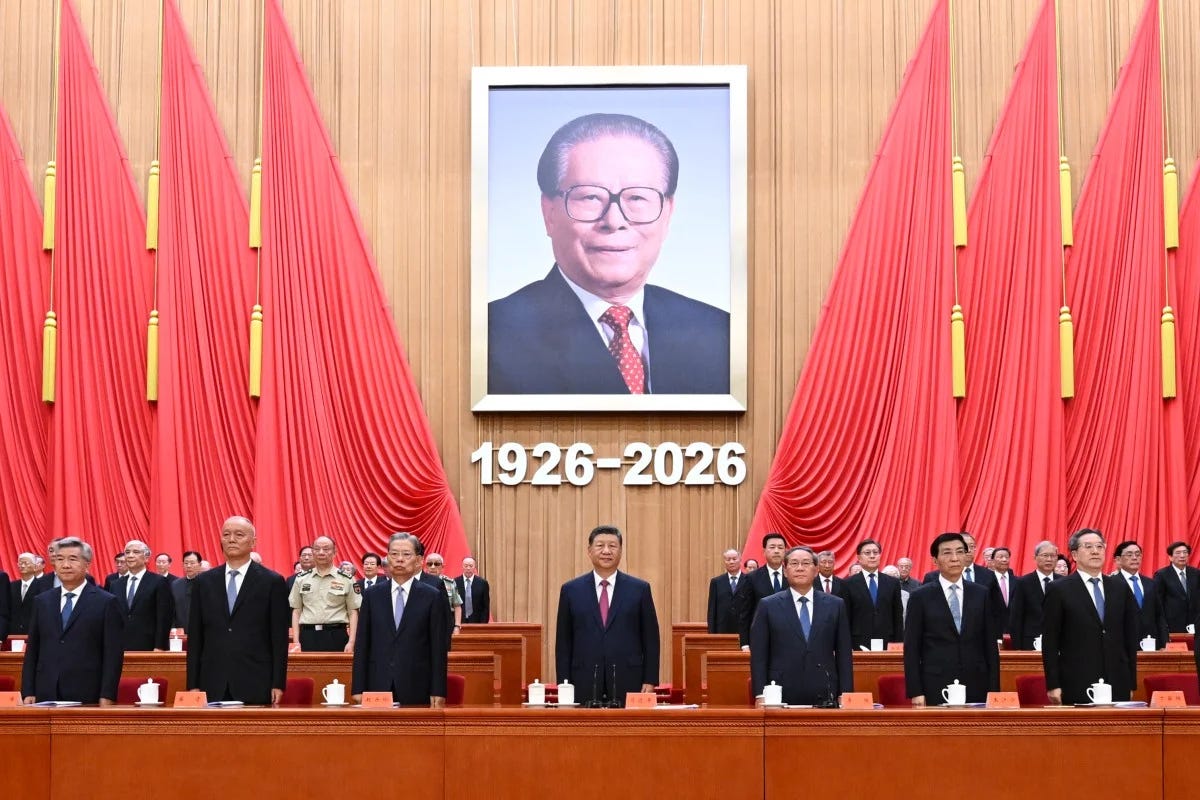
In a ceremony marking the 100th anniversary of Jiang’s birth at the Great Hall of the People in Beijing on Aug. 17, Xi spoke glowingly of Jiang, who died in 2022 at the age of 96. Xi praised Jiang for having lived a glorious life and making contributions that can never be forgotten. Xi commended Jiang for having made the Chinese people more prosperous and deepening economic reforms. Xi declared of Jiang, “We must learn from his strategic foresight.”
Cai Qi, the fifth most powerful Chinese leader, is hosting a discussion on the thought of Jiang in Beijing Aug. 17-19, Chinese state media reported. The forum will discuss “the Three Represents,” the signature philosophy of Jiang, which reconciled capitalism with Chinese Communist doctrine.
Jiang’s good old days
Under the current political and economic climate in China, Xi needs to respect Jiang’s accomplishments. Many Chinese remember that under Jiang the economy boomed and wages rose. Xi needs to create a narrative that builds on Jiang, rather than denouncing or criticizing him, because many Chinese question the course that Xi has chosen for China,” explained the ex-banker, who declined to be named.
Xi’s effusive praise for Jiang is an apparent reversal of the two men’s rivalry when Jiang was alive. In 2020, Xi cancelled the initial public offering (IPO) of Ant Group in Hong Kong and Shanghai, for example. The $37 billion dual listing would have been the world’s biggest IPO at that time. Alvin Jiang Zhicheng, a grandson of Jiang Zemin, was a minority shareholder of the Chinese online payment company.
Alvin and his father, Jiang Mianheng, attended the 100th anniversary event for Jiang. At the ceremony, Xi shook hands with Jiang Mianheng, the eldest son of Jiang Zemin, and posed for photographs with members of the Jiang family.
Former Chinese leaders like Wen Jiabao, Wang Qishan and Zhang Gaoli also attended the ceremony.
The meaning of the elders
Conspicuously absent was Hu Jintao, Xi’s predecessor. The former Chinese President was escorted out of a Communist Party Congress session in Xi’s presence in Oct. 2022 and is rarely seen in public any longer. Hu was seen as close to Jiang.
“A key point of observation for these commemorative events is whether Hu Jintao will make another public appearance. If he attends, it could at least be leveraged on the level of political messaging to demonstrate that unity persists between the current leadership and the retired elders; if he continues to be absent, it will inevitably reignite external speculation about his health and high-level relationships,” China watcher David Tsai tweeted on Aug. 15.
“By comparison, whether Wen Jiabao and Wang Qishan appear is equally noteworthy. There have been numerous unverified rumors surrounding their political circumstances in recent years, so if the two attend as normal, it would undoubtedly address some of those external speculations to a certain extent; conversely, if several heavyweight retired leaders are absent simultaneously, the political symbolism would only be further amplified,” Tsai said.
At the ceremony, Xi praised Jiang for being “decisive, confronting risky challenges, resolutely overcoming danger and difficulties.”
Deng had chosen Jiang to be his successor, largely because Jiang put down the protests in Shanghai without bloodshed in 1989, in contrast to the bloody crackdown in Beijing that year.
“We must learn from his resolve and unusual courage…to better combine development and security,” Xi said at the ceremony.
Another of the old titans, former premier Zhu Rongji, died at the age of 97 on Aug. 12. The next day, Chinese state media praised him in a lengthy obituary, saying that after Zhu stepped down as prime minister in March 2003, he “firmly supported” Hu as China’s leader and subsequently Xi as China’s leader.
In many circles, it is believed Zhu was at odds with Xi over his economic policy, but after retirement, Zhu remained quiet on policy matters, which allowed speculation to continue.
Don't Miss:
-
From Iran to China: An Emerging Trans-Central Asian Corridor
-
New documents show how a retail chain’s sales practices helped put guns on US streets
-
Singapore a battleground of commodities fraud lawsuits
-
From Propagandist to Criminal
-
On Indonesia’s fires, El Nino’s impact on the power sector, and other stories | Asia Sentinel Stories of the Week