
 IMDB’s China Connection
  Trump administration gave firm with ties to ballroom donor the green light to do business with a sanctioned Russian bank
  Claire Sylvia on the Constitutionality of the False Claims Act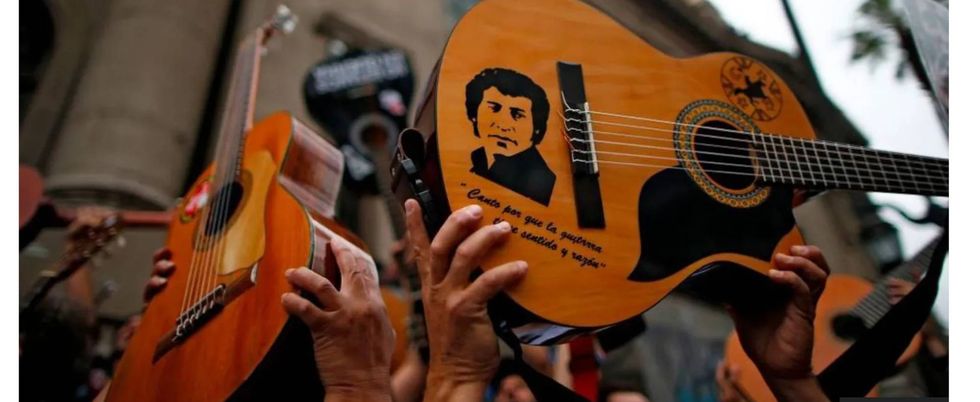
More than 50 years after the murder of iconic Chilean folk singer Victor Jara, the last man convicted of killing him has been tracked down and brought to justice. In 1973, a day after Pinochet’s coup, Jara was seized, tortured, his hands broken to silence what was deemed music “more powerful than a thousand machine guns.” Today, in a world tilting right, he remains an enduring symbol of resistance. Manifiesto: “A song has meaning/ When it beats in the veins/ Of a man who will die singing.”
On Sept. 11, 1973, troops under brutal, U.S.- backed General Augusto Pinochet bombed and stormed the presidential palace in Santiago to depose Salvador Allende, a Chilean physician who’d become the first democratically elected Marxist head of state in Latin America. Barricaded inside the palace, Allende gave a final speech defending Chilean democracy. “My words do not have bitterness but disappointment.,” he said. “May they be a moral punishment for those who have betrayed their oath.” He thanked the country’s workers, farmers, miners, women, intellectuals, students for their heartfelt loyalty to “a man who was only an interpreter of great yearnings for justice.” “I will always be next to you,” he said. “My sacrifice will not be in vain. History is ours.” Then he shot himself under the chin with an assault rifle.
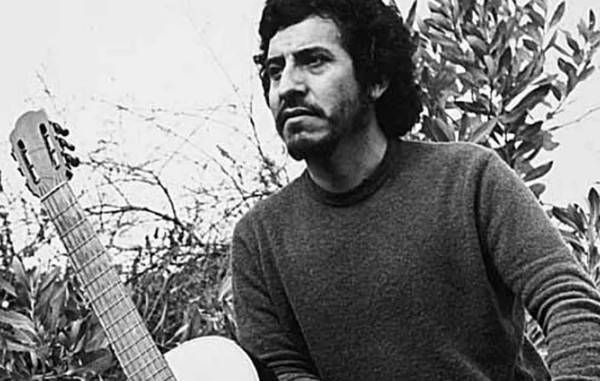
A Marxist activist and singer hugely popular with Allende supporters, Jara had re-written the 1969 song Venceremos – composed by Sergio Ortega with original text by Claudio Iturra – as an anthem for Allende’s 1970 Popular Unity election campaign. Born to a poor farm family, Jara was mestizo, a mix of Indigenous Mapuche and Spanish heritage. He once said his first memory was hearing his mother sing folk songs as she worked in their garden or kitchen; after she died when he was 15, Jara went to seminary school but eventually decided against the priesthood. After military service, he studied theater and music at university, then turned to writing songs that merged tender folk music with political themes – rural working-class stories, brutal evictions of squatters: “We began to create a new kind of song. It was music that was born out of necessity.”
In September 1973, widely recognizable, he was seized by soldiers the day after the coup and taken to Estadio Chile, a Santiago stadium now named for him, where about 5,000 people were being held. For four days, he was beaten, tortured, humiliated. An officer threw a cigarette on the ground and made him crawl for it; others played Russian Roulette with him; eventually, they broke both his hands before parading him through the stadium; later, through split lips, he sang a final Venceremos – “We Will Prevail.” On his last day, said a fellow detainee, he found a pen and notebook and scribbled one more song, or harsh poem, Estadio Chile, later smuggled out. Two hours later, he was killed, his body dumped near a cemetery. His body had 44 bullet wounds 56 broken bones, including a shattered skull. He was 40 years old.
The Pinochet dictatorship went on to kill or disappear over 3,000 people, and detain and torture up to 40,000 during its brutal 17-year reign. It ended in 1990 through a constitutional process wherein voters rejected extending its rule and elected a civilian president. After years of legal efforts to hold Pinochet accountable, in 1998 a Spanish judge issued an international arrest warrant for his human rights abuses; he was detained in the U.K during a medical visit after the House of Lords ruled he did not have immunity, but Britain ultimately released him back to Chile in 2000 for health reasons. There, Chilean judges pushed their Supreme Court to strip him of immunity to face trial for murders and kidnappings tied to military death squads, but he died under house arrest of a heart attack in 2006, age 91, having never been formally tried or convicted for his crimes.
Victor Jara, one of the regime’s most beloved and recognizable victims, swiftly became an enduring international symbol of resistance after the deadly, public silencing of his music. In 2003, Estadio Chile was renamed Estadio Víctor Jara; in 2009, Victor’s body was reburied in a public funeral attended by thousands of mourners; today, an annual 1,000 Guitars event held in his honor at that stadium also draws thousands. Still, the moral arc of the universe moved slowly. Over time, Chilean courts convicted hundreds of military officers and secret police for human rights abuses, but it was not until 2018 that eight retired officers were charged with Jara’s murder, and that of Allende’s director of prisons Littré Quiroga Carvajal. In August 2023, after five years of appeals and 50 years of evading justice, Chile’s Supreme Court convicted them all in a unanimous decision.
The Court sentenced the eight, several in absentia, to 15 years and a day for the murders of both men, and 10 years and a day for their kidnappings, for a total of 25 years. A ninth was given eight years for concealing the crimes. The Court also dismissed all their appeals for annulment, and ordered the state to pay large reparations to the families of both men. Of those sentenced, 86-year-old Gen. Hernán Chacón killed himself moments after police arrived to arrest him at his home in a wealthy district of Santiago. Another, Pedro Barrientos, had fled Chile for the US in 1989; he was extradited back in 2023 after he was arrested in the US during a traffic stop. During his trial, one former soldier testified Barrientos liked to brandish his pistol in a crowd and declare, “I killed Víctor Jara with this!”
Five others have been in jail since then. Only one, Nelson Haase Mazzei, had remained missing since he failed to appear in court in 2018. A retired colonel, Haase Mazzei joined the Chilean army’s notorious Tejas Verde brigade in 1972 and was part of Pinochet’s brutal secret police; he worked closely with its head, Manuel Contreras, sentenced to over 500 years in jail for crimes against humanity before his 2015 death. Last weekend, in likely the final act of a too-long quest for justice, Chilean police announced they’d arrested Haase Mazzei, now 80, in rural Puyehue, south of Santiago. A judge ordered his immediate imprisonment to start his 25 year sentence; one article noted, “Impunity Takes Another Hit.” Another said his defense lawyer has requested his transfer to Punta Peuco, a ritzy jail already housing many of the Pinochet era’s murderers.T
hrough the Víctor Jara Foundation, started by Victor’s widow Joan, a British dancer and activist who died in 2023 at 96, their daughter Amanda said she welcomes the news of Haase’s arrest but, “Half a century after the murders, it is difficult to see this as justice.” Still, Jara’s songs live on from when Allende, after he won the presidency, spoke before a banner reading, “You can’t have a revolution without songs.” “They were on the radio and television,” said Joan in 1975. “The song movement was a tremendous weapon.” Since then, music has continued fighting the fear authoritarianism depends on, transforming “political grievance into a shared language of survival” – Miriam Makeba, Mikis Theodorakis, Pussy Riot, America’s Woody Guthrie to Dylan to Bad Bunny, who launched his 2026 tour in Chile with Jara’s song, dedicated to Ho Chi Minh, The Right to Live in Peace.
In 2020, James Dean Bradfield, lead vocalist and guitarist for the Welsh alt-rock band Manic Street Preachers, released Even in Exile, a concept album dedicated to Jara’s life and work, along with a three-part podcast. Bradfield discovered Jara as a teen, taken aback by a tenderness he didn’t associate with “one of the only truly Marxist musicians. The truth…floats to you like a dream.” He learned more about Jara from poet Patrick Jones, whose brother is Bradfield’s bandmate; Jones had found two compilations of Jara songs in a thrift shop, became “obsessed” and wrote dozens of poems about Jara that, shared with Bradfield, became the album’s songs. For Jones, the story of Jara’s life and death is “a warning from history” that deeply . resonates with today’s rise of the right: “Power is always afraid of those who stand up and say, ‘There’s another way.'”
For the album, Bradfield wanted songs that span Jara’s life, from his rural childhood to his final hours. He was moved by his singing of Venceremos near the end – “He died defiantly, but with grace” – yet felt, “If you just focus on his death, you ignore the journey.” Above all, he wanted to highlight Jara’s daunting courage and conviction throughout his life, a “naked truth” that rendered him what Phil Ochs called, when he met Jara in 1971, “the real thing.” For Bradfield, it reminded him of the Preachers’ 1998 song, If You Tolerate This Your Children Will Be Next. He also deliberately chose to include Jara’s final Estadio Chile – “How hard it is to sing when I must sing of horror/ Horror which I am living, horror which I am dying” – which he calls “an anthem that became a prophecy.” Of Jara’s life and work, he hears “the echo time and time again. I wanted to show here’s an echo that doesn’t die.”
– YouTube www.youtube.com
– YouTube www.youtube.com
Don't Miss:
-
Watch: The New Supreme Court
-
On Unseriousness: Digging More Bonkers GOP Holes
-
“Our Dear Friend Umar”: How We Uncovered That a Russian Oligarch Bankrolled Donald Trump Jr.’s Wedding
-
Tennessee Lawmakers Demand Answers on Safety in State Youth Prisons
-
Judge Denies Efforts to End Oversight of Maricopa County Sheriff’s Office as Racial Profiling of Latinos Persists