
 TRANSCRIPT: ‘China Retains Levers for Long-Term Territorial Ambitions’
  On Indonesia’s new oligarchy, China’s state bank, and other stories | Asia Sentinel Stories of the Week
  ‘Tinder Swindler’s’ plan for a dating app sparks industry backlash
 In the three years since President of El Salvador Nayib Bukele opened his famous Terrorism Confinement Center (Centro de Confinamiento de Terrorismo – CECOT), leaders around Latin America have attempted to follow in his footsteps in hopes of replicating El Salvador’s success in repressing gangs.
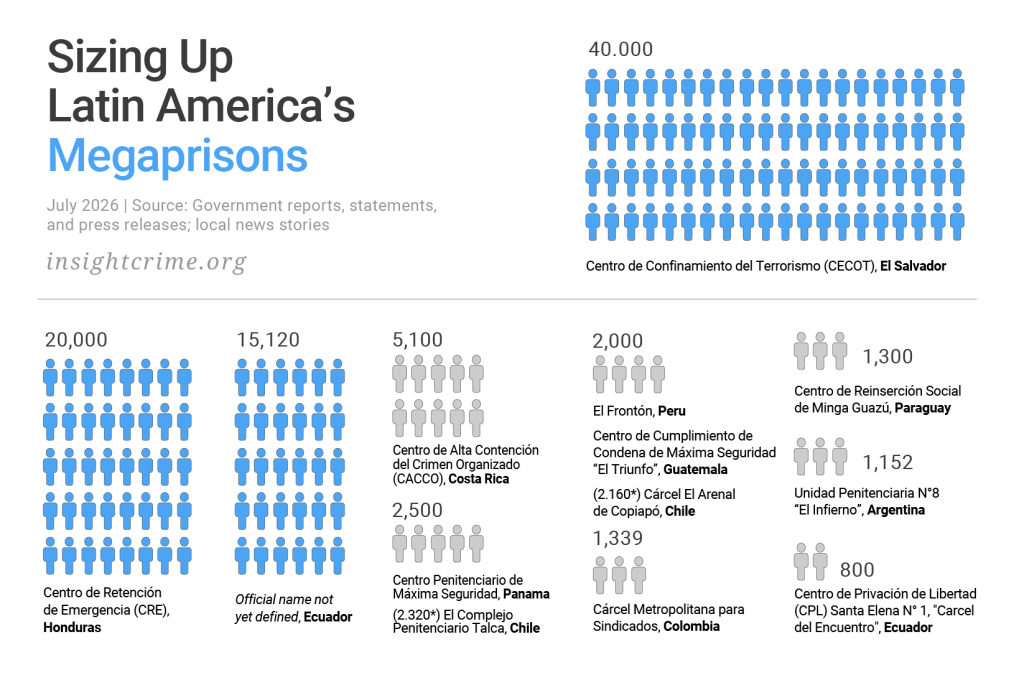
CECOT is one of the cornerstones of Bukele’s mano dura (iron fist) crackdown on organized crime in El Salvador. It is located in Tecoluca, about 70 kilometers east of San Salvador, and boasts a capacity of 40,000 prisoners.
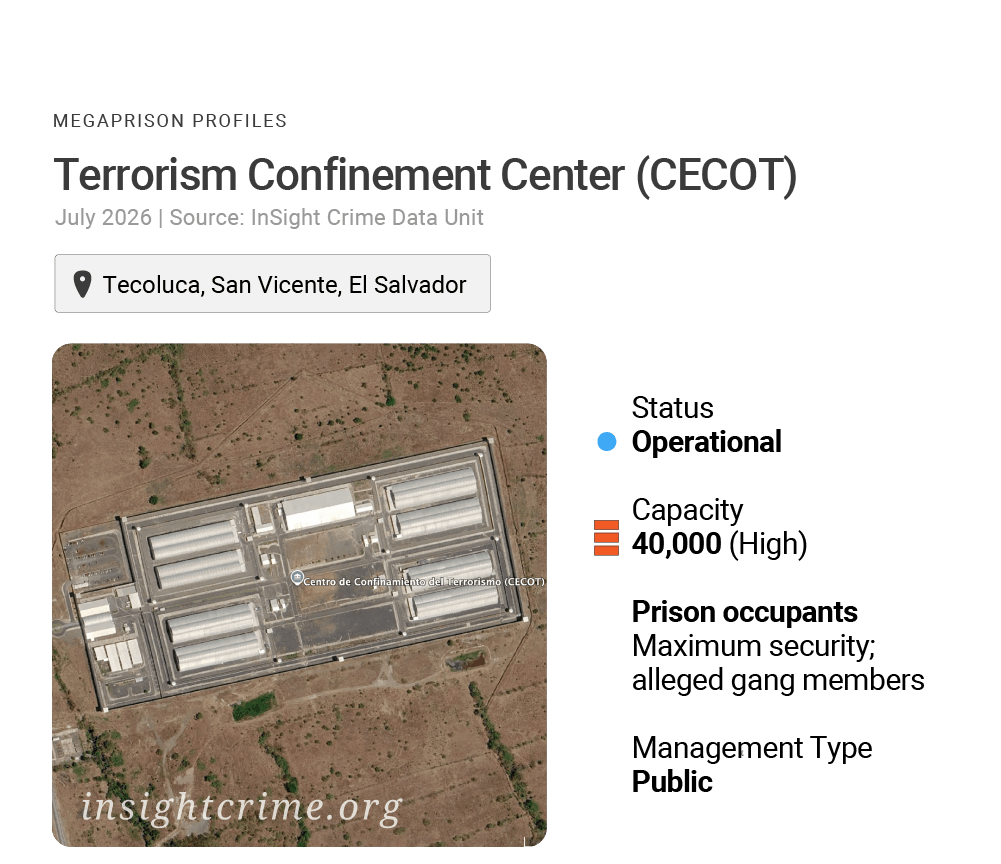
Built in just seven months, the prison opened in February 2023 to much hype—dramatic videos showing tattooed and shirtless prisoners rushing into massive cell blocks, heavily armed guards patrolling row upon row of men seated in tight lines with their heads bowed, sweeping drone footage of the prison’s expansive grounds—all highly polished and widely promoted on social media by the Bukele government. Between CECOT and other facilities, Bukele’s government has imprisoned nearly 2% of the country’s population.
Bukele’s crackdown began in March 2022, after a gang massacre left 86 dead. In response, Bukele implemented a state of emergency, suspending many constitutional rights and loosening rules on making arrests in the name of fighting organized crime. This state of emergency, which has since been renewed for 52 consecutive months, led to the arrest of tens of thousands of suspected gang members and collaborators, as well as widespread reports of human rights abuses ranging from arbitrary arrests to torture.
SEE ALSO: How El Salvador’s (Perpetual) State of Emergency: How Bukele’s Government Overpowered Gangs
Bukele’s relentless efforts have successfully weakened the Mara Salvatrucha (MS13) and Barrio 18 gangs that once terrorized El Salvador, after decades of failed attempts by other governments.
Leaders throughout Latin America are attempting to mimic Bukele’s approach, including building their own “megaprisons.” During her term as president of Honduras, Xiomara Castro announced plans for a megaprison that would hold 20,000. Rodrigo Chaves in Costa Rica and Dina Boluarte in Peru announced similar plans during their tenures as president, and under Daniel Noboa in Ecuador, José Raúl Mulino in Panama, and Bernardo Arévalo in Guatemala, construction on such facilities has begun. Colombia’s newly elected president, Abelardo de la Espriella, said during his campaign that he plans to build 10 new megaprisons during his mandate. Yet many of these initiatives function more as political signaling than substantive policy changes.
Below, InSight Crime analyzes the region’s proposals for new megaprisons.
Megaprisons Around the Region
Since the opening of CECOT in 2023, there have been 16 megaprisons proposed in 10 countries around the region.
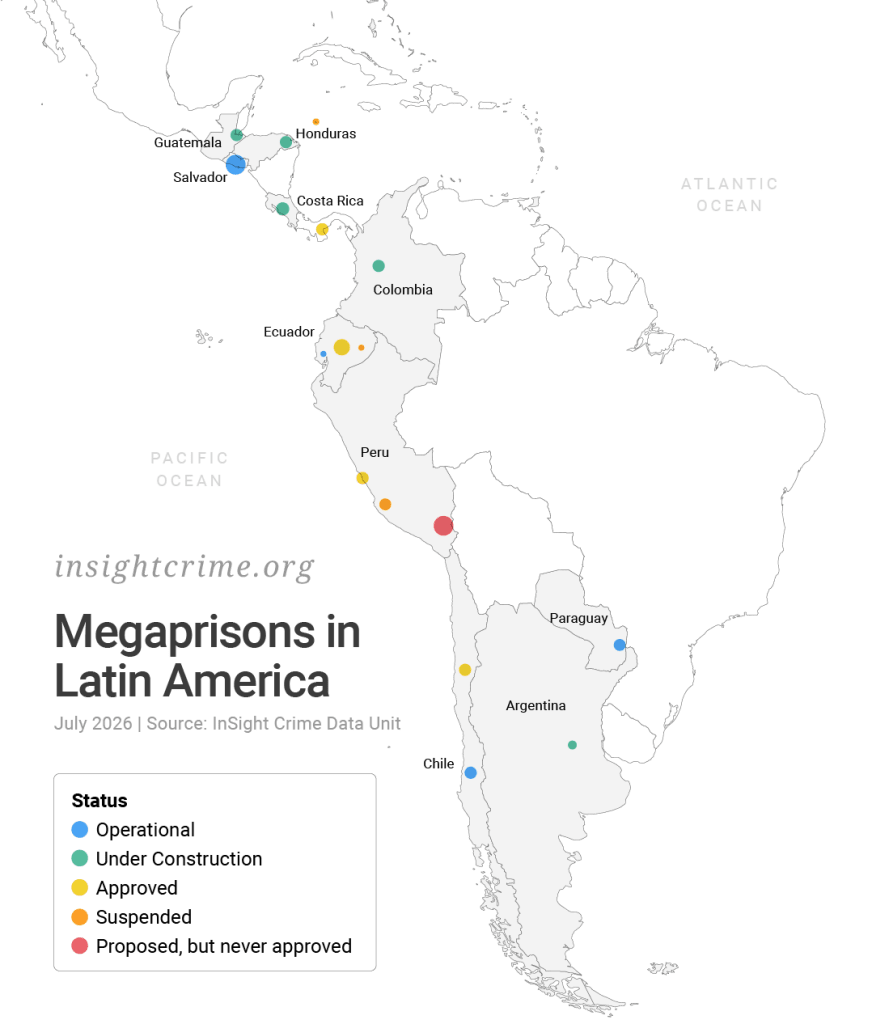
Several of these prisons have not made it past the proposal phase or were halted in early construction stages. The plans for a prison on Honduras’ Swan Islands in the Caribbean were quashed on environmental protection grounds. A proposal for a facility in Ananea, Puno, Peru, that would hold 30,000 prisoners was never even approved. While others in Panama, Ecuador, and Peru have been approved, construction has not yet begun.
Ecuador’s Noboa has been a particularly strong supporter of the mano dura approach. Like Bukele, Noboa declared an internal armed conflict against the country’s criminal groups in January 2024 after gang violence in Ecuador exploded in response to increased cocaine flows. Since then, he has proposed the construction of several prisons. “For all the Bukele lovers, this prison will be exactly the same,” he said when announcing his prison plans.
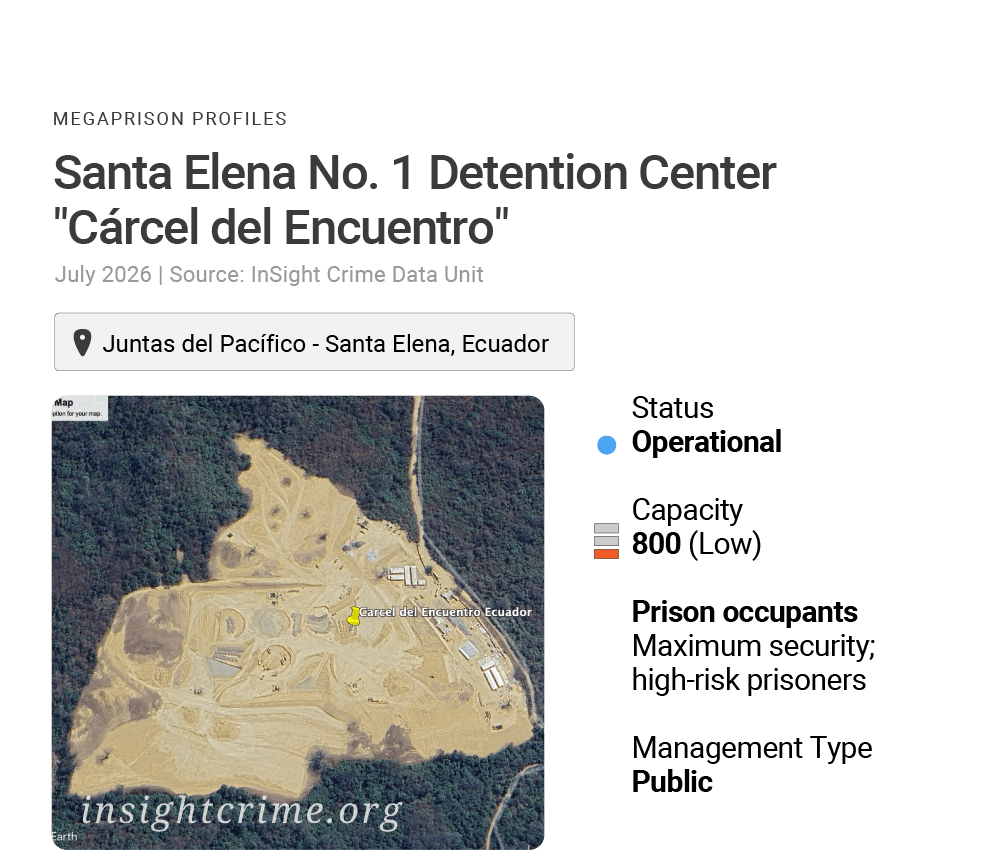
One is already operational: the Santa Elena No. 1 Detention Center, also known as “El Encuentro,” in Santa Elena province in western Ecuador. Another facility for 15,000 prisoners was announced in November 2025, though further details have not yet been shared.
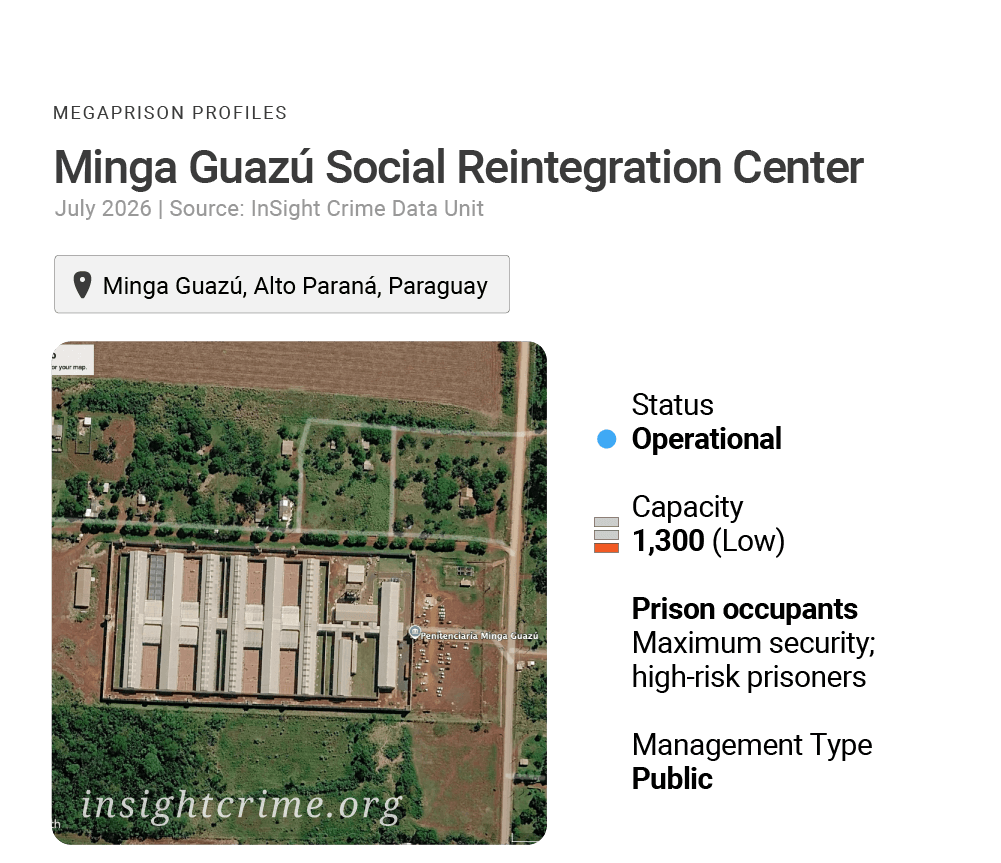
The Minga Guazú Social Reintegration Center in Alto Paraná, Paraguay, is the other operational megaprison in the region, though it is far smaller than CECOT in El Salvador. Built to hold just over 1,300 high-security prisoners, mass transfers to the prison began in August 2025.
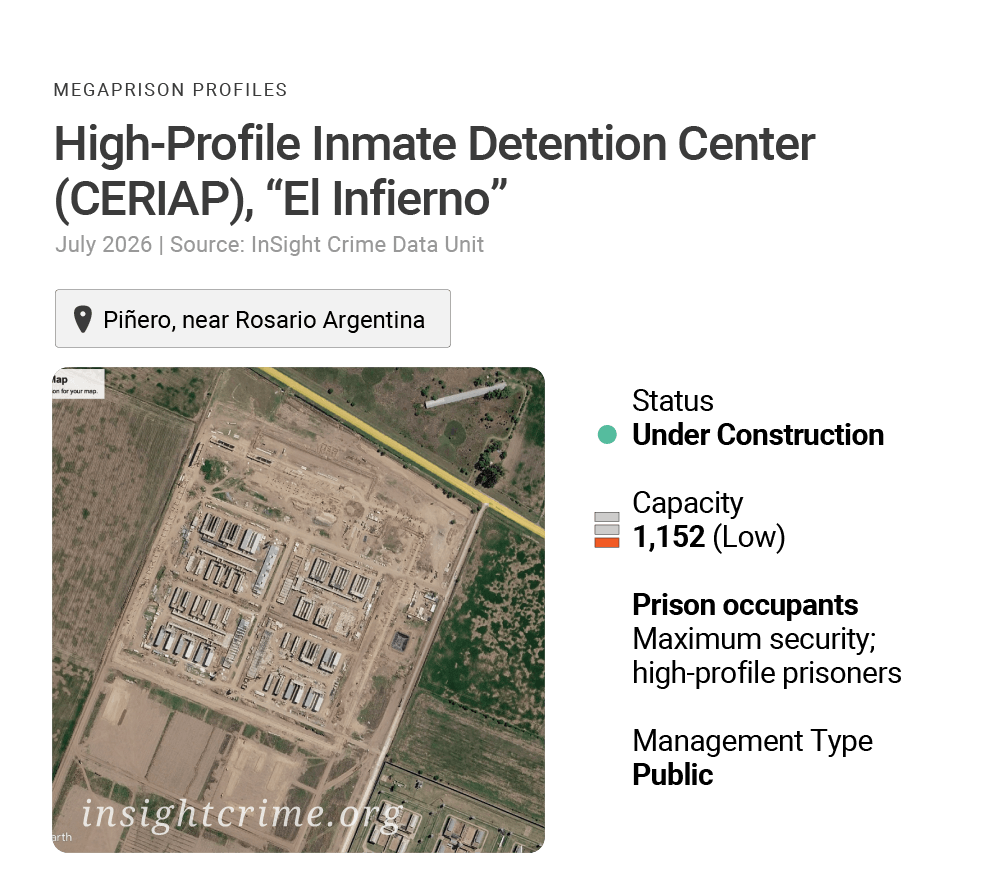
Argentina’s third-largest city, Rosario, has become an epicenter for drug trafficking and violence in the country in recent years. Less than ten miles away, construction for the High-Profile Inmate Detention Center (Centro de Reclusión para Internos de Alto Perfil – CERIAP), or “Hell” (“El Infierno”), as it has been nicknamed, is underway.
A Mega-Fixation on a Flawed Model
The term “megaprison” has become a buzzword for regional leaders attempting to signal a tough-on-crime stance. But so far, despite replicating Bukele’s playbook, none have achieved the same results.
While size alone does not account for CECOT’s success, most proposed facilities, despite being promoted as megaprisons, are considerably smaller.
But maximizing prison capacity is not a dependable recipe for success.
History has shown that jailing large numbers of people is not an effective anti-crime policy. Understaffed and underfunded prisons are breeding grounds for violence. Inmates form groups for protection and begin to compete for turf and business within prison walls. Many of the region’s most powerful criminal groups were forged inside overcrowded prisons, including Tren de Aragua, which formed in Venezuela’s Tocorón prison and in a few short years became the regional bogeyman of organized crime; Brazil’s biggest criminal groups, the First Capital Command (Primeiro Comando da Capital – PCC) and Red Command (Comando Vermelho); as well as the Choneros, the Lobos, and the Tiguerones in Ecuador. In El Salvador, as well, prisons used to function as de facto headquarters for the gangs. Starting behind bars did little to curb these groups’ growth; most came to control the prisons they occupied, using them as spaces to coordinate criminal activities, a steady stream of recruits, and a springboard to expand onto the streets.
SEE ALSO: The InSight Take: El Salvador’s Mass Trials Put Bukele’s Gang Crackdown on Display
CECOT is an exception because of its focus on imprisonment for life and its extremely restrictive conditions. Inmates are not allowed any contact with family or the outside world and are confined in crowded, windowless cells. They are mostly denied access to legal counsel and are subjected to solitary confinement for any alleged misbehavior. These conditions in themselves violate prisoners’ human rights, but there have also been reports of systematic physical and psychological abuse. In mass trials of hundreds of prisoners at a time, collective sentences of hundreds or even thousands of years are being passed. While this extreme subjugation has succeeded in subduing gangs in El Salvador, political opposition, civic resistance, and financial restrictions hinder other countries from replicating the model.
What’s more, megaprisons address symptoms of organized crime rather than the causes. In Panama, poverty drives gang growth. In Costa Rica, drug traffickers have seized on port vulnerability to establish themselves. In Guatemala, rampant corruption undermines security efforts, allowing gangs to flourish. Surging production and trafficking of cocaine from Colombia and Peru and through Ecuador continue to drive criminal competition and growth in those countries and around the region. Megaprisons are, at best, a partial response to these problems rooted in deeper social, political, and economic conditions.
Sources and Methodology
This investigation is based on a review of government statements, official press releases, reports, and other publicly available sources. When media reports were used, information was verified across multiple independent outlets. Satellite imagery was also used to confirm the location, construction, and status of prison facilities where possible.
*Amanda Rocha contributed to the research for this article.


Don't Miss:
-
Middle powers don’t have to wait for a Trump-Xi-Putin summit
-
Woman dies after suspected dog attack in Hong Kong’s Yuen Long
-
Murder trial of slain Hong Kong socialite Abby Choi’s former relatives to begin
-
University calls for government funds for shared sites in Northern Metropolis
-
‘Staunch patriot, close friend’: Beijing official hails Tung Chee-hwa’s legacy