
 From Iran to China: An Emerging Trans-Central Asian Corridor
  New documents show how a retail chain’s sales practices helped put guns on US streets
  Singapore a battleground of commodities fraud lawsuits
 More and more countries across Latin America and the Caribbean are reporting cases of ketamine trafficking, reflecting a shift in the region’s drug markets driven by the rise of synthetic drug cocktails and more dispersed supply chains.
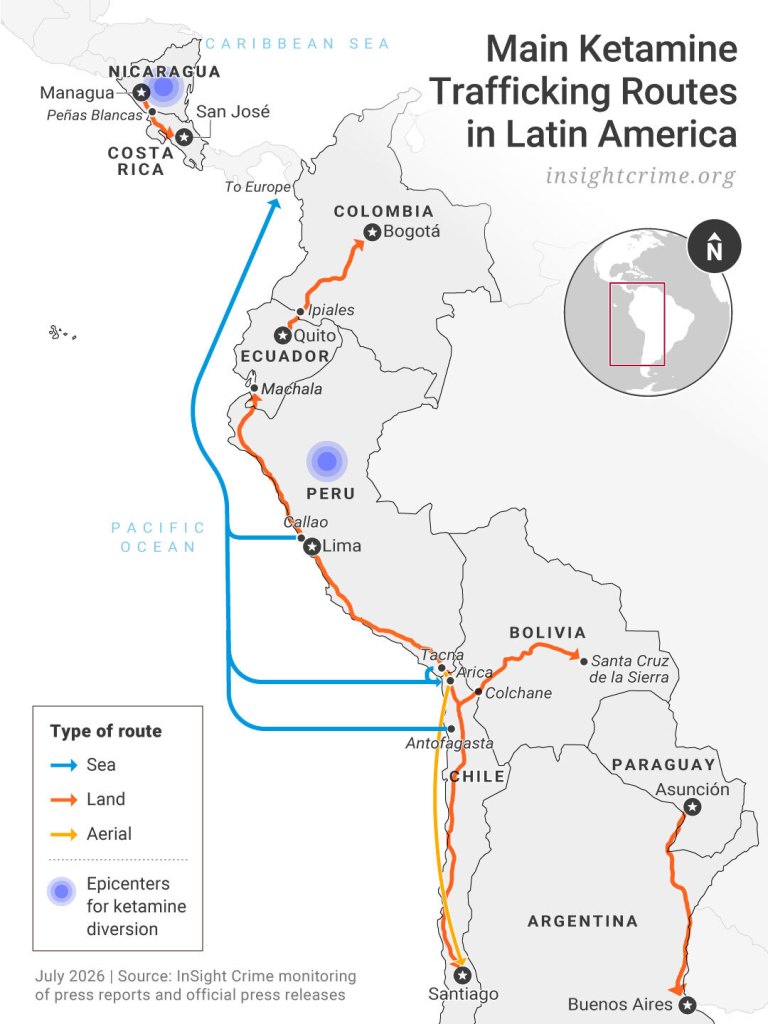
On August 3, the Regional Prosecutor’s Office in Arica, Chile, convicted 17 alleged members of an organization that trafficked ketamine from Peru to Chile. Shipments crossed the Tacna-Arica border using drug couriers who entered the country on foot and were then flown on domestic flights to supply drug markets in the Metropolitan Region, according to the investigation.
A few weeks earlier, on July 13, the Arica Court upheld the convictions of 18 members of another group that smuggled ketamine between the two countries, which included Peruvian, Chilean, Venezuelan, and Ecuadorian nationals. According to local media, some of its members may have had ties to the Ecuadorian criminal group the Lobos, although authorities have not disclosed further details.
Both cases illustrate a growing regional trend. Used as an anesthetic in human and veterinary medicine, ketamine is increasingly circulating in illicit markets across Latin America and the Caribbean because of its growing use in synthetic drug mixtures, according to the latest World Drug Report from the United Nations Office on Drugs and Crime (UNODC).
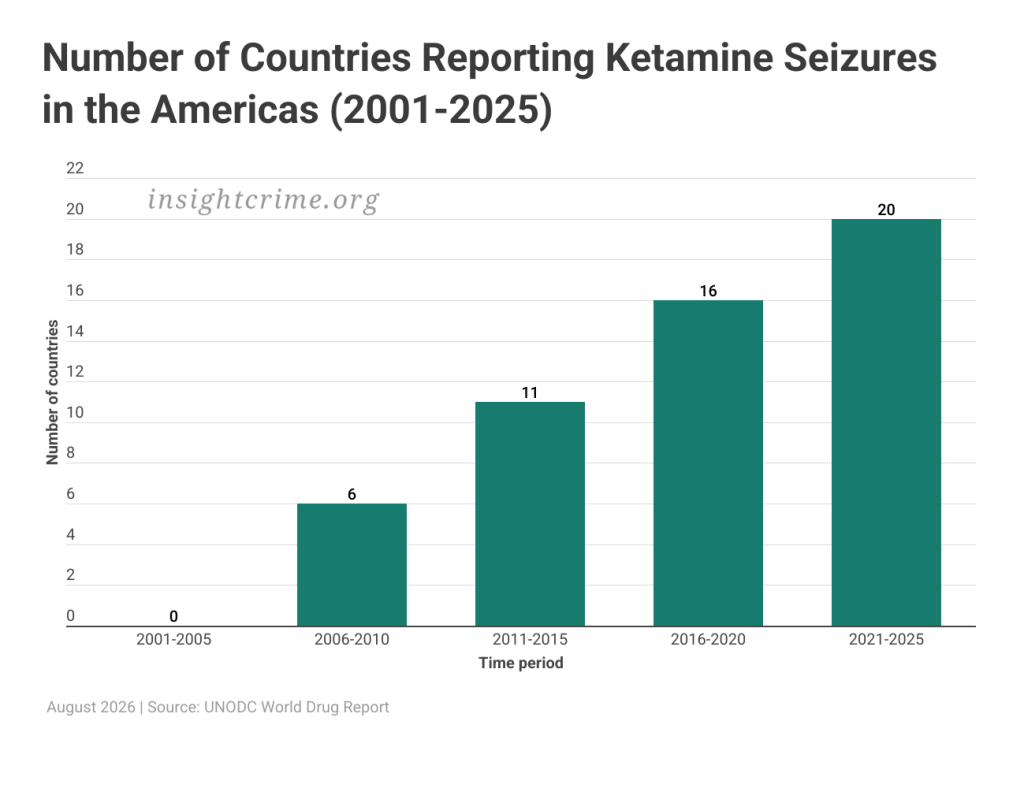
Although the Americas account for just 5% of global ketamine seizures, according to UNODC, the number of countries detecting the illicit trade in the substance has steadily increased, rising from none between 2006 and 2010 to 20 between 2021 and 2025.
The Rise of “Polysubstances”
For decades, ketamine occupied a marginal place in Latin America’s illicit drug markets. Although it has been used recreationally since it was first introduced as a pharmaceutical drug in the 1960s, its use was concentrated among small groups of consumers who gained access to it through contacts with medical supplies, with little involvement from organized crime.
But demand has surged alongside the growth of synthetic drug markets. The sale of mixtures containing multiple drugs, also known as polysubstances or “designer drugs,” has become increasingly common. These are substances with unique compositions designed to circumvent regulations and enhance the effects of traditional drugs.
In Latin America, this trend is reflected in the rise of so-called “tusi.” Although the name originally comes from the chemical compound 2C-B, today tusi rarely contains that substance. Instead, it is typically made from mixtures whose composition varies from one producer to another but which frequently include ketamine, MDMA, amphetamines, cocaine, caffeine, and medications such as paracetamol or acetaminophen.
SEE ALSO: Tusi: The Pink Drug Cocktail That Tricked Latin America
Ketamine also appears in other synthetic drug cocktails popular in the region, including some “speedballs”—mixtures of ketamine with stimulants such as MDMA—and the so-called “Calvin Klein” in Chile, a specific combination of cocaine and ketamine.
“Ketamine is a trendy drug and is highly sought after at electronic music parties. This has also helped it spread among an urban audience,” Pablo Zeballos, an organized crime researcher and former Chilean security official, told InSight Crime.
Chile, in fact, has emerged as one of the region’s largest consumer markets for ketamine, due in part to its relatively high levels of purchasing power per person and the prices synthetic drugs can command.
Low Barriers to Entry
Growing demand coincides with a key advantage for criminal networks: obtaining ketamine is often much easier than other drugs. Because it already exists as a widely marketed medication, traffickers do not need to manufacture the substance illicitly; they simply need to divert it from legal supply chains.
“We have detected several methods used to obtain [ketamine]: theft from veterinary facilities, recruiting people who work in the sale of the product, fraudulent purchases, forged prescriptions, diversion along the distribution chain, or illegal imports from neighboring countries,” Diego Chavarría, head of the Organized Crime Division of Costa Rica’s Judicial Investigation Agency, told InSight Crime.
Differences in regulations between countries facilitate this process, meaning trafficking occurs primarily between neighboring countries. Peru, for example, has fewer restrictions on the sale of ketamine than other South American countries, which has made it an important supply hub for Chile and Ecuador. In Central America, Nicaragua plays a similar role, according to Chavarría.
Once diverted from medical supplies, moving ketamine into the illicit market is also relatively straightforward. In liquid form, ketamine is transparent—earning it the nickname “water” in some countries—and can easily be concealed in ordinary containers. It can also be evaporated and crystallized into powder, which can then be transported in containers as small capsules.
In early July, for example, Chilean police dismantled a small laboratory in a residential area of Temuco, where liquid ketamine was being crystallized and divided into smaller quantities before distribution. Authorities seized more than 100,000 doses.
“Up to 40 doses can be obtained from one gram of ketamine, which is not common with other drugs,” Zeballos explained.
Transportation methods also rely on existing commercial infrastructure. Larger shipments, in the hundreds of kilograms or liters, are frequently moved overland in cargo trucks and private vehicles or by sea aboard fishing vessels traveling along the coast. Smaller quantities, from grams to tens of kilograms, are transported by drug couriers, often on commercial flights.
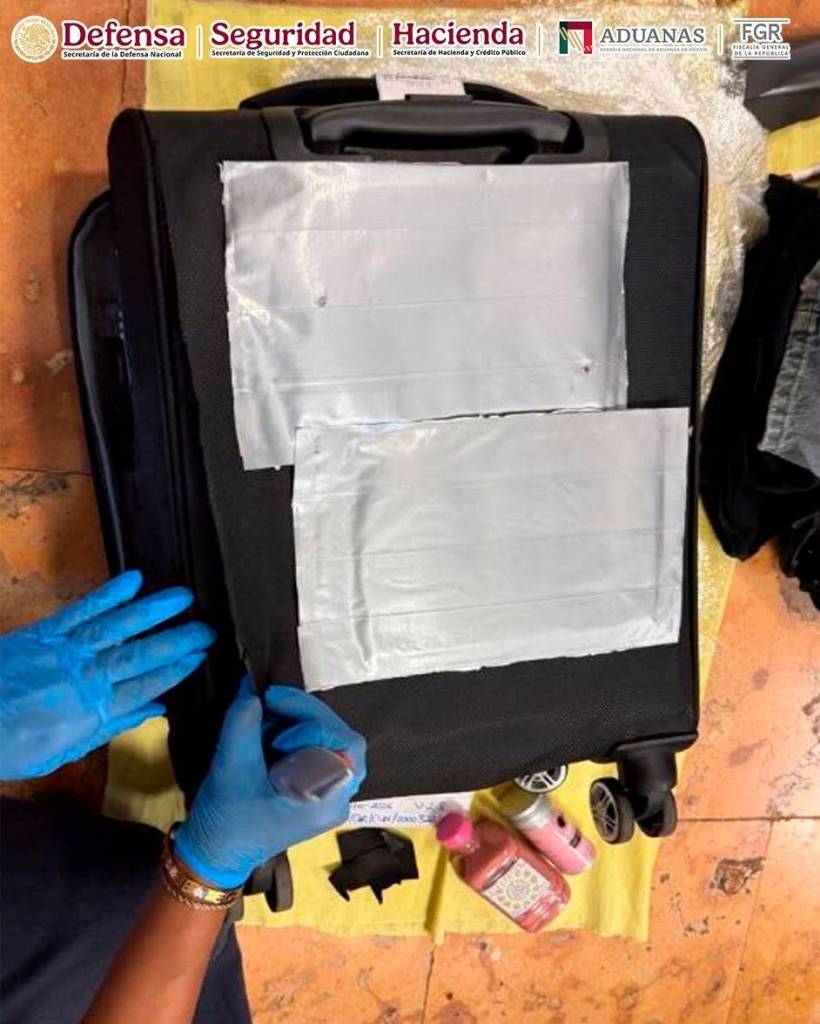
Authorities at Cancún International Airport in Mexico seized 2.6 kilograms of crystallized ketamine trafficked in carry-on luggage on a flight from Bogotá, Colombia. Source: Mexico’s Security Cabinet.
More recently, ketamine shipments from South America to Europe have also been identified, as demand there has likewise surged, according to the European Union Drugs Agency (EUDA). In March the Chilean Navy seized nearly 69 metric tons of drugs, including cocaine and ketamine—without specifying the amount of each—concealed in shipments of wood and rubber at the port of Arica bound for Germany and Italy.
“The could be that the logistics infrastructure built for cocaine trafficking to Europe is now being used for [ketamine], which offers high profit margins but faces less regulation and less police scrutiny,” Zeballos said.
A Highly Fragmented Supply Chain
No single criminal group controls the ketamine supply chain, or even specific parts of it. Low barriers to entry allow a wide range of actors to get involved, from large criminal organizations to independent networks and small-scale traffickers with no previous experience in drug trafficking.
“For now, the ketamine market appears to operate under conditions of polyarchy … different criminal organizations function as complementary links in the chain rather than as competitors,” Zeballos said.
The networks moving ketamine across borders are often multinational, as illustrated by the case of the group recently convicted in Chile. Another example emerged in Argentina in late 2025, where authorities dismantled a network of Paraguayan, Chilean, and Argentine nationals trafficking ketamine among the three countries.
Some larger criminal organizations have also established themselves along specific routes. Chilean prosecutors, for example, have identified the Colombian criminal group Los Costeños as a wholesale supplier of the substance along maritime routes between Colombia and Chile via Peru.
During InSight Crime field research in different parts of Chile, we found that the Tren de Aragua was one of the main drivers of the ketamine market, controlling trafficking from neighboring countries where it also had a presence and exploiting migrant communities as drug couriers.
At the local level, the networks that obtain ketamine or handle its retail distribution operate according to the criminal dynamics of each market. In Medellín, Colombia, for example—one of the region’s main hubs for tusi distribution—the drug mixtures are produced by individuals or small groups, but their sale is often overseen by larger gangs, including those linked to La Oficina de Envigado.
In Costa Rica, Chavarría explained, the procurement and distribution of ketamine is handled mainly by gangs dedicated exclusively to retail drug sales, with little involvement from criminal groups linked to the international trafficking of other drugs.


Don't Miss:
-
Hong Kong approves average fee hikes of up to 4.75 per cent for non-public schools
-
4 Indonesian seamen kidnapped by Somali pirates return home
-
UK police arrest seventh man linked to security incident at US-run airbase
-
Iván Cazarín Molina, alias “El Tanque”, Alleged CJNG Operator Active in Several States, Arrested
-
Iceland is ‘critical outpost’ for security, Rubio says during visit