
 Indonesia Finance Minister Firing Exposes Policy Disarray
  When Great Powers Talk, Who Speaks for Asia
  About the China Capital investigation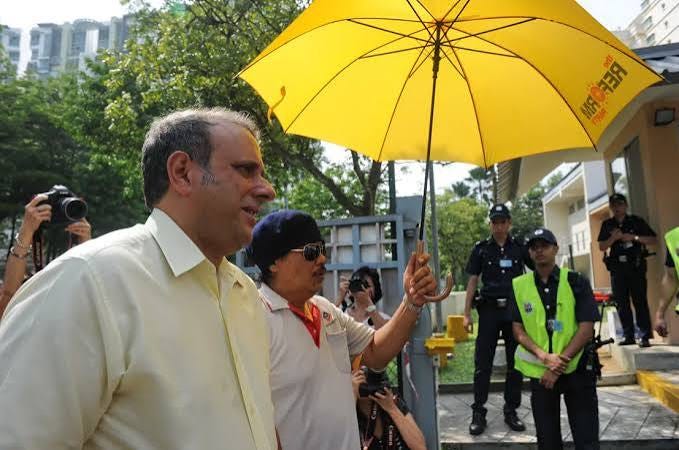
Kenneth Jeyaretnam, a trained economist who gave up a career in finance to take over his father’s opposition Reform Party as secretary-general to tilt at unassailable Singaporean political windmills, died in London on July 18 at age 67, leaving a fragmented and cowed opposition with one less voice.
Mr. Jeyaretnam’s wife, Amanda, announced his death after a lingering illness in a Facebook post on July 19. She said her husband had “died peacefully in his sleep surrounded by family.” Funeral details for a small family service are still being finalized, she told local media, and that a memorial to celebrate his life will be arranged at a later date.
“Kenneth was inured to the prospect of personal or political hardship and failures from watching his father’s dogged perseverance and political persecution as Singapore’s first elected opposition MP since its independence in 1965,” Amanda Jeyaretnam told Asia Sentinel. “Both father and son viewed political pluralism and civic participation as principles worth advancing regardless of personal electoral success. They believed that Singaporeans should have meaningful electoral choices and opportunities to exercise their democratic rights, even in a political landscape dominated by the ruling People’s Action Party (PAP) and their unbroken supermajority in Parliament.”
The opposition figure, his wife said, had been anxious to return to Singapore to face charges brought against him by the Singapore government and to return to the political fray, a wish he also expressed in conversations with Asia Sentinel, but as his illness progressed, he was never able to do so.
Although the Reform Party found little success at the polls, Mr. Jeyaretnam remained a tenacious critic of the Singapore government, and paid for it with numerous correction demands under the country’s controversial false news statute, the Protection from Online Falsehoods and Manipulation Act, which gives individual ministers the power to decide what constitutes a “falsehood” and issue correction directions, rather than submitting the issues to a test by impartial legal bodies when evaluating criticisms.
He was under constant investigation by the police and the POFMA office for possible offences as well as possible contempt of court. Officials issued at least 10 such POFMA demands between 2023 and 2025 regarding government spending, lucrative property rentals by cabinet ministers, the National Investment Returns Contribution (NIRC), and auxiliary police hiring, many of his criticisms issued from his bed in London, where he suffered from deep vein thrombosis and bilateral pulmonary embolism that ultimately contributed to ending his life.
Mr Jeyaretnam never managed to secure a full-time career in Singapore despite his double first-class honors in economics from Cambridge, facing multiple rejections from various government agencies and civil service departments, according to recently disclosed details online, which said he lost his first and only full-time job working as an assistant manager in HSBC’s merchant banking arm, Wardley, in 1987. Mr Jeyaretnam was reportedly compelled to resign after only weeks in his job following political pressure applied through one of Lee Kuan Yew’s permanent secretaries, according to the report.
“I admired Kenneth for his convictions — for his belief in fighting for the underprivileged and for those on the margins of society,” said Lim Tean, Secretary-General, People’s Alliance for Reform, another splinter opposition party. “When he believed in something, he never wavered, no matter how unpopular that cause might be. That was the measure of the man, and it was his father’s spirit living on in him. On behalf of the People’s Alliance for Reform, I extend our deepest condolences to his wife Amanda and his son Jared. Our thoughts and prayers are with them at this most difficult time.
Other opposition leaders issued similar accolades.
Mr. Jeyaretnam was the eldest son of the late opposition icon J.B. Jeyaretnam – popularly known as JBJ –the first opposition politician elected to the post-independence Singapore Parliament in 1981. JBJ established the Reform Party in 2008 after Singapore government officials repeatedly sued him, harassed him with legal actions, bankrupted his original Worker Party, and sought to put him in jail. The father was a mortal foe of Singapore’s modern founder Lee Kuan Yew and jousted with him on the floor of parliament repeatedly. After his father’s death, Mr. Jeyaretnam contested three general elections against then Prime Minister Lee Hsien Loong’s team but was unsuccessful.
He didn’t contest in the 2025 election, explaining that he decided against doing so after “the advice of doctors over some recent health issues,” which he didn’t specify. Deep vein thrombosis, which often occurs during long-haul international flights, involves the formation of a blood clot that forms in a deep vein, usually in the calf, thigh, or pelvis. It is dangerous because the clot can break loose, travel through the bloodstream to the lungs, and block an artery—a life-threatening emergency known as a pulmonary embolism.
Jeyaretnam studied at the United World College of South-East Asia and the Charterhouse School in England. In 1983, he graduated from Cambridge and went on to pursue a career in finance, first as a credit analyst at Wardley, HSBC’s merchant banking subsidiary, before moving to Continental Bank, Banque Indosuez, Lehman Brothers, and Nomura International.
In a letter to members and supporters posted on Facebook late on July 19, Reform Party chairman Mahaboob Batcha said RP was “deeply saddened” by Jeyaretnam’s passing. “Throughout his political career, he fiercely championed democracy and consistently put the needs of Singapore above his own political ambitions,” he said.
Besides his wife Amanda, Mr. Jeyaretnam is survived by their son Jared and his younger brother, High Court judge Philip Jeyaretnam.