
 From Iran to China: An Emerging Trans-Central Asian Corridor
  New documents show how a retail chain’s sales practices helped put guns on US streets
  Singapore a battleground of commodities fraud lawsuits
 Bill McKibben appeared on Ezra Klein’s podcast recently. Ezra Klein’s summary – there’s bad news and good news.
The bad news, what we all knew – climate change is accelerating.
The good news – “Green energy is getting better and cheaper, faster than we had ever dared hope,” Klein writes. “This next sentence was unimaginable even a few years ago: In April, the energy think tank Ember found that all of the new electricity demand around the world in 2025 was met with green power.”
“Clean energy abundance, a new form of energetic wealth, the possibility of the left actually offering a future of more and better – not less and worse – was a hard case to make even a few years ago. But now we cannot only imagine it, we can see it, touch it, live in it. It is here.”
It is here. And not everyone is cheering.
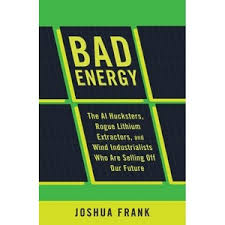
Joshua Frank, one of the editors at Counterpunch, is out with a new book titled – Bad Energy: The AI Hucksters, Rogue Lithium Extractors, and Wind Industrialists Who Are Selling Off Our Future (Haymarket Books, 2026).
In Bad Energy, Frank argues that the green energy transition is driven not by an effort to save the planet but by profit incentives.
“We must stop burning fossil fuels if we have any hope of saving the planet, but the significant, haphazard expansion of green energy in recent years – from large solar projects to wind energy to mining for renewables – has destroyed communities and ecosystems,” Frank writes. “And worse, renewables simply cannot match our ever-expanding demand for energy, driven in no small part by the rapid proliferation of data centers in the world’s wealthiest nations.”
Taking listeners from copper mines in Montana and Bolivia to wind farms in Wyoming to the geopolitical battle over deep-sea mining in the South Pacific, Frank offers a stark assessment of the costs of the rush for renewables and the demand for endless growth.
Frank argues we cannot consume our way out of climate chaos. What we need instead is rejection of the capitalist interests driving planetary collapse and a radical vision for a truly sustainable future.
How did you come to write this book?
“Living in southern California, I see all of these industrial sized so-called renewable developments in the Mojave Desert,” Frank told Corporate Crime Reporter in an interview last week. “For someone who spends a lot of time out there, it is alarming. At the same time, I’m seeing what Governor Gavin Newsom has done to the residential solar program in California. I investigated that a little bit and realized the motivation behind that. It was pretty clear that PG&E and these large utilities – they don’t want to decentralize the grid. They want to control the grid, they want to expand the grid – all under the guise of fighting climate change.”
“We have seen the desecration of the wilderness and a total gutting of the residential solar program in California, which was making great headway. But Governor Newsom has deep ties to PG&E. They have poured money into his campaign coffers since he was Mayor of San Francisco. There has been a revolving door with PG&E connected people.”
“Then you start looking into how energy companies are frothing at the mouth over the prospect of critical minerals. Their answer to climate change is more growth and more mining. I started looking at this thinking – something is off here. Is Elon Musk and his Tesla really the answer to our troubles?”
“Can we really consume our way out of climate chaos? The more I looked into it and the more I dug, it seemed like that wasn’t the case.”
The vast majority of big green groups, probably most environmentalists in the country would say they want solar farms, wind farms, batteries, hydro, a big chunk say they want nuclear. Your book says no to most of that.
“Many of the big green groups definitely supported Joe Biden’s policies of developing some of these industrial scale wind and solar projects on public lands in the West. I’m not against solar technology. Solar is imperative if we really want to get out of this mess. But do we really need six square miles of solar panels in the Mojave? Do we really need huge wind farms in Wyoming with transmission lines crossing through valleys and over mountains all the way to California? Is that the best we can come up with? Or should we instead be thinking about scaling down and producing energy locally?”
“These projects have been rolled out for profit, not for the environment. That’s where I might have criticisms of some of the Big Green groups who have blindly accepted policies because they are labeled Green.”
“If we are going to electrify the grid and expand these renewables, copper, lithium and many other minerals are going to be needed. And this isn’t just for electric vehicles and batteries. This is also for transmission lines, solar panels and wind turbines. All of it is going to require copper. And that’s going to require hundreds of new huge mines all over the globe. Then you start looking at a continuation of the extractive industries that came before it. There is really not much difference. “
“Then you start talking to people who are on the ground in rural and indigenous communities all over the globe who are going to be impacted by these new mining projects. The Big Green groups and others who support these projects blindly are not looking at the externalities.”
You support residential solar and that requires those sorts of extractive industries.
“It certainly does. But the question is – how can we minimize that damage? There is low hanging fruit – and that is building solar in already disturbed areas, on parking lots, brownfields. In a place like Los Angeles where I live, two thirds of the homes here don’t have rooftop solar. And that doesn’t include all of the box stores that could put up rooftop solar. We shouldn’t be doing it in biologically pristine areas.”
“Many people see the Mojave Desert as a wasteland. But there are endangered species there. And the desert itself is a carbon sink. So when we develop these deserts for solar, we are actually reducing the desert’s ability to absorb our fossil fuel pollution.”
Did you hear Ezra Klein’s interview with Bill McKibben?
“I did.”
During that interview, McKibben basically advocated for allowing Chinese electric cars into the United States. He says they are better and cheaper than Musk’s Tesla cars.
“I’m not opposed to electric vehicles. But that is not an answer to the pollution that our transportation industry produces. Instead we need to focus on expanding public transit. I don’t think replacing a gas guzzling GMC truck with a Cybertruck is the answer. Instead, we need more public transit. We need to radically rethink the urban landscape.”
“A culture defined by cars, no matter if it’s going to be one that is electric or gas, has a lot of problems. There are European cities that restrict vehicles. Those are good signs. We need more bikeability, walkability and public transit. Bill McKibben would agree with that.”
“In that interview with Ezra Klein, Bill talks about places like Australia and China and how their solar is booming and how that is a step in the right direction. But Australia is the second largest exporter of fossil fuel, after Russia. In China, they talk about how the huge boom in solar has benefitted China in reaching its climate goals. Not true. Solar last year kept up with the growth China had – which is about five percent.”
“When we talk about expanding renewables, unless it is replacing fossil fuels on a real scale, we are not moving in the right direction. Just keeping up with economic growth isn’t the answer. We need to be replacing fossil fuels with renewables. I would embrace degrowth. That’s the only way we are going to navigate ourselves out of this.”
“China produces thirty percent of fossil fuel emissions in the world. Unless that number comes down, we are not going to get out of this. Every coal plant they are building, every year they are producing more and more pollution that ends up in the atmosphere, that carbon stays in the atmosphere for a long time and continues to heat up the planet. Just because they are building solar capacity, that’s not producing the results that are necessary.”
What’s your ideal policy of replacing fossil fuels?
“The point of the book is to get people to think beyond capitalism. We need a criticism of fossil fuel capitalism and how that has dominated this problem. Replacing fossil fuel capitalism with critical mineral capitalism isn’t going to solve the problem.”
“Those who are opposing war – you are fighting capitalism. Working for affordable housing – that’s fighting capitalism.”
The first part of your book is about lithium mining. You are not opposed to lithium mining. How would you do it?
“There is a way we can democratize mining. But that’s not what’s happening.”
Are you talking about public power – like the Tennessee Valley Authority – a public authority that controls energy production?
“That would be a step in the right direction. It’s a lot better than selling off private lands to multinational corporations that want to come in, extract and leave biologically important lands desecrated. That’s been the history of extraction in this country and globally. We need a radical transition away from that.”
“If that lithium mining is only going into new GM vehicles and not to local batteries for local battery storage, that’s a problem. Also, there are alternatives to lithium batteries. Anything that can hold heat can be used for batteries. Sodium batteries are coming online. Those have potentially less impact than lithium mining. It’s not the technology itself that is the problem, it’s the way it’s being sold to us. Small scaled mining operations with less impact are a better way to go.”
“And these big mining operations are being done mostly on public lands. The benefit to the public is minimal at best. Many of these mines are on indigenous lands, sometimes on sacred sites. That needs to change. And the public needs to be more aware of these impacts.”
What countries in the world have implemented a degrowth policy that can be used as a model?
“I don’t think there are any going in the right direction. There are countries that are stuck, but it’s not by choice. There is a lot to learn from the way Cuba has operated under a blockade. For decades, they were able to revamp their food system, rethink their energy and their consumption and transportation.”
“There are cities that provide pretty good examples. One of them surprisingly is New York City, which has one of the lowest emission rates of any city in the world. It’s a walkable city. They have ample mass transit. Of course it’s not perfect.”
“Copenhagen, Stockholm – there are cities in the Nordic countries where they eat food locally, they don’t drive as much as we do. And their economies are still growing. It’s not the perfect solution, but it’s definitely better than what we are doing.”
You are actually proposing degrowth – we have to consume less, we have to scale back.
“My book is an indirect critique of the abundance movement. I’m looking at what this abundance movement looks like on the ground and in the oceans.”
“We know that these big fossil fuel giants go all over the world and look for ways to extract fossil fuels at the expense of the environment and local communities. When they are finished, they get up and leave and often leave behind them places that are completely ruined.”
“That’s what we are seeing now with renewables. I have a whole chapter on the deep sea mining industry and all of the unknowns associated with that. If they can find these nodules on the sea floor, crush them, get out nickel and other elements to produce batteries at the expense of wrecking the ocean – is that renewable?”
“Abundance requires exponential mining indefinitely. There is no closed loop system in which we can have abundance for everybody.”
Were you inspired by E.F. Schumacher, the author of Small is Beautiful: Economics as if People Mattered?
“Yes, but more the more contemporary Kohei Saito (author of Slow Down: The Degrowth Manifesto) or people like Murray Bookchin (author of The Ecology of Freedom).”
“I don’t think of myself as a theorist or academic. I’m a journalist. I’m looking at how these technologies are playing out in the real world, on the ground. That’s where this book comes in. It’s a tool for looking at these things, even things we believe are good – like wind and solar, which I support. But they have to be done in a way that minimizes their impacts.”
“When we are talking about climate change, we also have to look at the loss of biodiversity. The loss of biodiversity is overfishing, killing the rainforests by chopping them down, polluting through industrial agriculture. The underlying issue is capitalism. And this is where I have a critique of Bill McKibben. Bill can talk the tough talk and in the past has done a real service by bringing economics into the conversation. But when you hear him now, he rarely talks about capitalism, if ever.”
“I don’t believe there is any solution to the climate crisis without radically changing the economic system that underpins it.”
Is there anyone on the public policy scene – member of Congress, politician – who reflects this point of view?
“There is a contingent in the Democratic Socialists of America (DSA) who are thinking about these issues. But generally no. It’s not a conversation happening at that kind of policy level. If it is, I haven’t seen it. That’s a reflection of the environmental movement not addressing these issues.”
“And I have seen some people criticize the book by saying – you are just a shill for Big Oil. Obviously they haven’t read the book. If they do, I don’t think they would say that.”
“In the book, I also critique hydropower and nuclear. There is a contingent in the abundance movement that believes nuclear power will save us. There is a contingent on the left that believes nuclear power will save us.”
[For the complete q/a format Interview with Joshua Frank see 40 Corporate Crime Reporter 32(12), August 10, 2026, print edition only.]
Don't Miss:
-
From Iran to China: An Emerging Trans-Central Asian Corridor
-
New documents show how a retail chain’s sales practices helped put guns on US streets
-
Singapore a battleground of commodities fraud lawsuits
-
From Propagandist to Criminal
-
On Indonesia’s fires, El Nino’s impact on the power sector, and other stories | Asia Sentinel Stories of the Week