
 About the China Capital investigation
  Frequently asked questions about the China Capital investigation
  ICBC promoted corrupt executive, ignored employee misconduct as it pursued global expansion
The use of liquids to conceal and traffic cocaine through commercial supply chains is growing, and driving an evolution in Europe’s role in the global cocaine supply chain, which is evolving beyond bring a major consumption market into an intermediary processing point as well, according to experts.
What is Liquid Cocaine?
“Liquid cocaine” refers to powdered cocaine hydrochloride—the crystalline salt form of cocaine—that has been dissolved in a liquid such as water, a solvent such as ethanol or acetone, or other products containing chemical compounds such as mannitol, glucose, cellulose, or lactose. On arrival at its destination, the drug is reconstituted and processed for distribution.
Hiding cocaine in liquid form is a sophisticated trafficking method that has been increasingly used over the past decade. It was documented in Bolivia as early as 2011, when liquid cocaine was seized during a small-scale cross-border trafficking operation. Over the last four years, shipments of liquid cocaine originating in Latin America have been discovered in France, Croatia, Spain, Ireland, and the Netherlands.
How is it Trafficked?
There are two main ways that traffickers use liquid cocaine to pass undetected through scanners. The first involves dissolving cocaine into a carrier liquid, which is concealed within containers labeled as shampoo or alcohol, or industrial products such as chemicals, cleaning products, paints, adhesives, and resins. Often, the liquid cocaine is mixed with legitimate commercial liquid products.
Impregnation is the form of concealment in which cocaine is made into a liquid and then absorbed into a solid carrier material such as solid plastics, furniture parts, acrylic resin, charcoal, cardboard, and even metals. Earlier this year, for example, Irish authorities seized plywood impregnated with liquid cocaine allegedly en route from South America to an illicit laboratory hidden in County Kildare. The plywood had reportedly been ground into sawdust and soaked in liquid cocaine before being shipped.
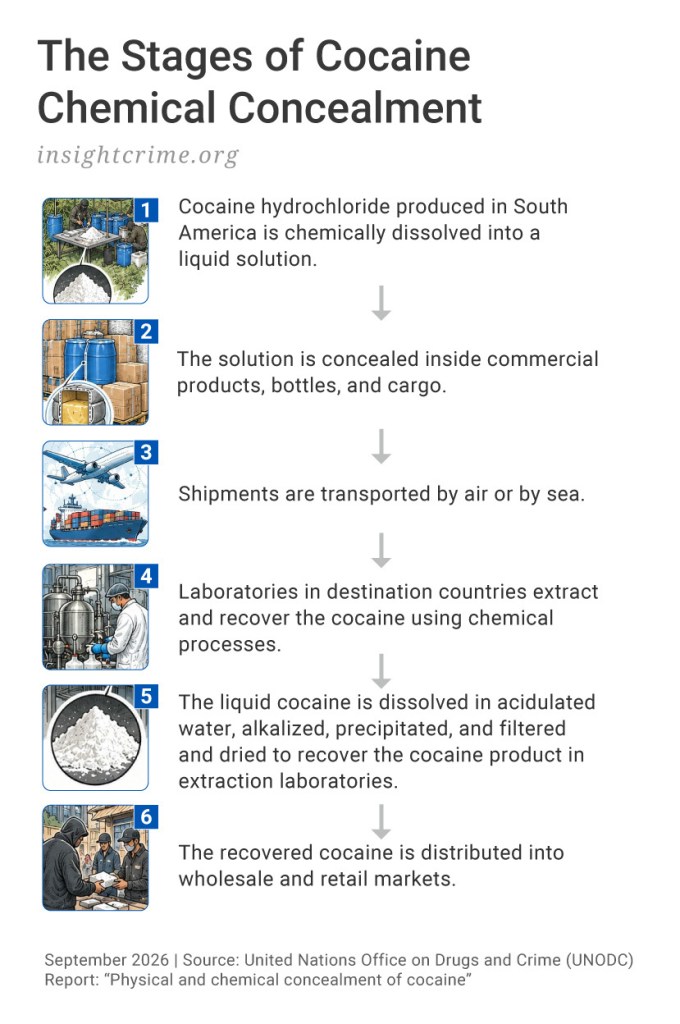
Traffickers are constantly innovating, and the use of ever more complex physical and chemical concealment techniques is on the rise, according to a 2026 European Union Drugs Agency (EUDA) report.
The liquid cocaine is recovered at secondary processing laboratories. The solutions are dissolved in acidulated water, alkalized, precipitated, and filtered and dried. Extraction laboratories of this nature have been found across Europe, according to EUDA data. In 2024, six EU member states reported dismantling at least 42 sites related to cocaine production, extraction, cutting, or packaging, compared with 34 in 2023.
Beyond Cocaine
Though not as common, the same methods can also be used to move other drugs, like methamphetamine.
During the seizure of a methamphetamine shipment from Mexico to Australia, Australian Federal Police (AFP) investigators found a layer of methamphetamine infused within the internal paintwork of a container they took apart. Industrial equipment was later recovered, allegedly intended for the extraction of the methamphetamine at a Sydney property believed to be associated with the recipients.

Don't Miss:
-
Zelensky says Ukraine is ready for ‘de-escalatory steps’ if Russia does the same
-
Huawei’s US trial puts jury to the test amid China, Iran links
-
Oil tanker has exploded in Strait of Hormuz, says Iran’s IRGC
-
Beijing threatens ‘serious consequences’ after Panama lawmakers support Taiwan
-
The classic Chinese parenting playbook won’t survive the AI age