
 Malaysia’s Brewing ‘Corporate Mafia’ Scandal
  Ending the Iran War and Stabilizing the Middle East
  The Middle East Crisis – Japan’s Catch-22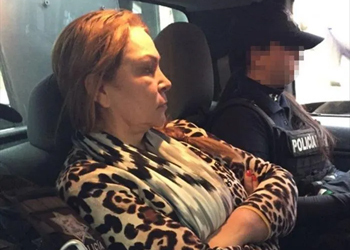
When Guadalupe Fernández Valencia, alias “La Patrona,” was photographed sitting in the back of a cop car following her 2016 arrest in Culiacan, Mexico, her expression gave little away.
Wearing a leopard-print cardigan, arms crossed, hair loosely braided, the 60-something’s expression was flat. She looked less like a kingpin nabbed for international drug trafficking charges and more like an annoyed abuela waiting in traffic.
Perhaps her seeming nonchalance was part of how she’d gotten so far in one of the most powerful trafficking networks in the Western Hemisphere.
While US prosecutors began closing in on the Sinaloa Cartel’s inner circle in the later 2010s, Fernández Valencia emerged as the intersection of two of the cartel’s most critical flows: narcotics heading north and cash flowing south.
For years, Fernández Valencia was a key architect in overseeing the flow of cocaine, heroin, methamphetamine, and marijuana into the United States — and millions of dollars back into Mexico. Prosecutors alleged she was equivalent to the Sinaloa Cartel’s chief financial officer, and the right-hand woman of Jesús Alfredo Guzmán Salazar, alias “Alfredillo,” one of El Chapo’s sons and a founding figure of the Chapitos faction of the cartel.
A seat at Sinaloa’s most powerful table required trust, and placed her unusually high within the ranks of a criminal organization long dominated by men. She was arrested a month after Joaquín “El Chapo” Guzmán, on the same indictment that would eventually send him to prison for life.
But her origins in the drug trade were humble.
After leaving her home state of Michoacan for California in the 1990s, she was convicted of street-level drug dealing. The charges cost her a decade behind bars in California before being deported back to Mexico in 2007.
Her return to Mexico launched a new chapter in her trafficking.
SEE ALSO: Sinaloa Cartel Profile
She relocated to Culiacán, the capital of Sinaloa state and home turf of El Chapo’s network, and connected with her brother Manuel, who was already embedded with the cartel. The California contacts she’d built dealing on street corners now became an asset for transnational drug trafficking and money laundering.
But when Manuel was arrested in 2010, she paused her trafficking activities, relocated her family to Guadalajara, and waited, according to court documents.
Two years later, she returned, and came back to Culiacán, and over the next decade evolved from a drug trafficker to an illicit financier. Drug proceeds collected in Los Angeles were funneled through Guadalajara currency exchanges back to Mexico.
Bulk cash, structured bank deposits, wire transfers, and alternative credit systems were all part of her money laundering playbook.
Fernandez Valencia’s ascent culminated in a direct reporting line to Alfredillo, whose operations she helped oversee as his chief lieutenant from supply to delivery. She pleaded guilty in a court in Chicago in 2019.
During her sentencing, a federal judge noted that her cooperation with prosecutors had put her life, and the lives of her five children, at serious risk. She was released in 2023 after serving roughly three years of a 10-year sentence.
Fernandez Valencia’s current whereabouts are currently unknown.
Featured Image: Guadalupe Fernández Valencia following her capture in Mexico in 2016. Credit: Mexican Police.
Don't Miss:
-
Bondi won’t appear before US lawmakers over Epstein files, Justice Department says
-
Asia’s flood of cheap Ozempic generics opens gates to weight-loss abuse
-
US ceasefire with Iran sets diplomatic clock as war powers deadline nears
-
Strait of Hormuz: is a Trump‑Iran joint venture really possible?
-
Canada’s Carney on verge of majority after another Conservative MP jumps ship