
 Tunisian court dismisses case to dissolve publisher of ICIJ partner Inkyfada
  Prabowo Faces Growing Discontent as Jokowi Revives His Political Ambitions
  Five years after the Pandora Papers, transparency laws lose their teeth
 It was time for after-school pickup at the San Francisco de Asís elementary school in downtown Guayaquil one recent afternoon when someone slotted pamphlets beneath the windshield wipers of the school’s minibuses. The message was cordial but ominous.
“Greetings from the CJNG Group,” it said, misspelling the word “greetings.” “We want to come to an agreement: 6,000 to 4,500 Are we clear (sic).”
At the top of the page, the pamphlet’s authors had fashioned the “j” into a pistol and left a Chilean telephone number for the bus owners to call.
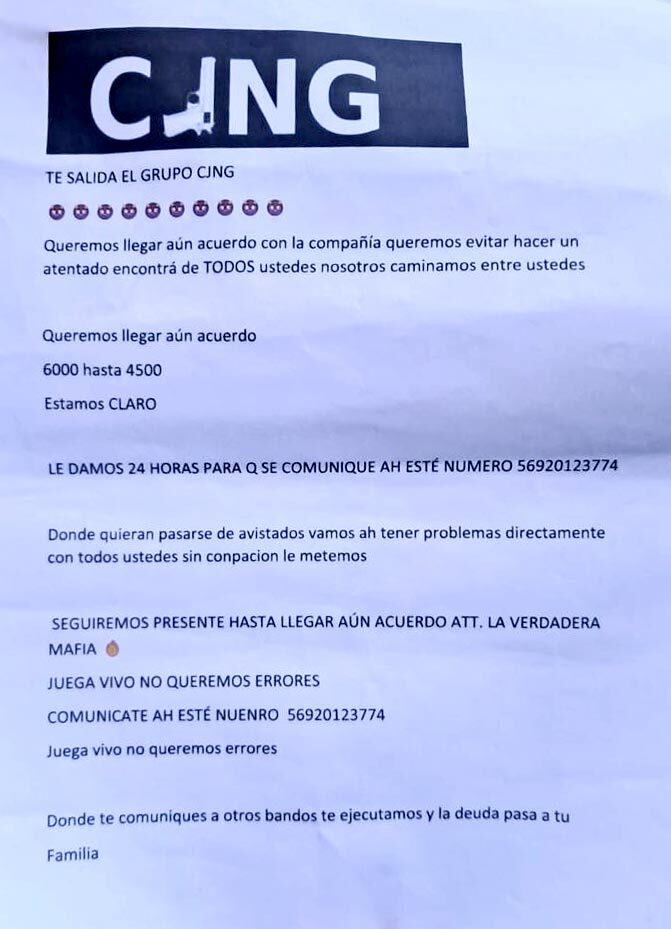
“We do not want any mistakes,” said the pamphlet, adding another signature from what it called the “true mafia.”
CJNG is the acronym for the Cartel Jalisco Nueva Generación, or Jalisco Cartel New Generation, a Mexico-based criminal group. That they were extorting the buses for a small, Catholic primary school in Ecuador seemed unlikely but provoked fear all the same.
“It’s in the hands of the authorities now,” one driver told InSight Crime before scurrying to his bus and speeding away with close to a dozen children inside.
The scheme was part of a national trend. In a country where big criminal groups are atomizing at a rapid rate, the remnants, derivatives, and copycats of these groups have expanded into extortion equally fast.
Ecuadorian police say their ongoing offensive against gangs has displaced extortionists, citing crime statistics. But experts and victims say there is a dissonance between what authorities are saying about extortion and what Ecuadorians are experiencing.
Extortion: A Criminal Gold Mine
Extortion has skyrocketed in the last five years, rising in tandem with an unprecedented wave of organized crime and violence that turned what was once one of Latin America’s most peaceful nations into its most violent.
In 2019, Ecuador’s Attorney General’s Office recorded 1,616 cases of extortion. In 2024, that number rose to 23,080, an increase of over 1300%. During this time period, criminal groups like the Choneros, Lobos, and Tiguerones gained strength, expanding their involvement in criminal economies like transnational cocaine trafficking and illegal gold mining. Local muscle—street gangs—were crucial to their rise, helping secure drug trafficking corridors and move and store drugs. But they needed a way to keep rank-and-file members paid.
SEE ALSO: Why Have Ecuador’s Drug Trafficking Gangs Turned to Extortion?
They turned to extortion, growing it into a criminal market worth millions of dollars. Some local groups approach residents in their own neighborhood strongholds, asking for $1 to $5 in daily or weekly payments from each household. Local businesses pay more, with gangs demanding payments of a few hundred to even a couple thousand dollars or more. In other cases, gangs kidnap, extorting family members and friends of victims for exorbitant ransoms.
“They’ve now realized the power they hold through kidnapping,” Lieutenant Colonel Herbie Guamaní, the former police commander in northwest Guayaquil, a stronghold of gangs like the Tiguerones and Águilas, told InSight Crime in 2025.
Guamaní said kidnappers demand anywhere between $10,000 and $500,000. And while victims often have no means of paying these ransoms, gangs still cash in on the biggest sums their families can offer.
Have Authorities Clamped Down?
In 2025, the police conducted near-constant operations targeting extortion networks, while they instituted new measures to deter the perpetrators by giving victims an easier path to denouncing crimes to the police. And by the end of last year, reported extortion cases had plummeted. The Attorney General’s Office data showed 16,131 cases for 2025, a 30% drop from 2024 and the lowest yearly total since 2022.
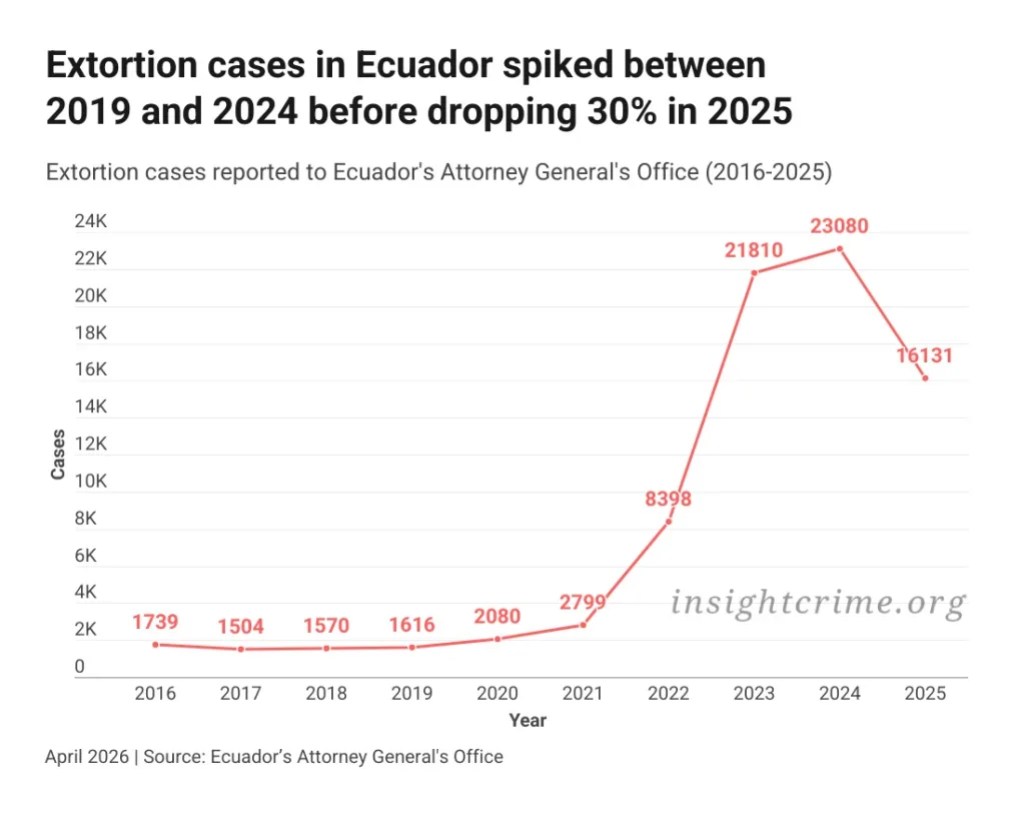
Police data—which differs slightly from the Attorney General’s Office in its classification of cases—shows an even greater drop in reports. Cases fell 64% between the first nine months of 2024 and the same period in 2025, according to statistics shared with InSight Crime.
The decrease is “a clear indication of the effectiveness of the measures taken,” a police spokesperson told InSight Crime by email.
Nevertheless, experts, security officials, and residents cast doubt on the police’s version in interviews with InSight Crime. Victims often do not report extortion, they said, out of distrust of police, the low clearance rate on extortion cases, and fear of retaliation by extortionists if they find out the victim notified authorities. As a result, extortion statistics may be significantly lower than actual levels.
“There comes a point where the number of extortion cases reaches such a high level that citizens feel the authorities are doing absolutely nothing about it,” Renato Rivera Rhon, an Ecuadorian security analyst for the Global Initiative Against Transnational Organized Crime, told InSight Crime. “That, from my perspective, does have an impact on the number of reports. Cases will reach a peak and then start to decline.”
Still, in some cases, authorities may indeed be having success in preventing extortion. But the gains are limited to certain segments of the population, with criminals adapting strategies and targets in response to law enforcement scrutiny. For example, a Durán business community leader, who chose to remain anonymous for safety reasons, told InSight Crime in 2025 that the city’s large industrial companies were seeing drops in extortion and improvements to security, but that the extortion of small businesses and individuals was increasing.
The Harsh Extortion Reality
Extortion has seemingly touched every sector of society. Victims now include teachers, port workers, motorcycle taxi drivers, fishermen, water truck drivers, and, as noted, school bus company owners, among others. Some even pay extortion to secure a burial plot in Guayaquil’s public cemetery.
The government is aware of the problem and its widespread political implications. In 2024, President Daniel Noboa launched an offensive against organized crime, sending the military into the streets and prisons. Over two years later, security forces have captured dozens of Ecuador’s top criminal leaders.
But the reshuffling and fragmentation resulting from the government crackdown has, in many cases, exacerbated extortion. Previously united street gang factions now seek new extortion arrangements with businesses, while independent criminal opportunists have taken advantage of the chaos to threaten victims by impersonating criminal groups.
One Guayaquil businessman, who chose to remain anonymous for security reasons, told InSight Crime that the increasing number of dispersed gangs means his distribution company now has to pay multiple groups to continue operating, all while navigating an increasingly complex set of gang territories and invisible borders. In another case from Durán, the capture of Chone Killers leader Julio Alberto Martínez, alias “Negro Tulio,” led to extortion hikes for vendors as other gangs moved to impose their will over the captured leader’s extortion territory, a high-ranking Durán local government official told InSight Crime.
As part of the government crackdown, the military runs 11 of Ecuador’s 36 prisons, which have long been hubs of organized crime activity, including extortion. Still, in 2026, authorities have uncovered a number of extortion networks operating out of prisons in Guayaquil, Manabí, and Cotopaxi. This shows that the intervention has failed to prevent corrupt security forces from smuggling items like cell phones to inmates, facilitating extortion.
“Corruption is systemic. It is not as if the police or the military are the saviors…[gangs] have bribed these officials,” a Manabí police official, who chose to remain anonymous as they were not authorized to speak publicly, told InSight Crime.
The official added that the “vast majority” of extortion demands in the coastal province come from its prisons.
Featured image: Collage created by InSight Crime’s design team using images captured by InSight Crime during fieldwork in Ecuador.


Don't Miss:
-
Veracruz Mafia vs. CJNG: The Fight for Veracruz
-
Former Michoacán Official Used AI for Extortion: Here’s How They Cloned the Voices of Politicians and Ministers
-
Two Years On, the Sinaloa Cartel War Changes Shape | The InSight Take
-
US wraps up military mission in Iraq, giving Baghdad room to strengthen China ties
-
As China and the EU begin crunch trade talks, optimism is in short supply