
 The Taliban’s New War Begins at Home
  Panama removed from EU’s tax haven ‘blacklist’ a decade after the Panama Papers
  Crackdown and Controversy: The Battle Over Beach Bars and Noise in Phuket’s Bang Tao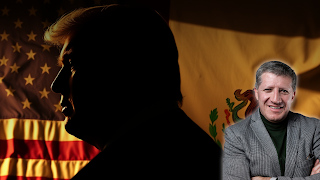
“Sol Prendido” for Borderland Beat

Hello everyone. Once again, there is controversy in the relationship between Mexico and the United States regarding security and the fight against drug trafficking. U.S. President Donald Trump has reiterated—even while acknowledging cooperation with the administration of President Claudia Sheinbaum—his claim that cartels govern Mexico and dominate the country.
It is difficult to walk back Trump’s statements, especially given recent events in several states. Consider what happened in Morelos: while these may be minor incidents, they demonstrate that, unfortunately, organized crime wields excessive power in certain parts of Mexico. At the same time, we cannot claim that there is no authority in Mexico or that cartels control the entire country; doing so would be to obscure the reality.
We are certainly not denying the existence of insecurity—I am among those who have spoken most frequently about this issue, which is the greatest source of pain for our nation. Furthermore, we cannot overlook the blows dealt to the Jalisco New Generation Cartel—such as the removal of Nemesio Oseguera Cervantes, known as “El Mencho”—or the recent captures of other kingpins from both that cartel and factions of the Sinaloa Cartel.
To suggest that cartels dominate Mexico is to sensationalize the situation, painting a picture of a country living in anarchy. It would be akin to responding to the United States by claiming that, because of the high levels of drug abuse and the many deaths caused by overdoses involving fentanyl-laced narcotics, the entire U.S. population consists of drug addicts. Such a claim would distort reality and diminish the societies of both nations.
Trump’s statements seem to imply that all 120-plus million Mexicans are criminals—that they are all drug traffickers—though this is not about defending any particular government. In my view, the responsibility for the lack of security lies precisely with those who are currently governing us. They answer to us, and they must be held accountable. Trump has doubled down on this, but we are already familiar with his rhetoric.
Let’s look at the actual news. This week, it was revealed that the U.S. Department of the Treasury imposed a $100 million penalty on one of the major American banks, Bank of America. Why? Because it violated anti-money laundering laws, facilitating—or allowing—transactions that funded, among other things, terrorism and drug trafficking. How long have I been pointing out in my work that the primary problem and driving force behind drug trafficking is money laundering?
A significant source of the cash dollars flowing to organized crime originates in the United States, moving through banks that permit countless transactions without a rigorous oversight system—a system that the U.S. Congress refuses to implement. Why? Because it serves their interests. Now, a $1.2 billion fine for a bank on the scale of Bank of America is nothing. I have previously mentioned that Mexico’s central bank, Banxico, estimates that the profits generated by remittances—a channel through which vast amounts of drug-trafficking money are laundered—yield at least $1 billion in earnings for financial institutions.
Do the math, and you’ll see. This should have been the biggest news story in the United States. Money is being laundered through Bank of America—but, naturally, they aren’t going to shoot themselves in the foot in a capitalist country. And I’m not talking about ideology—whether you call it capitalism, socialism, communism, or whatever label you choose—I’m talking about a criminal reality that facilitates money laundering.
That is why I’ve pointed out that claiming everything in Mexico is controlled by cartels is just as false and exaggerated as claiming that everyone in the United States is a drug addict. Politicians talk about this because that’s just how they are; we are well-acquainted with the rhetoric Donald Trump has employed—rhetoric that has persisted halfway through his four-year term—regarding Mexico. Donald Trump has threatened to launch invasions to wipe out the drug trade.
Today, he reiterated that they know exactly where the drug traffickers are—a claim he has made on several occasions. In the past, he even went so far as to say they know the color of the doors behind which the drug kingpins are hiding. Well, if there is truly cooperation—as he claims—then he should provide that information to the Mexican government so they can take action. If they fail to do so, the corruption would be laid bare.
And I will repeat this: drug trafficking cannot exist without corruption—within the government, the police, the military, and at every other level. That is a fact. Just as you cannot punish every single bank simply because corruption exists—which is why I brought up the case of Bank of America. The economic situation in the United States is critical.
Trump and the Republicans—or rather, Trump himself—are desperate to turn the situation to their advantage and salvage their party. From what can be seen, the midterm elections on Tuesday, November 3, could turn into an electoral catastrophe, with the Democrats potentially defeating the Republican Party. We shall see what happens. It is not our place to advocate for anyone; let those in the United States who are eligible to vote choose whomever they wish.
Ultimately, their votes are driven by the economy—not by foreign policy, and certainly not by drug trafficking. They swallow whatever narrative Trump feeds them: that Mexicans are the villains, while we are the victims. There is no greater lie than that fallacy. Donald Trump—and let this be clear to both politicians and criminals—give us back the Mexico that was stolen from us.
Source: J. Jesus Esquivel

Don't Miss:
-
Ivan’s Mob Beheads A Los Mayos Member
-
Ex-OFAC Official: The Cartel Risk Companies Can’t See | The InSight Take
-
Why Ecuador Is Losing Its Fight Against Organized Crime
-
‘El Cromo’ Arrested in Guadalajara; He Is Linked to a Group Affiliated with the CJNG
-
A Blow to the Caborca Cartel! ‘El Cara de Cochi,’ Wanted in the U.S. for Fentanyl, Is Captured