
 Crackdown and Controversy: The Battle Over Beach Bars and Noise in Phuket’s Bang Tao
  East Asia’s Youth Job Crisis Is Hiding Its Coming Labor Shortage
  Leaked files reveal how Deloitte Cyprus helped Roman Abramovich hide $10B fortune
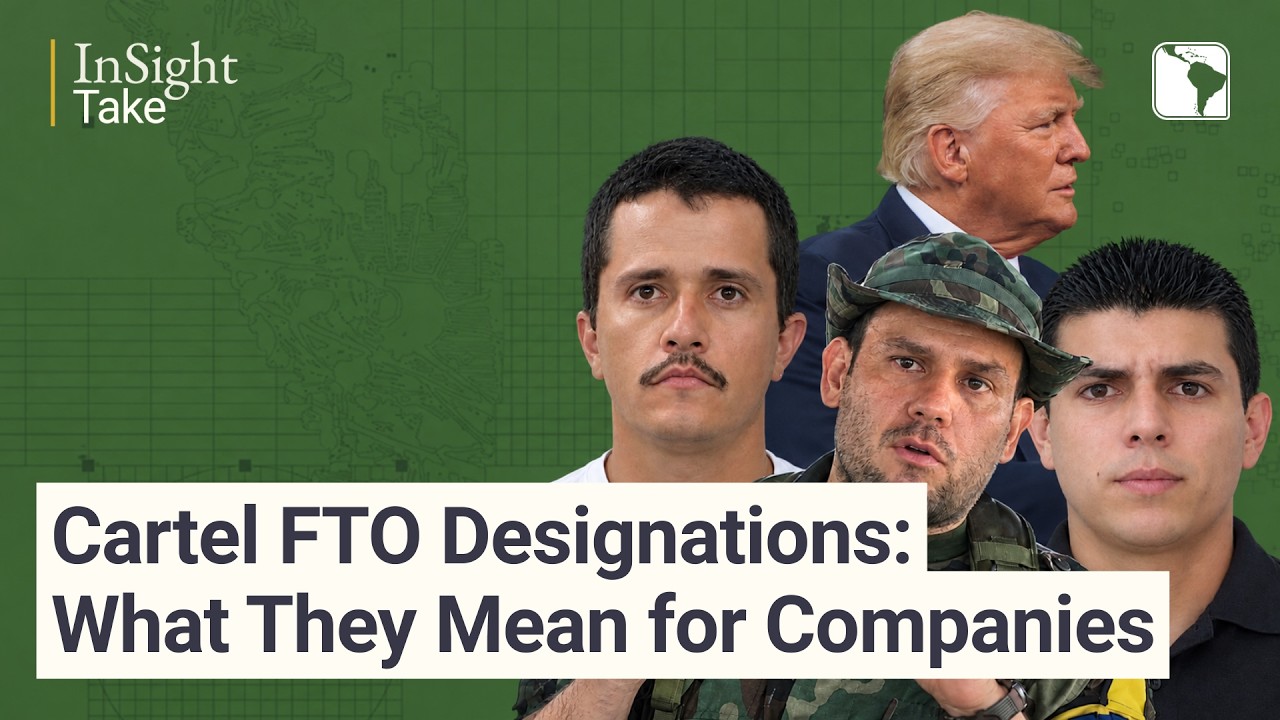
Claire McCleskey, a former head of compliance at the Office of Foreign Assets Control (OFAC) spoke to InSight Crime’s managing editor Deborah Bonello on what the designation of a further 21 Latin America and the Caribbean criminal organizations as Foreign Terrorist Organizations (FTOs) actually changes for companies, and why the counter-terrorism playbook may be the wrong tool for criminal groups embedded in legitimate business.
McCleskey is the co-founder of Clarity Compliance Consulting, a sanctions advisory firm, and she spent years inside the US Treasury. She led the Compliance Division at OFAC and served as a senior OFAC policy advisor, building programs like the Russian oil price cap. Before that, she ran investigations at FinCEN and served as Financial Crimes Enforcement Network (FinCEN) attaché in Mexico. She began her career at InSight Crime.
Here are four big takeaways from the conversation.
Supply Chain Exposure is One Step Removed from the Companies
What worries the companies she talks to in Mexico and Colombia is that they may have contractors, subcontractors, and logistics providers paying extortion to get trucks through or to keep goods and staff safe without the company above them knowing it’s happening. In other words, the risk often sits with these companies, which are more vulnerable to criminal groups.
Companies Don’t Want to Know What is Really Happening
Banks and large multinationals were already focused on this. Many others, especially non-US companies with less direct exposure, are waiting for a problem to surface, and deterred by compliance budgets, patchy beneficial-ownership data, and a sense that enforcement is unpredictable. Some avoid the risk assessment precisely because finding the problem obliges them to fix it.
Cartels Present the Opposite Problem as Terrorist Groups
The counter-terrorist-financing playbook was built for groups that could do enormous damage with very little money. Cartels are the opposite problem, and deeply embedded in legitimate business. Claire says Mexican criminal organizations like the Jalisco Cartel New Generation (Cartel Jalisco Nueva Generación – CJNG) benefit from Mexican fuel smuggling, which isn’t about drugs but rather tax fraud built on the permit system. Her assessment is that counterterrorism authorities were applied for deterrence and bigger penalties, not because anyone thought the tools fit.
More Designations Are Coming and Possibly a Criminal Case
More network designations; possibly a first civil or criminal material-support action against a company, though these cases carry a long tail; and above all who OFAC and DOJ choose to target, which will reveal the real order of priorities. Her read is that OFAC has two priorities — Iran and narcotics — and that movement on Iran would pull attention back there.
Since February 2025, the US State Department has designated 21 organizations in Latin America as FTOs. Peru’s Shining Path and Colombia’s National Liberation Army (Ejército de Liberación Nacional – ELN) were designated FTOs in October 1997, and Colombia’s Segunda Marquetalia and Revolutionary Armed Forces of Colombia – People’s Army (FARC-EP) were designated in December 2021.
Don't Miss:
-
Ivan’s Mob Beheads A Los Mayos Member
-
Why Ecuador Is Losing Its Fight Against Organized Crime
-
‘El Cromo’ Arrested in Guadalajara; He Is Linked to a Group Affiliated with the CJNG
-
A Blow to the Caborca Cartel! ‘El Cara de Cochi,’ Wanted in the U.S. for Fentanyl, Is Captured
-
Tiguerones Leader ‘Willy’ Is Living Free in Spain