
 Manila’s EV ambitions confront economic and energy realities
  Tunisian court dismisses case to dissolve publisher of ICIJ partner Inkyfada
  Prabowo Faces Growing Discontent as Jokowi Revives His Political Ambitions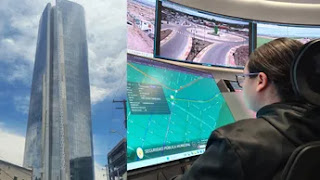
“Sol Prendido” for Borderland Beat

Following the controversy sparked by the presence of CIA agents in Chihuahua—a presence revealed by the deaths of two agents in a road accident—the state government is currently assessing the legal propriety of allowing U.S. security agencies to be stationed on the 18th floor of the Centinela Tower.
As recently as April 13, Chihuahua’s Secretary of Public Security, Gilberto Loya, announced that U.S. personnel would be stationed on that specific floor of the agency’s headquarters building with the aim of improving coordination and information sharing—a stance that has since shifted.
“Nothing has been finalized yet, but yes, that was indeed supposed to be the idea,” Adrián Eduardo Chavira, Undersecretary for the Centinela Platform, told *MILENIO*.
For their part, state officials confirmed to this media outlet that the legal and logistical feasibility of the project was indeed being analyzed.
What is known about the Centinela Tower?
Against this backdrop, Gilberto Loya sidestepped confirming the stationing of U.S. agencies within the tower, limiting his remarks to stating that all operations are being conducted in strict accordance with established coordination protocols.
“The key issue here is collaboration—as the President [Claudia Sheinbaum] herself stated: ‘Collaboration is a legal practice,’ provided that the Ministry of Foreign Affairs is represented in all our meetings. This applies to all working groups—since we operate under the Border Security Protocol program—which include the participation of all relevant authorities, the Ministry of Foreign Affairs among them,” he replied when questioned on the matter, before abruptly taking his leave.
Doubts regarding the presence of agencies from that country within this tower—a structure that has been a source of controversy since its very construction—have intensified following the deaths of two CIA agents who had participated in an operation to dismantle a drug laboratory in Chihuahua. Days before the accident, Loya announced that one of the top floors of the Tower—the headquarters of Chihuahua’s Secretariat of Security—would be allocated for offices of the Federal Bureau of Investigation (FBI), the Drug Enforcement Administration (DEA), and Customs and Border Protection (CBP).
Chihuahua Governor Maru Campos sought to transform the *Torre Centinela* (Sentinel Tower) into a security operations hub equipped with over 10,000 cameras.

Ever since the CIA’s presence in a state-led operation was confirmed, an investigation was launched to determine whether the country’s sovereignty had been violated. Consequently, questions have arisen regarding whether such sovereignty can be guaranteed given the presence of foreign agents within the *Torre Centinela*—known on social media as “Maru Campos’s Mini-Pentagon” and serving as the flagship project of the program bearing the same name.
MILENIO toured three floors of the new headquarters for the Secretariat responsible for security and police intelligence in Chihuahua. The headquarters is situated in Ciudad Juárez—a location chosen because this border city previously recorded the highest rates of criminal activity in the state—and has since yielded positive results.
“The indicators we have been tracking include, in fact, the ranking of the world’s most dangerous cities. Previously—if I recall correctly—we were ranked 12th when we first arrived; now, we have dropped out of the top 15, currently sitting at 17th place… That was one of the key factors behind the decision to relocate the Secretariat here,” explained Chavira.

Technology that Chihuahua hopes will strengthen its position
The official is in charge of managing the technological tools for the *Centinela* (Sentinel) program; he highlighted the resources currently available for combating both local delinquency and organized crime.
“There are 13 sub-command centers—which we refer to as C7 centers—equipped with Artificial Intelligence. In other words, the entire state is divided into 13 regions, and each region possesses its own command center. Additionally, there is the central state command center—the *Torre Centinela* (Sentinel Tower). We have access to over 10,000 cameras, distributed across 3,065 video-surveillance poles, 102 highway arches, and 11 checkpoints situated along the state’s highways and roads.
“Furthermore, we possess 75 drones, 25 anti-drone systems, and 40 trailers equipped with cameras that can be deployed anywhere within the state—connecting via satellite—or positioned specifically to help prevent crimes in targeted zones,” he explained.
Located on the 15th floor is the operational hub for the Center for Command, Computing, Control, Coordination, Citizen Contact, Quality, and Communications (C7), from which thousands of streets across Chihuahua’s 67 municipalities are monitored.
Chihuahua Governor Maru Campos sought to transform the *Torre Centinela* into a security operations center equipped with a network of over 10,000 cameras.

The State Police maintain a 24-hour watch; however, the National Guard and the Ministry of Defense are also stationed on this same floor. Through the coordinated efforts of federal and state forces, joint operations have been conducted to combat arms and narcotics trafficking—operations that have even garnered recognition from the federal government for the resulting increase in fentanyl seizures.
“Through the Secretariat of Public Security, we have participated in operations leading to the seizure of fentanyl and other narcotics. Specifically, the Undersecretariat for Police Deployment and the Undersecretariat for General Staff Operations have been the key entities driving this work, achieving highly successful results.” “The operation is staged here; we coordinate that joint operation… In terms of public security, what we have represents a transformation—a shift from the approach previously employed to the one currently in place; it was a complete 180-degree turn,” commented Pablo Nava, Director of Operations and Emergency Management at the C7.
From a distance—even from certain areas of El Paso, Texas, in the United States—the Centinela Tower in Ciudad Juárez is clearly visible. It rises imposingly from the center of the municipality, featuring a distinctive structure designed to withstand strong winds.
It remains in the final stages of construction, and currently, only the three floors housing the C7 and the Centinela Program are operational. MILENIO requested permission to visit the 18th floor, but the request was denied. Inquiries were also made regarding the Secretariat’s current stance, as well as for confirmation regarding which agencies would maintain a presence at the site.
Source: Milenio

Don't Miss:
-
Fight at Mazatlán Prison Leaves 10 Dead: A 2-Year-Old Boy Died During a Family Visit
-
Veracruz Mafia vs. CJNG: The Fight for Veracruz
-
Former Michoacán Official Used AI for Extortion: Here’s How They Cloned the Voices of Politicians and Ministers
-
Two Years On, the Sinaloa Cartel War Changes Shape | The InSight Take
-
US wraps up military mission in Iraq, giving Baghdad room to strengthen China ties