
 Rick Claypool on Pay to Play Corporate Crime Enforcement
  Labaton Launches Whistleblower Practice with Former SEC Acting Chair Allison Herren Lee
  Kremlin payment firm A7 has been pumping billions in ‘untraceable’ cash into global financial system
 There is a battle within the Democratic Party.
The dominant faction is controlled by powerful corporate interests.
The insurgent faction is one that wants to put corporate power and corporate crime front and center in the upcoming 2028 election.
Douglas Farrar wants to see the insurgent faction win.
Farrar is the former head of the Office of Public Affairs at the Federal Trade Commission (FTC). He now heads his public affairs firm – Maywood Strategies.
There was a moment when Trump started his second term that many people thought there was a chance he would try and understand the political economy through a Lina Khan lens.
On the one side you have these big tech companies, these large powerful corporate conglomerations of power. On the other side, you had a left/right convergence to push back against that corporate power.
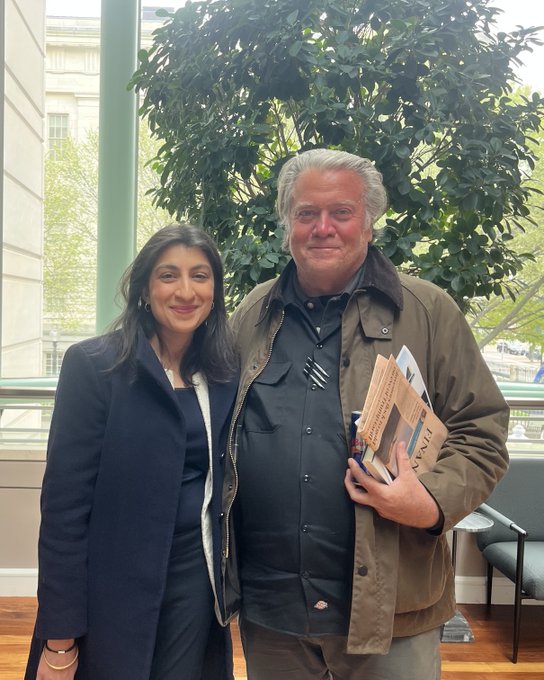
We famously saw the picture of Lina Khan and Steve Bannon standing together, was it outside the White House? And Bannon says – “I think Lina Khan is one of the more important political figures in this country, and I think if she had been listened to more by Democrats they would actually have been more competitive against us in November of 2024.” Why didn’t that left right convergence come to fruition?
“It’s such an interesting question and the best people to answer it would be Donald Trump, Andrew Ferguson and Omeed Assefi,” Farrar told Corporate Crime Reporter in an interview last week. “My own view is that the President’s populism is rhetorical and hollow and not sincere. While he likes to portray himself as a man of the people, concerned about the forgotten American and the little guy, the way he has governed has been on behalf of very wealthy people and his own bottom line. There is a lot of pressure on people in government under the Trump administration to toe the line as opposed to going their own way.”
“You see the end result of that incentive structure with someone like Gail Slater trying to push back on what she viewed as an illegal merger. And what she found out was that the person really in charge of merger control at the Department of Justice was not her, but a lobbyist who has a close relationship with Trump and who works for a company seeking to merge.”
“President Trump did use antitrust law pretty aggressively in his first term. But I think he used antitrust law for revenge against companies he felt had wronged him. This time around, corporate leaders understand they can flatter the President and avoid any real regulatory scrutiny that way.”
How is the FTC today different from the FTC that you worked under?
“It has become a partisan organization that envisions itself as not independent, but simply as a vessel for President Trump’s wishes. They are very clear about that, both in their actions and public messaging.
The Democrats have been fired. There is a challenge before the Supreme Court that appears destined to end Humphrey’s Executor v. United States (1935) – the landmark 90-year-old Supreme Court precedent establishing that presidents cannot remove members of independent agencies, like the FTC.”
“A lot of really smart, capable lawyers who had been at the FTC for a long time have left, as a result of this shift at the FTC and the way in which the leadership at the FTC has treated staff. You have seen a lot of cases and lawsuits thrown out. Efforts that were worthwhile have been set aside by this leadership. Or you are seeing weak and wimpy settlements.”
“The chair at the FTC didn’t like various rulemakings that we were doing. We did one on noncompetes in which we sought to instruct the market that noncompete clauses besides a certain select type were illegal.”
“Chair Ferguson did not fight to make that rule final. But in this sort of funhouse mirror FTC, he has declared that he is against noncompete clauses and intends to prosecute companies who have them. You have this weird dynamic where he opposed things Chair Khan did for murky legalistic reasons, but supports them in his own way.”
He has brought cases against companies with these noncompete clauses – most recently against the pesticide industry.
“When we saw noncompete clauses when we were in office, we brought our individual cases as well against a security guard company and against a glass manufacturer. But what we realized was that thirty to forty million Americans are under these noncompete clauses.”
“And the FTC is a pretty small agency. Case by case enforcement really doesn’t solve the problem. The FTC has broad rule making authority. It may not have used it recently for a variety of reasons. But it certainly has a long history and there is precedent for using it. And this is a marketwide problem that we believed we could have solved more simply with a rule.”
“It’s like – I don’t agree with this rule but I am going to bring a couple of lawsuits against these companies – and that’s great for the workers who are freed from those noncompete clauses. But it doesn’t really solve the problem.”
“This isn’t a Republican or Democrat thing. But I do notice a difference in people in government. Do I really want to solve the problem? Or do I just want to work around the edges to claim credit for having done something?”
“And yes, it is difficult to write rules. We found that out with a number of our efforts. They will likely find that out too if they try and write rules. I believe they are moving one on subscription traps, for instance. The courts are very friendly to business and leery of federal agencies using their authority. But if you are in charge of an agency and you can make a difference in people’s lives, it is better to do so to try and solve a problem or change a dynamic than to try to do one off nibbles around the edges.”
“My hope for this agency is that they would be a little more bold and try and have a vision of how they can help working people have a bit more economic liberty.”
Who on the Democratic side in the upcoming election would make the FTC into a force to be reckoned with? Is there anyone out there who would restore the FTC into a strong anti-monopoly force?
“It’s hard to say here in 2026 which candidates will be on stage in 2028. But I will say that it seems to me that for the vast majority of Democrats, there has been an awakening to enforcing laws and helping to use the laws on the books to structure markets more fairly. A lot of that is because of Chair Khan and the way she was able to make real progress using these laws as well as make progress helping people remember that these laws exist.”
“This is a long story of antitrust law that has existed since 1890. But for many decades it has been controlled by a small group of lawyers and economists, used mostly for the benefit of corporations. In fact, the laws exist to benefit more Americans. Democrats confronting affordability issues, which has become so important for political discussions, will be looking to try and structure markets in ways that are better for people and less good for Wall Street.”
“It will be interesting to see how far Democrats come on this issue. And that will be very much on display on the debate stage in 2028.”
An affordability platform is one thing. But then there is a corporate crime platform, an anti-monopoly platform. Those would involve different campaigns and different candidates.
Can that kind of campaign surface within the Democratic campaign?
“Yes, absolutely. And it’s because of two forces working together to make this something that would be politically dynamic. And those forces are the rising costs of health care, housing and groceries – all in some large part being driven by illegal corporate business practices.”
“A report came out the other day that Amazon was working indirectly with Wal-Mart to keep the prices of trousers high. People feel this in the economy. They feel it is unfair.”
“The other thing that’s happening to make this corporate crime dynamic politically relevant is the incredible in your face corruption that the Trump administration is pursuing. One of the Gulf countries allegedly bought a $500 million stake in a Trump crypto company to get access to semiconductors. Another country gave Trump a plane to use.”
“A lobbyist told the Wall Street Journal that he has been so successful in getting mergers through the Trump administration that he could retire this year. He’s taking cash from companies seeking to merge and they are using his influence to circumvent the regulatory process. Americans see all of this. This type of corruption feels wrong and unfair. And it’s even more galling than the affordability crisis affecting people’s spending ability. So yes, I think it’s very possible that corporate crime can be a centerpiece of a Democratic Party platform and I hope that it will be.”
Which of the public interest groups are strongest in pushing this agenda forward?
“There are so many that are doing amazing work. Lina Khan has a new group at Columbia Law School – the Center for Law and the Economy. The American Economic Liberties Project is doing great work. The Roosevelt Institute. The LPE Project is doing interesting work. Basel Musharbash is doing great work with his anti-monopoly firm that he runs.”
“There is so much interest and excitement about this work.”
Who in Congress best represents these views?
“Senator Amy Klobuchar understands and supports antitrust and anti-monopoly work. Senators Bernie Sanders and Elizabeth Warren. They have done incredible work on the way markets are structured and how it affects Americans across the country.”
“It’s interesting to see members who in the past have not focused on this work become interested in it. There is a recent CNN article looking at how Senator Cory Booker is talking about how the party needs to be more like FDR in putting the interests of labor and working families ahead of corporate interests.”
And you see some Republicans understanding this left-right dynamic that we talked about – people like Senator Josh Hawley.
“Yes, historically, there have been Republican members of Congress like Josh Hawley who have been good on these issues. Right now they are very politically isolated. I don’t think that right now President Trump is listening to Josh Hawley or Steve Bannon or Tucker Carlson on these issues. This administration is now being governed in the opposite way with a pro big business, pro oligarch mentality.”
“There are strands of this, certainly within Republican voting communities. But they have not being widely represented in Republican policy circles.”
Was the FTC staff under Ferguson actually slashed? Or is it just a slow down in enforcement?
“I know people who were fired. But the FTC escaped aggressive efforts to close offices and fire staff that other agencies faced under DOGE. But there have been many departures. People who had been working in the previous administration trying to bring anti-monopoly lawsuits against companies that were trying to rip off Americans using illegal business practices are suddenly being thrown into investigations over into medical issues like transgender kids or these quixotic attempts to punish news organizations for saying things that are mean about the President, which are clearly a violation of the First Amendment, not to mention way outside of the FTC’s jurisdiction.”
“The political leadership of this agency has pushed many really smart and experienced lawyers out of the FTC. These are hard working lawyers. They have a ton of experience. When you have such partisan leadership, you will find that good people will not want to be part of it.”
Could somebody like Lina Khan have a political future and put corporate crime front and center the way the Mayor of New York has put affordability front and center?
“I’m not going to speculate on Lina’s political future. She has said she is not interested in running for office. She did put these issues back in the public consciousness in a way that is so important. And now we see state attorneys general taking big swings against monopolies and winning in court.”
“What Lina Khan helped awaken was the understanding that markets are structured in a way that are oftentimes illegal and damaging to most Americans on price and economic liberty. Now you have actors across the country – from state Attorneys General to local elected officials to Democrats in Congress seeking to implement these policy ideas.”
You have a Twitter page. On it, you quote a New York Times op-ed by Lina Khan saying this: “Fighting for an economy where small businesses can thrive was once core to the Democratic Party. Democrats built a lasting coalition by shifting economic power to ordinary Americans, checking the power of big business, and expanding the middle class. But for decades, the party has largely ceded issues important to small businesses to Republicans.”
The FDR era was 100 years ago. But since, big corporate interests have taken over the Democratic Party. What makes you think that the Lina Khan wing of the party can win this internal battle?
“I’m an optimist. I have some cause to be, but it’s not a guarantee. Over the last forty years, since Ronald Reagan, we have seen aggressive deregulation. But that’s coming to an end because people are sick and tired of living in an economy where they have limited opportunity and they are being exploited by corporate power that is totally unaccountable.”
“Washington is always the last to find out. But they are finding out. Politicians are seeing the popularity of a New Deal style politics. You see Mamdani at the vanguard. His style is modern, he is young and he has a lot of energy. That is encouraging to me.”
The problem is there is no Mamdani at the national level representing FDR style populism. If you say – anti-monopoly – people keep thinking Lina Khan, but there is no one in second place. Who might emerge in second place?
“No one saw Mamdani coming. He just happened. He was an assemblyman. And now he is mayor of New York. And by the way, an incredibly popular mayor. There are Senate candidates like Dan Osborn in Nebraska, Graham Platner in Maine and others who are pushing ideas that do center corporate power as part of a political message that is being successfully received by the voters.”
“There is a lot of time left. There is an outcry across the country for political leaders to do something to structure the economy in a way that is more fair, more dynamic and more competitive. My hope is there will be at least one or many candidates who will grab the mantle and run with it.”
[For the complete q/a format Interview with Douglas Farrar, 40 Corporate Crime Reporter 18(12), May 11, 2026, print edition only.]
Don't Miss:
-
Rick Claypool on Pay to Play Corporate Crime Enforcement
-
Labaton Launches Whistleblower Practice with Former SEC Acting Chair Allison Herren Lee
-
Kremlin payment firm A7 has been pumping billions in ‘untraceable’ cash into global financial system
-
New US law requires dating apps to include warnings on romance scams
-
Southeast Asia Welcomes Japanese Investment but not Soldiers