
 Beyond the Bipolar Binary: The New Art of Sovereign Resilience
  Michael Marx on Corporate Campaigns in the USA
  Losing language and culture in Xinjiang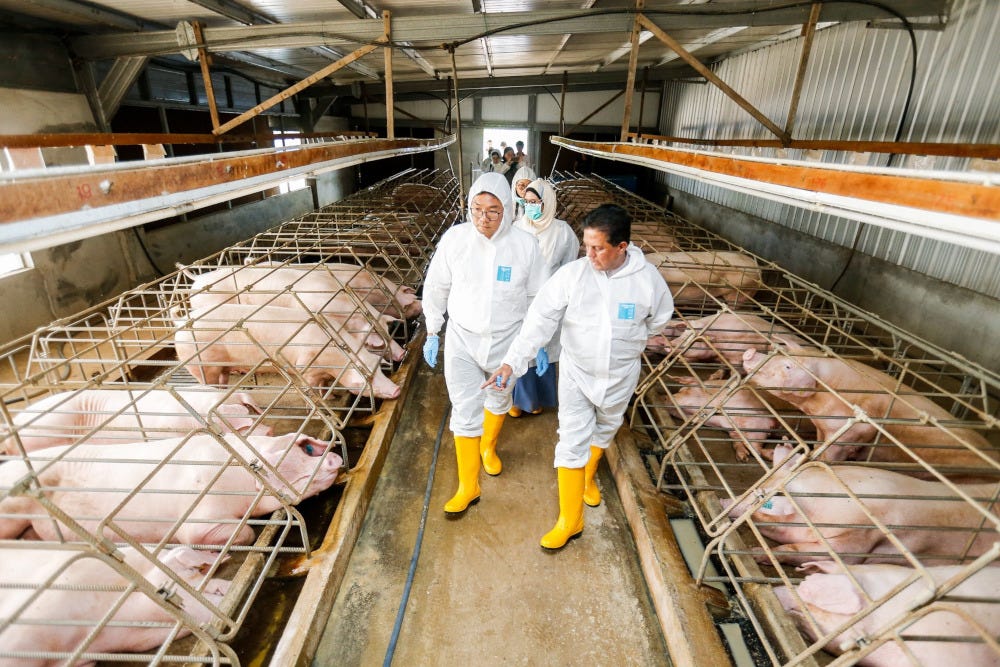
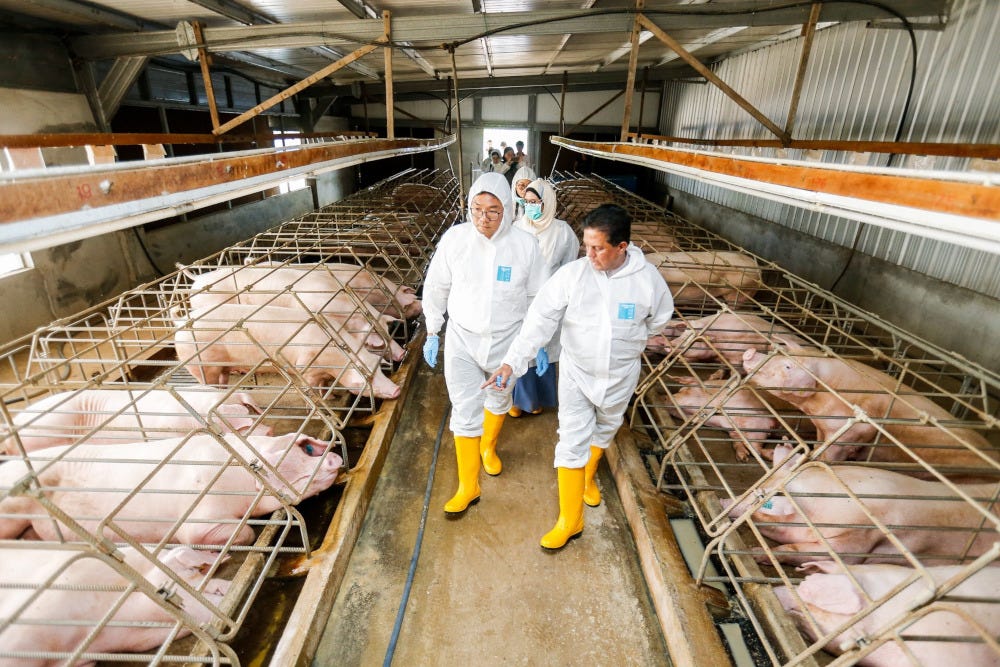
Malaysian Prime Minister Anwar Ibrahim, already heading a weakened coalition partly due to an opposition Perikatan Nasional coalition, particularly the Islamist party PAS, capitalizing on Malay-Muslim identity politics, is now faced with a head-on confrontation with one of the country’s most influential and powerful Sultans over pig farming.
The 80-year-old Sultan of Selangor, Sharafuddin Idris Shah, decreed last month that no more pig farms should be allowed in his state, which is the country’s richest industrial and commercial center, to avoid environmental pollution and to respect the state’s majority Muslim population. Despite some rumblings from Anwar’s party, which draws support mainly from non-Muslims, Anwar agreed to the ban. The government then said pork would be brought in from other states to meet Selangor’s needs.
But the non-Muslim ground has rebelled and rumblings have grown louder. The consumption of pork has long been a volatile issue in Malaysia, where Muslims find the consumption of pork to be against religious laws and the Chinese, who make up approximately 23 percent of the population, consider it a mainstay of their diet. They constitute the second-largest ethnic group in the country, with a population close to 7 million. Selangor has a marginally higher number of Chinese residents, often numbering over 1.7 million and 28 percent of the state’s makeup, one of the largest concentrations in the country. The industry is mainly operated by ethnic Chinese, with significant commercial farms using modern, closed-house systems.
Anwar’s Pakatan Harapan coalition, whose backbone is the Chinese-majority Democratic Action Party, has suffered continually eroding support since it came to power at the end of 2022. This has largely been due to lack of promised reforms, corruption, internal strife and Anwar’s leadership, described by critics in Malaysia as lackadaisical. Although the World Bank had forecast resilient growth of 4.0 percent to 5.0 percent in 2026, driven by strong domestic demand, tourism, and a tech-upcycle boost in electrical and electronics exports, the war on Iran and the resulting oil and energy crisis has put further strain on the country’s finances with economists predicting the situation will get worse over the next two years even if the war ends soon.
Faced with this, Anwar was preparing for a general election at the end of this year ahead of an even worsened economy in 2027. Elections need not be called until early 2028 under Malaysia’s Westminster parliamentary system.
Anwar’s cabinet decided to reverse the ban on pig farming at its weekly cabinet meeting two days ago and he sought an audience with the Sultan to inform him of the decision the same afternoon. The Sultan does not have executive powers and is a constitutional monarch. However, the royalty is largely revered amongst the Malays and hold the trump card of appointing chief ministers and the prime minister, particularly when there is no single party with a simple majority.
The 80 -year-old Sultan immediately struck back, posting a quotation from the late US President Harry Truman on his official Facebook, saying “no man can get rich through politics unless he is a crook.” On May 7, the Sultan doubled down, saying there would no pig farming in his state, “Full Stop.” He posted an image of himself attesting to this.
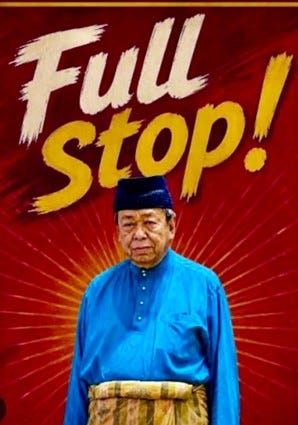
Anwar and his government are thus in a conundrum – open confrontation with the monarch at the cost of Malay votes or accede to his decree and lose crucial non-Muslim votes.
Anwar has, in the past 42 months as prime minister, always backed off from openly opposing the country’s King and nine hereditary monarchs. This has allowed the monarchs, who had their powers curtailed through two bruising constitutional crises during the rule of strongman Prime Minister Mahathir Mohamad in 1983 and 1992, to flex their muscles of late.
In the pig farming impasse, Anwar will have to decide – capitulate and lose a major portion of his support base or confront the Sultan and lose any hope of coming to power in what will again be a fractious general election as in 2022, which resulted in the country’s first-ever hung parliament after no single coalition secured the 112 seats required for a simple majority. The then king forced Anwar into an unwieldy coalition with the corruption-ridden United Malays National Organization, which has continued to frustrate his efforts to govern effectively ever since.