
 El Niño changes Southeast Asia’s power sector trajectory
  Gunvor publicly condemned Russia’s war but continued to do business with Russian energy firms, records show
  Growing Defense Ties between India and Japan
 Reporting Highlights
- An Easy Process: In Arkansas, all it took to establish a school was filling out a form on a state website, $45 and the purchase of an American flag.
- No Qualifications Needed: Having no experience running a school — or even teaching — didn’t stand in the way of founding schools.
- Fewer Barriers: We discovered that opening microschools, which are proliferating nationwide, offer an even easier route.
These highlights were written by the reporters and editors who worked on this story.
We have no business running a private school.
We’re reporters, not teachers. That doesn’t matter. Inexperience has hardly been a barrier for those who want to start their own schools, as we have reported this year. And it didn’t stop us, either.
Over the last few months, to test the process, reporters from ProPublica partnered with local journalists in three states to establish private schools. None required much effort.
In Arkansas, all it took was a few clicks on the Arkansas secretary of state website, $45 and an American flag to form a bona fide private school with the Arkansas Times.
We established a school with Mountain State Spotlight in West Virginia after filing our new school’s name and location with authorities on a piece of notebook paper, then exchanging a few emails.
And with The Assembly in North Carolina, we filed an online notice of intent to open a private school at Ponysaurus Brewing Co. in Durham, while perched on its metal bar stools, eyeing glasses of a crisp kolsch.
We used our names and news organization email addresses, following each state’s rules for starting private or microschools, a type of private school intended for just a few students. Experience running a school wasn’t needed. No one from any of the states asked us about our backgrounds or qualifications, though West Virginia did ask for proof of a high school diploma. No one questioned what we plan to teach or how we would measure whether students are learning.
And yet we could enroll students in two states right now, if we wanted to. Arkansas even suggested ways our school could accept public money through the state’s voucher-style program.
For the record, we are not enrolling students and have no intention of operating our new schools. We did, however, register a website for our new school ventures, ProPublicaAcademy.com, and even designed some fun pencils to show our school spirit.
This year, a team of ProPublica reporters has been documenting how the American education landscape is shifting dramatically as states use public money to help fund private schools. With few regulations, hundreds of new private and microschools have proliferated.
Our reporting has shown the relative ease with which people — some with questionable backgrounds — founded their own schools in unusual places. They’ve popped up in barns and on farms, in strip malls between an antique shop and an ax-throwing business and in churches, where lighting and sound for worship services is part of the curriculum.
All of this led to a clear reporting question: If the hurdles to open a private school are so low, could we do it? And what would we learn along the way?
Inside a flag shop in Little Rock, we surveyed our options. There were handheld American flags on skinny sticks, midsize ones to display on a wall and majestic formal flags adorned with silky gold fringe.
State law in Arkansas doesn’t require much to open a private school, nothing about teacher skills or what kids learn. But it does require that all schools display an American flag, and we wanted to follow the rules. So, at the Arkansas Flag and Banner store, we decided on a smallish one that could fit in a circular base atop a newsroom cubicle. We also bought an Arkansas flag — even though only public schools are required to have those. Total cost: $49.45.
Picking the flags for our new school was the hardest part of an astoundingly easy process.
Early in our reporting in Arkansas, we tried to figure out what steps we’d need to take to make a private school. We couldn’t find all the answers online, so we called the state.
“We don’t have rules for opening a private school,” Kaelin Clay, an Arkansas Department of Education spokesperson, told us earlier this year.
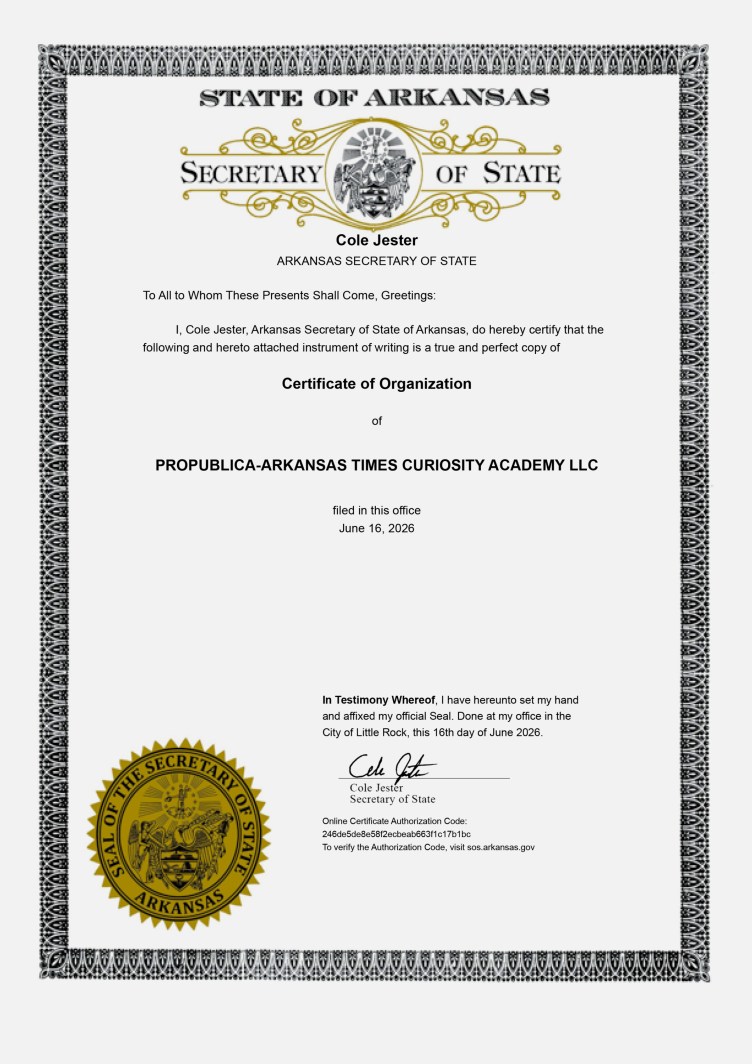
In fact, we didn’t even have to file anything with the Education Department. All it took was a few clicks on the Arkansas secretary of state’s website, where we registered the ProPublica-Arkansas Times Curiosity Academy LLC as a business, listed ourselves as agents and officers, and paid a fee.
“We picked a name. We paid 45 bucks,” a ProPublica reporter noted after we submitted the application. With that, we had created a private school.
The secretary of state’s office approved our new business the same day. We even got a certificate.
The Arkansas Department of Education does not regulate private schools once they’re open, and no one from the state inspected the Arkansas Times newsroom, the location we chose for our school. As far as we know, nobody checked our backgrounds, either.
Arkansas adopted a private school funding plan in 2023, and back then there were fewer than 100 private schools on record. With the state in the fourth year of its Education Freedom Accounts program, which provides vouchers that can be spent on private schools, there are now more than 220.
In addition, 143 microschools, which are a different category in Arkansas, were approved this year to accept tax dollars. That’s up from about 100 last school year.
Establishing the Curiosity Academy was so simple — and, frankly, a bit anticlimactic — that reporters then applied to become eligible to receive public funds. (Again, we applied with our names, work email addresses and a note that this was a journalistic exercise. We had no intention of actually ever taking any public money.)
We wanted to see how far our curiosity could take us.
Accessing public funds as a microschool in Arkansas is easier than it is for other types of private schools, even though there is no limit to the number of students one can enroll. Unlike private schools, we didn’t need to seek accreditation or show proof of financial solvency to accept state funding.
It took about 10 minutes to fill out the required information in early September. Other than our contact information, we had to upload just two documents — one detailing our proposed tuition and fees, and the other with our refund policy.
We said that — “should we open a school” — our tuition and fees per student would not exceed $7,208 per school year, the exact amount of Education Freedom Account money that each student in Arkansas is eligible for this year. We said tuition “would be collected only if education is delivered, and it would be the policy of the school to refund all tuition payments for educational services that are not provided.”
When more than two weeks passed and we hadn’t heard back, we reached out to the state Education Department. An employee called back that afternoon and explained that the department had decided not to accept any more because the school year was underway.
But he didn’t reject us outright. He looked up our application and invited us to keep pursuing the public money. He said we still could apply to receive public money this school year, but as a vendor providing educational services such as tutoring. He also said we could apply as a microschool next year and even suggested a tweak to the language in our tuition policy should we decide to do that.
After we hung up, he emailed us the vendor application (which we will not pursue) and let us know the microschool application for next school year will open in the spring.
We asked the state Education Department whether it would be OK with us operating a publicly funded microschool. Clay, the spokesperson, said the agency’s role is to decide if schools meet state requirements. Microschool families, she said, “have the freedom to choose the educators and learning environments that best meet their children’s needs.”
Hunched over a desk in the Mountain State Spotlight newsroom in Charleston, West Virginia, pen in hand, we scrawled out official notice of our new school in a spiral-bound notebook. We wrote that we would serve middle school students and listed our first day as TBD.
Leaving the crunchy, ragged edges on the paper, we stuffed our notice of intent into an envelope. We’d seen other new operators file similarly casual ones as they sought to register private schools in West Virginia.
Then we drove over to the state Education Department to deliver the request. Our group — two reporters, a photographer and a video journalist — went through security and, camera rolling, wound our way through the maze of the midcentury building. We got lost once, and our entourage received several perplexed glances from workers, but otherwise it was smooth sailing. The person we needed to deliver the letter to was out, but a friendly employee agreed to place it on his desk.
Dozens of new private and microschools have set up shop in the state in recent years, fueled by the roughly $5,400 the Hope Scholarship offers each student to pay tuition. New private schools all go through Dustin Lambert, a manager in the Office of Student Enrichment and Support at the West Virginia Department of Education.
We heard back from Lambert the next day. Our notice was received. (Hooray!) He said now we needed a letter from the fire marshal that our school building was safe for children. (Oh no.)
This was a problem. Our school would be housed in the Mountain State Spotlight newsroom, which had not been inspected as a school site. We didn’t want to usurp public resources to undergo a new inspection. It felt like the end of our Mountain State school experiment.
But it wasn’t.
After we followed up to ask whether all schools, including virtual schools, need safety clearance to register with the state, Lambert told us that though all brick-and-mortar private schools do, we “may want to consider the microschool route.”
In that case, we later learned, the department wouldn’t be involved because state law doesn’t include any mechanism for oversight.
West Virginia defines microschools as schools that charge tuition and are started by one or more teachers. In practice, there’s no real difference between a microschool and private school — neither has a limit on enrollment. (Yes, a micro can be macro.) He forwarded us the rules for starting a microschool, which involve providing proof of a high school diploma, at least. We notified the local school district of our new microschool venture and sent a college transcript.
The Kanawha County school district, in turn, notified the state of the existence of a new microschool.
And with that — bypassing the building health and safety requirements — we established the ProPublica-Mountain State Spotlight Curiosity Academy. Officials at the Department of Education said they were aware that journalists were establishing a school. But they had to just watch us do so — they have no authority over the state’s microschools.
In an official statement, the department’s spokesperson said it “does not approve or deny the operation of microschools for any reason, including the qualifications of the owner/operator.”
By law, should we open our microschool — and we won’t — we could enroll an unlimited number of students.
On Friday evenings, hundreds of people gather at Ponysaurus Brewing Co., a trendy spot in Durham, North Carolina, to savor its craft beers and cocktails, hardly the place you’d expect a school to open. But why not?
On a recent Tuesday morning, the brewery was quiet and closed to customers. Behind the bar, yeast busily converted sugars into alcohol inside giant stainless steel fermentation tanks. Two journalists settled onto barstools beneath signs for pilsners and cherry sours. Icy cold glasses of Tell the Truth, a light and lemony ale, sat before them on a high-top table beside a stenographer’s notebook and a laptop.
The brewery created the craft ale in partnership with The Assembly, which also is ProPublica’s journalistic partner in this private school endeavor, so it all felt very symbiotic. Ponysaurus’s owners had agreed to let us use their building and its fire and sanitation inspections, which are required to open a private school in the Tar Heel State.
Reporters from The Assembly and ProPublica scanned a state of North Carolina website that details how to file a notice of intent to open a private school.
First, it explained the state’s statutory requirements for opening a private school, things like reporting the school’s name and address. We also would have to administer a standardized test in certain grades, if we were going to open an actual school, and maintain annual records about student attendance and immunizations.
Then, we watched a four-minute, 39-second video explaining how to file the required notice of intent.
From there it seemed simple. We created a login, then filled in the address of our school (Ponysaurus’s building), noted its owner and chief administrator (our reporters), and named it the ProPublica-Assembly Academy. We’d hoped to include the word Curiosity in the name, but the field in the form didn’t allow enough characters. In North Carolina, our curiosity would have to be implied.
We filled in a few more fields, including the grades we would serve (high schoolers), whether we would open a religious school (no) and the dates of our academic year.
Then we needed to upload fire and sanitation inspection reports. This step is what brought us here, to Ponysaurus, filling out the online notice to the tune of a hissing compressor that kept clean air moving through the brewing system.
“You will need to secure inspections for the building where the school will be housed. You will need a fire inspection from the local fire marshal and a health and sanitation inspection from the local health department,” the video said.
Just that morning, a City of Durham Fire Department inspector had visited the brewery and provided Ponysaurus with a fresh business occupancy inspection. We uploaded the new report, along with the brewery’s current food establishment inspection (on which it received a 99, an excellent score, we felt, for a school).
The screen flashed a confirmation. “Thank you. We have received your request to open a private school.” If approved, the page said, we should receive a school identification number in three to five business days.
We hoped to join the at least 169 other new private schools that have opened in North Carolina since the 2021-22 school year, which marked the start of a series of expansions to the state’s publicly funded vouchers for private school tuition.
If we wanted our school to tap the voucher money, we’d have to go through some additional steps such as getting criminal background checks. We weren’t doing that.
The following day, we hit a snag. It came in a brief and garbled email. It said only: “Good morning and thank you for submitting a Notice of Intent to operate a private school. To complete the process we need to fire and sanitation inspections to” and then ended abruptly like that, no explanation or period. We emailed back, asking for clarity and noting we had already uploaded the inspection reports.
An official from the state Division of Non-Public Education then called. The school’s name needs to be on the inspection reports, she said, something we had not seen in any of our research. We also had not found any state statutes or rules that would preclude us — or anyone else — from opening a private school wherever we saw fit, be that a church or a brewery, as long as it passed “reasonable fire, health and safety inspections.”
In a follow-up call, she clarified that her division checks only to be sure the building has passed inspections specifically for a school. A spokesperson for the agency later added that state statute does not allow them to deny a private school application, but they won’t process an incomplete application — notably one without the proper inspections.
We hadn’t expected we would need a school-specific inspection at this point. The video explainer referred to inspections only generally, and the state’s written guidance indicated only that this would need to happen before occupancy.
Given we had no intention of actually opening a school, we had decided ahead of time that we wouldn’t consume any additional public resources — such as fire or health inspectors’ time — in our journalistic pursuit.
Perhaps Ponysaurus could pass the school-specific inspections. But the ethical red line would be our stop sign. Our curiosity would have to end in North Carolina.
Don't Miss:
-
Her Agency Distributes Billions for Housing Projects. Her Husband’s Company Helped Develop Some of Them.
-
It’s Easy to Start a Private School. Take Our Quiz to Find Out Where You Can Open Yours.
-
Patriotic Cowboys ‘R Us
-
Texas’ Education Board Raised Questions About an AI Learning Tool. The State Then Helped Pilot It in Public Schools.
-
Four Kids in One Faith-Healing Family Died. Authorities Could Do Nothing.