
 When Great Powers Talk, Who Speaks for Asia
  About the China Capital investigation
  Frequently asked questions about the China Capital investigation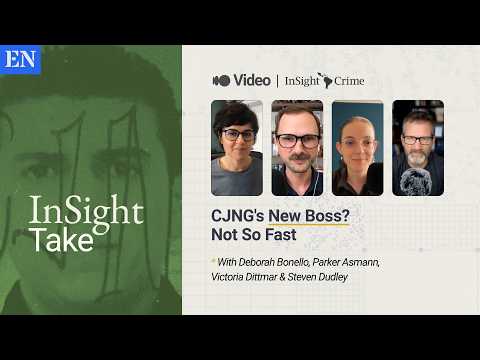
Following the death of CJNG leader “El Mencho” in a February 2026 military operation, US authorities have named his stepson, Juan Carlos Valencia González, alias “El 03,” as the group’s new leader. But El 03 is one of several senior CJNG figures with a claim to power, and the group may avoid naming a single visible boss at all.
InSight Crime’s Managing Editor Deborah Bonello speaks to Co-director Steven Dudley and Mexico investigators Victoria Dittmar and Parker Asmann about the CJNG’s messy succession.
Transcript
Deborah: [00:00:00] For nearly two decades, Juan Carlos Valencia González built influence inside Mexico’s Jalisco Cartel New Generation while staying almost invisible to the public. Now, the US government says he runs the whole organization. Its National Counterterrorism Center recently updated its anti-terrorism guide and named Valencia Gonzalez, known as “El 03,” as the cartel’s current leader, months after the killing of its historic boss, El Mencho, in a military operation in Jalisco back in February.
Deborah: [00:00:38] But is that actually what’s happening, or is Washington reaching for a tidy answer to a rather messy succession fight? I’m Deborah Bonello, Managing Editor of InSight Crime, and I’m joined this week by our co-director, Steven Dudley, and our Mexico investigators, Victoria Dittmar and Parker Asmann, who’ve all been tracking the Jalisco cartel’s post-Mencho landscape. Thanks to all of you for being here.
Steven: [00:01:04] Good to be here.
Victoria: [00:01:05] Thanks, Deb.
Parker: [00:01:07] Thanks for having me.
Deborah: [00:01:08] Okay. So, Vic, let’s start with the basics. Tell us who El 03 is and why would the US land on him specifically?
Victoria: [00:01:18] Sure. Yeah. So, Juan Carlos Valencia Gonzalez is El Mencho’s stepson, which, at least on paper, makes him a very logical successor if we understand these groups as a family business where you trust who is in your family more than anyone else to take over your business, right? In the case of Juan Carlos, or El 03, he comes from one of the most influential criminal families in the Jalisco, Michoacan area, in western Mexico, which is an epicenter for methamphetamine production, the historic home of many of Mexico’s underworld leading figures. He’s linked to the Valencia family, which was one of the pioneers in the methamphetamine trade.
The Millenio cartel was very influential during the ‘90s, early 2000s. They worked very closely with the Sinaloa cartel. And when that alliance broke, which was around 2010, the Jalisco cartel was born. So some of the relatives and some of the factions that were linked to the Milenio cartel then eventually joined the CJNG, the Jalisco cartel. One of the most well-known factions is Los Cuinis, which are the brothers and brothers of Rosalinda Valencia, who is Juan Carlos’s mother and used to be El Mencho’s wife before he passed away.
Victoria: [00:02:40] So he comes from that family, right? And then he’s linked to El Mencho because his mother was married to him.
Victoria: [00:02:47] Now, El Mencho has his own children as well, but there are no candidates at the moment to succeed him because they are either in prison or they’re in some sort of legal process, even some of them are cooperating with US authorities. So there isn’t a clear family-based successor. So I think when the conversation started a few months ago, right after El Mencho was killed, about who was going to succeed him, the logical answer was someone from the family. And Juan Carlos, I think, was one of the most obvious choices, given these very deep family connections and his career that he has made both with the Milenio cartel and the CJNG.
SEE ALSO: US Names El Mencho’s Successor—CJNG May Have Other Plans
Deborah: [00:03:32] Right. And he’s not some fresh face. He has actually been on the radar for a while.
Victoria: [00:03:37] Yeah. So he actually has an indictment in the US District of Columbia, which was published in 2020, where they accuse him of drug trafficking and weapons trafficking charges. And in the indictment, US prosecutors actually say they have been tracking him since at least 2007. So again, we’re talking about a long criminal career. But he had kept a very low profile, as you mentioned at the beginning. I don’t think he was very well known, at least publicly, up until recent years. And his role in the CJNG is believed to have started to grow around 2015 when Rubén Oseguera, who is El Mencho’s biological son, was arrested and then eventually extradited to the United States. And that’s when a lot of press reports started to link Juan Carlos to the roles that El Menchito—which is the alias that El Mencho’s son had—it is believed that he inherited a lot of the roles that he had, including, for example, leading El Grupo Élite, also known as Fuerzas Especiales Mencho, which is an armed wing that is very prominent in central Mexico. So that’s when his profile, I think, started to grow. And eventually it led to the indictment and to the State Department offering a reward for his capture, which until now is $5 million.
Deborah: [00:05:04] Right. So, Parker, let me bring you in here because I feel like there might be a but coming.
Parker: [00:05:10] Exactly, Deb. You know, naming a kingpin might make for a convenient narrative in the eyes of the United States, but it doesn’t actually reflect the reality that Vic and I have seen on the ground doing fieldwork in Mexico. The fact of the matter is the CJNG does not operate around a single leader anymore with a strict top-down hierarchy.
Parker: [00:05:31] We like to think of it more as a franchise model. And I think a useful way to look at this is sort of several different pyramid structures that have their own leadership structures that overlap and interact with one another, as opposed to one large pyramid with just one single leader at the top of that. If we look at the Jalisco cartel across Mexico, you know, they have several semi-autonomous regional factions, and each of those has their own commanders, has their own territory, and essentially manages their own revenue streams in day-to-day operations. I think El Mencho sort of held that together to some degree, but with his death, you don’t automatically get a successor. You get a power vacuum, and I think there are multiple people within the Jalisco cartel that could potentially fill that void. Certainly Juan Carlos Valencia is one of those individuals, but he’s not the only one with sway within the Jalisco cartel.
[00:06:30] In our reporting, we’ve heard a lot about an individual by the name of Ricardo Ruiz Velázquez “Double R,” who leads sort of one of the CJNG’s most elite armed wings in Jalisco, its main operating base. And he sits at the more militarized end of the spectrum. There’s also an individual by the name of Tio Laco, who is accused of running a big chunk of the Jalisco cartel’s fuel theft business, which has become a multibillion-dollar racket over the last decade. There’s also a guy by the name of El Sapo who’s allegedly involved in sourcing Chinese precursor chemicals that are used for producing methamphetamine and fentanyl.
[00:07:11] So with this in mind, it’s really unlikely that the Jalisco cartel would have a singular leader in charge of everything after El Mencho’s death.
Deborah: [00:07:23] So when the US says that the Jalisco cartel has, “a hierarchical command structure in which regional leaders manage day-to-day operations for Valencia Gonzalez as overall leader,” how much weight should we place on that?
Steven: [00:07:42] Well, I think we have to be careful. Just look at the framing—that quote is doing a ton of work. We can interpret it—overall leader can mean a lot of different things. Could mean even what we’re referring to, right? That there is that there is a sort of realization that there are a number of parts of this organization, that it is spread out into these regional command structures that are in and of themselves hierarchical, and may have some overlap, but there isn’t one single hierarchy.
Steven: [00:08:25] The other possibility that we have seen across the region is that there is some kind of a board of directors. This is a model we’ve seen in other places like Colombia, and to a certain extent, that was how the Sinaloa Cartel was also organized. It was a number of different structures. Now those structures have kind of collapsed on themselves in recent years, but that was the general model. And we’ve seen this play out in other places as well. Ecuador would be a good example of that, where you have a number of leaders or a number of organizations that are grouped under the umbrella of a big, strong organization. And certainly Jalisco has operated that way over the years as well. They’ve brought in local groups to work underneath them, oftentimes at the point of a gun. So it’s either you align yourself with us or you die or leave. And that’s the way in which they have operated. So that doesn’t mean that that’s a very cohesive structure because that’s based on force or the threat of force. And so all of these things make for a much more complex structure than what you might see on a Netflix series.
Deborah: [00:10:04] Right, and we have warned about this before. And we here at InSight Crime, we haven’t independently verified that Valencia González is the sole leader. We’re just reporting that the US government has named him as such.
Steven: [00:10:19] Yeah, and I think that that distinction matters. It may not matter as much to the Trump administration, though. I think we have to keep in mind that this administration has really set itself up to be the kingpin killers. And that is important because so much of what the Trump administration does is based around narrative. You can’t kill a kingpin until you have a kingpin. So that is something to keep in mind.
SEE ALSO: Special Series: The Deadly US Strikes on Suspected Drug Traffickers
Steven: [00:10:58] But by the same token, as Vic pointed out, there’s also a reason to believe that this person is a very significant player in the CJNG. I don’t think that we can step back and say this is not an important person. Of course, within the structure, this is a very important person given the pedigree, given the connections, and long-standing activities. We’re talking about a decade of activities at the very top of arguably the strongest criminal organization, at least in the northern part of this hemisphere.
Deborah: [00:11:37] So, Vic, back to you. Is there a way to think about this as competing currents or competing pyramids rather than competing individuals?
Victoria: [00:11:48] Yeah, I think so. I think that’s a useful way to look at this, and this goes back to what Parker was mentioning just a few minutes ago. So if we go back to when El Mencho was still alive, he was this almost mythical figure. But really the reality on the ground is that day-to-day decisions across a lot of the territories in which the CJNG is present are made by these regional commanders, right? They are the ones often forging alliances or breaking them. They decide when to launch certain offensives. They manage relationships with politicians, with communities, etc. Some of them rely more heavily on violence, others are more business-oriented. It really depends a lot on the context and the actors that are present in each of the territories.
Victoria: [00:12:37] There has always been some degree of central coordination. So some strategic decisions have required CJNG approval of the inner circle at least. For example, we reported a lot on our website as well on the relationship or the alliance thatwas formed between the CJNG and the Chapitos to support them in the Sinaloa Cartel war. That allegedly was something that El Mencho approved as well, even though it was mostly coordinated by a local leader.
Victoria: [00:13:08] So it varies, as Steve was saying as well. It varies a lot. There’s some overlap. Sometimes there isn’t. But I think we really shouldn’t underestimate the influence and the autonomy that these regional leaders have on the ground.
Victoria: [00:13:23] So if we look at Juan Carlos Valencia, he is obviously just one current—if we want to see it like that—one part of the organization. He is this guy who represents the family part, this clan-based logic of understanding the CJNG. He’s linked to the money laundering wing. And I think it’s likely that he manages even the armed wings from afar. He’s not necessarily getting his boots dirty as some of the other regional leaders probably are. Those who are more prone to using violence and intimidation rather than this more entrepreneurial approach.
Victoria [00:14:02] So yeah, a lot of different currents make up the CJNG. At the moment it’s not clear if they’re competing. We haven’t seen extreme violence, so we can assume there isn’t. But if a certain arrangement of how the organization is run now isn’t broadly accepted, I think these differences could eventually turn into a power struggle.
Deborah: [00:14:26] And, Parker, has there been much actual violence tied to the Jalisco Cartel and the succession, similar to what we saw with the Chone Killers in Ecuador after Ben 10 was killed? Or the way we’ve seen most prominently, perhaps, in Sinaloa, which has descended into that civil conflict with the arrest of El Mayo two years ago.
Parker: [00:14:50] Deb, we haven’t really seen violence on that scale just yet. And I think that’s maybe one of the more interesting parts of the story. When El Mencho was killed back in February, the immediate reaction was intense. We saw dozens of narco blockades and coordinated attacks across something like 20 states in Mexico. There were highway disruptions and other parts of major cities like Guadalajara that were completely shut down. It was a real show, I think, of the Jalisco Cartel’s capacity, but at the same time, it was extremely short-lived.
Parker: [00:15:24] After the dust settled in the days that followed, it’s largely been business as usual. We haven’t seen the kind of factional warfare that we’ve documented in places like Ecuador with the Chone Killers, and that group, which has splintered into five warring cells in places like Durán after their own leader was killed. And I think a lot of that has to do with the Jalisco Cartel’s entrenched local structures and the diversification of their revenue streams. That seems to at least have provided enough resilience to sort of push back against the uncertainty that El Mencho’s death has caused so far, but we haven’t seen that sort of large-scale violence that we’ve seen elsewhere in the region.
Deborah: [00:16:10] So does that mean that the transition’s actually going smoothly, or does it mean that the violence could start?
Steven: [00:16:20] Well, you know, these things go there. We’re always reading the tea leaves in some respects. So I think we don’t know right now. In the past, this group, if we’re speaking specifically about the Jalisco Cartel, has definitely weathered storms. Probably not this significant, but there was this split that was like the Nueva Plaza split in 2017, or the Mezcales broke off in Colima, this major hub of operations of the Jalisco Cartel in 2022. And this was like when sort of the first rumors, or one of the many rumors about El Mencho being dead, rose up, so then that was the spark. But they kept it together. I mean, they’ve kept the operation—the federation, whatever you want to call it—they’ve kept it intact. So there is some precedent for the Jalisco Cartel to keep it together.
Steven: [00:17:31] By the same token, in other spaces, going back to Ecuador, for example, you’ve seen the atomization process play out over a long span of time. So while the leader may be killed or extradited, you start seeing the effects six months to a year, or even a year and a half out. So, I think we’re still in that time period. We’re still in that window in which we don’t know what the result is going to be.
Deborah: [00:18:04] Yeah, and Vic, if you let me come back a little bit to the comparison I made earlier with Sinaloa, you know, we have seen over the last couple of years this really brutal internal conflict between the different factions of the Sinaloa Cartel with the tricking and arrest of El Mayo in the US. How would you compare that to what we’re not seeing in Jalisco?
Victoria: [00:18:31] Yeah, it’s a great question because I think what we’re seeing in Sinaloa now is, to a great deal, the result of a betrayal. A betrayal between two families that for many years had worked together and were key partners in many businesses. So the Chapo faction and the Mayo faction. It’s not a—well, it’s a treason that culminated or a betrayal that culminated with Joaquin, one of the sons of El Chapo, allegedly tricking El Mayo, kidnapping him, taking him to the US and handing him over to US authorities. But it was brewing for some years because several members of El Mayo’s faction and family had testified against El Chapo. And we had seen how in many parts of the country, mostly in the northern border, armed wings linked to the Mayo faction or the Mayiza faction and armed wings linked to the Chapitos had already been fighting over routes, over drug markets. So it’s something that culminated with the arrest of El Mayo. But I think the violence we’re seeing today has to do with that, with that logic, right? That logic of betrayal. If we had only seen a capture of El Mayo with no betrayal and without any of these dynamics, I think the story may have been different.
Victoria: [00:19:52] Not to say that there wouldn’t have been any violence, because we have seen, for example, when El Chapo was arrested and then extradited, there wasn’t violence right after that happened. But a couple of years later, one faction linked to Damaso López, who was also one of El Chapo’s historic partners, started engaging in conflict with the Chapitos. So these things happen sometimes, as Steve was saying, they take time. But I think the main difference here with the CJNG is at least publicly, we don’t know if there was any betrayal. We can’t rule it out because these things are very common in the underworld, but so far we don’t have that. There are no clear disputes between any of the different regional leaders or factions that make up the CJNG. And to me, that explains why it’s so different from what we’re seeing in Sinaloa. Again, not to say that there won’t be violence in the future or that that possibility doesn’t exist because these things take time. And if a certain arrangement doesn’t work for the regional leaders or for different factions of the group, these disputes can occur.
Deborah: [00:21:01] So, Vic, what would you need to see before you’d feel confident to be able to call El 03 the real functioning head of the Jalisco Cartel.
Victoria: [00:21:12] Great question. I mean, I think the only scenario in which I would comfortably call him the leader, so kind of to think of him as a Mencho 2.0, is if that leadership is clearly reflected in the organization, as much as it was under El Mencho. I mean, for example, if communications of the organization reflect that, if regional commanders recognize his authority, which they often also do publicly or through songs, for example, or messages that they leave in communities or through social media. And so there’s like a visibility of these different factions being aligned with him.
Victoria [00:21:54] That said, I’m not convinced that’s how the organization itself works, as we have discussed throughout this conversation. I think what we’re more likely to see are multiple centers of power across the country rather than a single one—even though I agree with Steve, there’s no doubt that Juan Carlos or 03 under the leadership structure, he is part of the family, so he has some influence but shouldn’t be underestimated, and he likely has a lot of decision-making power. But I also wouldn’t underestimate the influence of the other power centers of the organization, meaning the different regional leaders.
Deborah: [00:22:37] Parker, what do you think we should be watching for in the coming months?
Parker: [00:22:41] That’s a great question, Deb. Honestly, I think there are a number of things that we should be keeping an eye on to see how things play out. The first of which being whether any of these influential commanders that we have discussed make any public or violent move to consolidate control. That, I think, is a great indicator of where the organization stands internally.
Parker: [00:23:02] Second, I think looking at levels of violence and whether the low levels—relatively low levels—that we’ve seen since El Mencho was killed hold, or whether this is just sort of a lag, like Steve had mentioned, before things catch up and we start to see this sort of violent fight for control play out. In certain spaces, especially along the US-Mexico border in places like Tecate, we’ve seen some internal splits within the CJNG faction there that have really caused violence to soar. But so far that’s remained extremely local and hasn’t necessarily spread to other regional strongholds of the organization.
Parker: [00:23:40] And lastly, I think it’s really important to look at the Jalisco Cartel’s primary criminal economies—certainly synthetic drug trafficking and fuel theft—and whether or not there’s any sort of real disruption in those criminal economies. I think at the end of the day, those sometimes are a better indicator of where the Jalisco Cartel stands than, you know, who the United States has named the next top leader of the group.
Deborah: [00:24:06] Right? I mean, what’s clear is the US has made its call, and El Mencho’s stepson may well end up running parts of the Jalisco Cartel. But everything that we’re talking about points to a claim resting on a plausible story and a family tree, but not yet on actual confirmed control. And the real answer may only be visible to us once we see whether the Jalisco Cartel’s various currents fight it out or just fall in line. Steve. Vic Parker, thanks. Thanks for joining me, all of you.
Steven: [00:24:41] Thanks, Deb.
Victoria: [00:24:42] Thank you. Deb.
Parker: [00:24:43] Thanks, Deb.
Deborah: [00:24:45] And thanks for watching. You’ve just watched The Insight Take, our weekly video chat analysis on the biggest crime stories in Latin America. You can find profiles and coverage of all of the things that we’ve been talking about on the website and other episodes of this chat in the multimedia section, as well as on YouTube and Spotify.
Deborah: [00:25:06] If there’s a story or subject you want us to pick apart, then please reach out to me at [email protected]. And we’ll be back with another InSight Take next week. Bye for now.
Don't Miss:
-
China urges ‘constructive dialogue’ with EU in high-level call with France
-
Hong Kong airport builds third runway with strategy to help marine environment thrive
-
Cambodia, Thailand take US$300 billion seabed dispute to UN
-
Hong Kong visitor arrivals hit post-pandemic monthly high in August
-
Indonesian finance minister found out about his firing in mid-meeting phone call