
 New documents show how a retail chain’s sales practices helped put guns on US streets
  Singapore a battleground of commodities fraud lawsuits
  From Propagandist to Criminal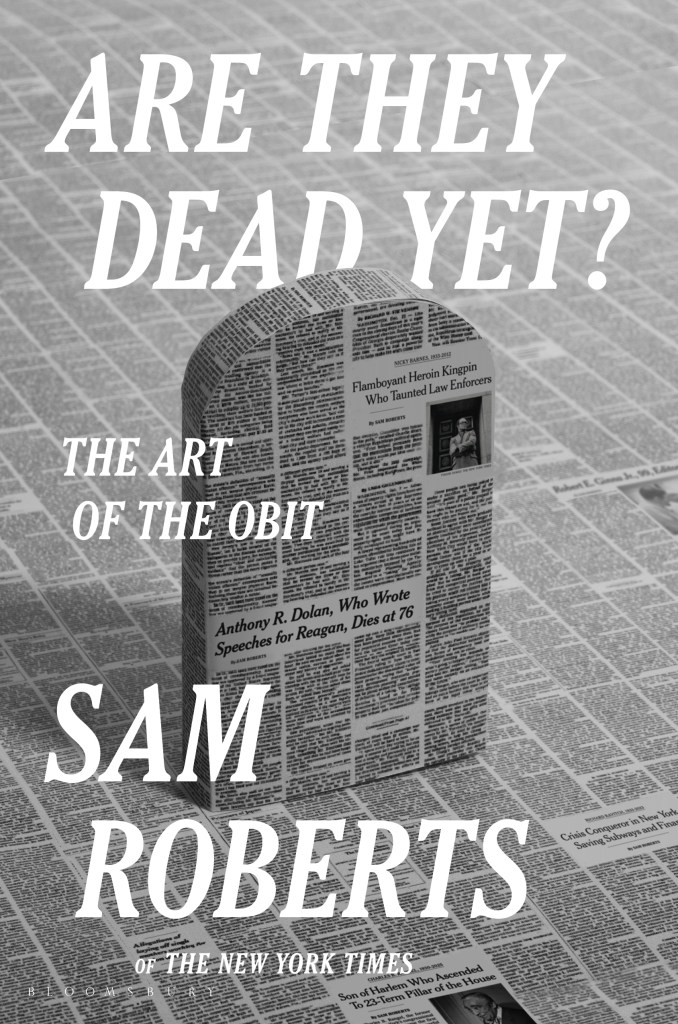
Sam Roberts | Longreads | August 11, 2026 | 4,862 words (20 minutes)
This is an excerpt from Are They Dead Yet? by Sam Roberts, which was published on August 11, 2026, by Bloomsbury Publishing, Inc.
Tuck Everlasting is a cautionary tale about a family of the same surname who, by inadvertently discovering the proverbial Fountain of Youth, is forced to reconcile with eternity. When I was assigned to write the obituary of the book’s author, Natalie Babbitt, I wondered whether she had continued pondering immortality herself. It turned out she had. Not surprisingly, her own take on eternal life echoed that of the fictional family patriarch, Angus Tuck. “I think that living forever would be a terrible thing,” I quoted her as saying in her Times obituary. “It would be boring, sad and lonely.” Babbitt died when she was 84. But Tuck and her other novels endure as Babbitt’s legacy for readers. So does my obituary, which in 2016 revealed her motivation to become an author: She was inspired to write Tuck, she said, when her four-year-old daughter woke from a nap crying because she was scared of dying. Babbitt had intended to become an illustrator, not an author, but pivoted after taking one writing course in college. She had enrolled because her husband hoped to become a novelist and she wanted to understand the challenges he faced.
Back at the Daily News, obituaries weren’t the best way to achieve immortality. We mostly ran one-paragraph squibs for members of the paper’s family, of printers, pressmen, and their immediate relatives. Instead, like most tabloids, the News thrived on the reported details of murders, assassinations, and suicides. Few news stories generated more of a sensation than death in all its dimensions. No less an authority once defined “news” than the ancient newspaper deliverer—a beloved man known as Bo Gee, who was decades too old to be described as a newsboy—weaving up Second Avenue with a wire shopping cart brimming with Chinese-language newspapers, calling out the headlines as he delivered the papers to Chinese bars and restaurants on Manhattan’s East Side. He began his route in Chinatown, where the papers were printed. Subscribers on Manhattan’s Upper East Side were often a day or two behind the headlines because the last stop on his evening route depended largely on the number of drinks he had finagled from bartenders along the way before he was too wobbly to walk any farther. When a colleague of mine, the columnist Jimmy Breslin (who described him as “a small, thirsty man”), asked him which headlines sold the most papers, he responded unhesitatingly. He didn’t need a public opinion poll or a focus group of readers or a real-time digital analysis of clickbait: Two were surefire circulation boosters. One was war! The other: big guy dies!
Taken separately, obits constitute an individual’s legacy. In aggregate, they can capture the social and cultural currency of an era. Which people are worth remembering? Which values are worth celebrating? How do we measure success and failure, good and evil, achievement and defeat, social rank and professional standing? How many of the one hundred thousand people now immortalized in the periodically printed historical compilation Who Was Who were deemed worthy of obituaries at the time of their death? How many of the more than 33,000 contemporary notables included in the latest editions of Who’s Who will get obituaries when they die? (That the titles of those reference books don’t include question marks suggests that the listings themselves are indisputable, a questionable supposition when the price of inclusion by some publishers seems to be for the “whos” to buy at least one copy of the book. An entry for Michael Fowler Cullis, a former British diplomat, describes his recreation as “writing obituaries for friends.”)
People want to be remembered, and we want to remember them, or, at least, we do. “Obituaries commemorate a life at the point where it is completed by death. Yet the completion is also depletion, in the sense that the life is constructed as meaningful precisely at the point where it stops,” Professor Clare Brant, who teaches literature and culture at Kings College London, has written. “They act as the first version of a biography—sometimes the only one, although Wikipedia has closed the gap with each life story seemingly waiting for a death sentence.” But as valuable as Wikipedia can be, the New York Public Library notes, “Obituaries provide an important tool to researchers by offering biographical information on individuals that may not be readily available elsewhere. In many cases, the obituary supplies the only biographical data extant on a person.” Philip Sutton, a genealogy librarian at the library, told Legacy.com, the self-proclaimed world’s largest commercial provider of online memorials and guest books, that obituaries may reveal the married name of a daughter identified years earlier in the census only by her maiden name; that by identifying an immigrant’s specific birthplace, obituaries can also invigorate research on a family’s roots.
Especially in small towns and midsize cities, local newspaper obituaries bond one generation to the next. By recalling where the deceased went to school and whom they married and who survived them, those obits provide the frames that form a moving picture of continuity, a narrative of cohesion. They describe whether, and how, the departed outpaced their parents in personal and professional achievement, their legacy to contemporary readers, and the promise of their progenitors—grandchildren or great-grandchildren who are still blank slates with the potential to add to the story.
To me, obituaries evoke the heartrending backstories of the characters in Thornton Wilder’s play Our Town, the unfulfilled promise of Joe Crowell, who got a scholarship to the Massachusetts Institute of Technology and graduated first in his class: “Goin’ to be a great engineer, Joe was. But the war broke out and he died in France. All that education for nothing.” Emily is dead, too, but so consumed by nostalgia—before being persuaded that “live people don’t understand, do they?”—that she descends from the town’s cemetery and wants to return to her past life in Grover’s Corners, New Hampshire, until the Stage Manager reminds her, “You not only live it but you watch yourself living it. And as you watch it, you see the thing that they, down there, never know. You see the future. You know what’s going to happen afterwards.” “When I think of an obituary, it’s as objective as journalism can be, a story on someone’s life,” Holly Shreve Gilbert, a journalism instructor at Oakland University who was the interim president of the Funeral Consumers Information Society, told Molly Birnbaum of Atlas Obscura. But “hyper-local journalism is dying, and so is the obituary of the local person.” Gilbert added, “Now, if it’s on Legacy.com or Facebook or a blog, we’re basically whitewashing everyone’s lives. We’re all happy. Everyone is happy.”
Well, not everyone.
Obituaries are a reminder that when you die, someone else gets the last word on your legacy—or, at least, the first of the last words. And for all the beloved and respected and cherished and valued that punctuate paid obituaries, don’t forget that families can try to perpetuate irreverent descriptions unilaterally to settle scores when one is no longer in a position to retaliate or respond. In Shakespeare’s Macbeth, Malcolm declaims of the repentant Thane of Cawdor, who was executed for treason, “Nothing in his life became him like the leaving it.” If the Thane got the benefit of ambiguity, Florence Harrelson of Chelsea, Maine, had no such luck when she died in 2024 and her daughter, Christina Novak, placed a paid obituary in the Kennebec Journal. Wasting no words, the four-line obit read that the 65-year-old Henderson died “without family by her side due to burnt bridges and a wake of destruction left in her path.” It continued, “Florence did not want an obituary or anyone including family to know she died. That’s because even in death, she wanted those she terrorized to still be living in fear looking over their shoulders. So, this isn’t so much an obituary but more of a public service announcement.”
In 2023, Gayle Harvey Heckman took the trouble to announce the death of her mother, Linda Lernal Stull, in her Michigan hometown newspaper, the Three Rivers Commercial-News, even though they hadn’t spoken in 24 years. “As a mother, Lernal was violent, hateful and cruel,” Heckman wrote. “She physically, mentally, emotionally, verbally and financially abused Gayle.” After going into excruciating detail, the obituary concluded, “Gayle and her family forgive Lernal and hope that she has found peace. They also hope to find peace within themselves. Lernal will not be missed by Gayle or her family. They all understand that the world is a much better place without her.”
Blunt isn’t always bad. If writing can be a cathartic, it can also offer an object lesson. In 2015, a nine-hundred-word paid obituary in Maine’s Bangor Daily News (down-easters seem less inhibited about publicly evaluating their kin) began, “Coleen Sheran Singer (born Coleen Sheran Clark) would have turned 33 this August 31, but she died in Lewiston in an unsuspecting suburban professional couple’s home of a heroin overdose on the morning of December 25, 2014.” The obit was written by Singer’s former husband. It detailed her considerable assets—intellectually gifted, creative, and spirited—without concealing her hefty baggage as a woman who was addicted and suffering from borderline behavioral disorder. Brent Singer attributed the life his former wife led to her broken childhood home but blamed her death on Maine’s governor for denying her access to the methadone clinic she had relied on to stay straight.
In 2008, the Casper Star-Tribune in Wyoming reported that Jim Adams died at 53. Weary of soppy obituaries of patients who had courageously struggled against one disease or another until the bitter end, Adams went through his son to provide an unvarnished premortem verdict on his abbreviated life. And he had no compunctions about belatedly exercising personal responsibility and admitting that he lost his battle for less inspiring reasons entirely: “It was primarily as a result of being stubborn and not following doctor’s orders or maybe for just living life a little too hard for better than five decades.” He did lament, however, that he “was sadly deprived of his final wish, which was to be run over by a beer truck on the way to the liquor store to buy booze for a date.”
In 2019, the family of Joe Heller (not that one) playfully celebrated his life in the Hartford Courant. They described him as “a frequent shopper at the Essex Dump” who “left his family with a house full of crap, 300 pounds of birdseed and dead houseplants.” Heller was so practiced a consummate napper that “there wasn’t an occasion too formal or an event too dour that Joe didn’t interrupt with his apnea and voluminous snoring.” The obituary added, “The family is seeking donations to offset the expense of publishing an exceedingly long obituary which would have really pissed Joe off.” (It then appealed generously for contributions to the Seabee Memorial Scholarship Association.)
The Hellers weren’t kidding. Those paid “obits” aren’t cheap. The New York Times doesn’t accept paid obituaries, but their paid death notices, depending on the edition and the day, cost about $1,000 for a bare-bones nine lines of type and $50 for each additional line, which verbose encomiums and fervent eulogizing can raise into the thousands of dollars. (In memoriam notices in newspapers that wish the departed “Happy Birthday in Heaven” remain a testament to the enduring value of print advertising.) While radio and television have generally fallen short in memorializing the dead, there are blogs, zines, and commercial websites devoted to dying, and personal web pages and online videos have all helped democratize death. So far, though, it’s one area in which even a buzzworthy website can’t always live up to its name (such as when Michael Jackson’s death was announced on MichaelJacksonLive.com).
The Charlotte Observer in North Carolina used to publish brief obituaries of local figures for free—until executives discovered that printing a full page of them daily was costing $350,000 annually for newsprint alone. When the paper imposed a fee, readers revolted; the editors relented in some editions. MyGoodbye.com was started by Stephen Miller (definitely not that one), who grew up next to a cemetery and, after escaping from his bank’s eightieth-floor office in 2 World Trade Center on the morning of September 11, 2001, decided to become an obituarist full-time. Legacy.com partners with hundreds of newspapers and thousands of funeral homes worldwide to account for about 70 percent of the deaths in the United States alone. A prototype called EPOCH—Electronically Preserving Obituaries as Cultural Heritage—created by the Orange County, Florida, Library System enabled people to publish an obit online for free. Another website, MyObits.com, also lets anyone publish a free memorial. Facebook even allows users to designate an executor to manage their profile after they’ve personally logged off this mortal coil for good.
Paid death notices have been wielded as much to ward off the living as to get the last word on the dead. In the early 1920s, Audrey Munson, America’s first supermodel, became so fed up with fame that she tried to fake her death by paying to run a phony death notice in her local upstate New York newspaper. Her gambit failed; she was so celebrated that the clerk she approached refused to accept the advertisement because he recognized her. Rudyard Kipling may have done her one better: When a newspaper reported his death prematurely, he wrote to the editor, “I’ve just read that I am dead. Don’t forget to delete me from your list of subscribers.”
Six months before Oliver Sacks died of cancer at 82 in 2015, the London-born neurologist who lived in Manhattan wrote an op-ed in the New York Times that amounted to an auto-obituary. Sacks was galvanized, he wrote, by the eighteenth-century philosopher David Hume, who, learning he was mortally ill at 65, penned a short autobiography in a single day in 1776. “I feel a sudden clear focus and perspective,” Sacks wrote. “There is no time for anything inessential. I must focus on myself, my work and my friends. I shall no longer look at ‘NewsHour’ every night. I shall no longer pay any attention to politics or arguments about global warming.” He explained that his shifting priorities were influenced less by passion than perspective: “This is not indifference but detachment—I still care deeply about the Middle East, about global warming, about growing inequality, but these are no longer my business; they belong to the future.”
Kelly McMasters, the author of The Leaving Season: A Memoir, started writing her obituary when she was 12; she has refreshed it almost annually since then. Her ritual was inspired by an assignment her mother was given while training as a volunteer at a local hospice. “I usually end up with a gentle accounting of the year, held against all the past ones,” McMasters wrote in a New York Times opinion essay. “I found many of the accomplishments that felt precious one year were hardly worth a mention the next.” Her private accounts produced an album of verbal snapshots, unreachable versions of herself that seemed as good as the dead about whom obituaries are otherwise published. “It seems dreadfully unfair that we wait until after our deaths to write them and never get to read them ourselves,” McMasters wrote. “Writing your obituary while you’re still alive can offer clarity about your life and, mercifully, if you find something lacking, you still have time to revise.”
By inspiring the “Portraits of Grief” series of intimate minibiographies of the victims of 9/11 in the New York Times, the attack by fanatical al-Qaeda suicide bombers on the World Trade Center in 2001 may inadvertently have made the obituary more egalitarian than any event since the Civil War. These 200-word vignettes with thumbnail photographs weren’t standard obits or news stories. Volunteer reporters interviewed families and friends of the victims and the missing to sketch some 2,500 hundred profiles. Overseen by Jon Landman and Christine Kay on the Metro Desk, the portraits were published over nearly five months. “Terrorism rather than the internet democratized the obituary,” Professor Clare Brant wrote. Roy Harris wrote for the Poynter Institute of the project, “The portraits identified one aspect of life—a woman gardening, a man taking his daughter to ice-skating lessons, or perhaps indulging in a fondness for cigars.” The obituarist Nigel Starck said, “Each day’s pages would renew a sense of the tragedy’s scope, while the individual portraits made each person intimately real.” Our exercise in mining the unremarkable found a larger-than-life common denominator, one that challenges the novelist W. P. Kinsella’s conclusion that “the lives of ninety percent of the population are so dull that no one would care in the least about them, the lives of the remaining ten percent are so bizarre that no one would believe them.”
Some of the deaths in those “Portraits of Grief” were preceded by chivalrous acts of courage and self-sacrifice. Those heroics worked their way into news articles. The portraits were not about how people died, not about their last moments of life, no matter how gutsy, but how they lived and what their loss meant to their family, friends, neighbors, and colleagues. The gruesome, grisly details were superfluous, unlike an earlier obituary style in which the how sometimes seemed to predominate over the who, what, when, where, and why.
When Louisa May Alcott died in 1888, for example, the New York Times explained in the first paragraph of her obituary, “For a long time Miss Alcott had been ill, suffering from nervous prostration. Last Autumn she appeared to be improving and went to the Highlands to reside with Dr. Rhoda A. Lawrence. She drove from there into town to visit her father on Thursday last, and caught a cold, which on Saturday settled on the base of the brain and developed spinal meningitis.” The first five paragraphs of Teddy Roosevelt’s Times obituary in 1919 left nothing about the cause of death to the reader’s imagination: “His physicians said that the immediate cause of death was a clot of blood which detached itself from a vein and entered the lungs.” In 1892, reporting the death of Caroline Harrison, the wife of President Benjamin Harrison, the Atlanta Constitution described her corpse in clinical detail: “She shows in her emaciation the effects of the long wasting illness of eight months that has reduced her large, matronly figure to a thin, frail form.” Then again, as recently as 2000, the paper, now called the Atlanta Journal-Constitution, ran an obituary by Kay Powell of a local church-choir tenor, who had also written a manuscript on the philosophy of religion, beginning this way: “David Robeson Morgan was a brilliant man whose future looked good, until he had a frontal lobotomy in 1947.”
“A writer may bear the same name as the subject of his memoir, but he is hardly the same person,” Robert W. Fuller, the former college president and self-styled dignitarian, surmised in the epilogue to his own memoir. “He has long since morphed into the subject’s successor, and then the successor of the successor.” Bridget Fowler, a sociology professor at the University of Glasgow and the author of The Obituary as Collective Memory, wrote, “The auto/biography as such is under the expressive control of its author and is thus as profound (or simplistic) as he or she is. In contrast, one characteristic of the obituary is that these lives are selected as particularly memorable, distinguished, or newsworthy.” She adds, “The obituary offers the rare accolade of public recognition, the first step toward posthumous memory. Yet it is not just a store of value, it is also a measure of value: the obituary as a biographical form illuminates the social reality of dominance and distinction, whilst only rarely shedding light on the world of subordination.”
The onset of the AIDS epidemic presented editors with a sensitive dilemma: Merely having the virus implied vulnerable behavior—either drug use or homosexuality—that society was far from accepting. In 1986, the fashion designer Perry Ellis died of AIDS at age 46, as stated in his obituary in the Washington Post. In the New York Times and the Los Angeles Times, his cause of his death was reported to be viral encephalitis. In early May 1987, Charles Ludlam, a playwright, parody actor, and admired figure in New York’s East Village underground arts scene, withdrew from the New York Shakespeare Festival’s scheduled Central Park production of Titus Andronicus. On May 28, Ludlam’s publicist announced that he had died of pneumonia. The New York Times‘s Jeremy Gerard assumed correctly that the pneumonia was a complication of AIDS, and believed the refusal to acknowledge the disease compounded the tragedy of Ludlam’s death by validating the stigma attached to gay people, who were among its most prominent victims.
As Leah Rosenzweig reported in Slate, for hours Gerard desperately tried to persuade Ludlam’s parents to confirm the actual cause but failed. “They were working-class Catholics from Long Island; as far as they were concerned, their son had died a shameful death,” Gerard recalled. But fifteen minutes before his deadline, the family’s lawyer called back. The Ludlams agreed to confirm the cause. On May 29, 1987, Gerard’s obituary of Charles Ludlam was the first that identified AIDS as the cause of death in the Times, on the front page.
“Obituaries contribute to national myths or collective memories of contemporary heroes by symbolically ‘reflecting what, in death, was most valued about the lives of individual citizens,’” Janice Hume wrote. “An obituary distills, publishes, and thus legitimizes something more abstract than mere facts. It also reveals values, highlighted in the attributes of the deceased, and should be examined not just as an indifferent chronicle but as a commemoration, a representation of an ideal, with its own distinct contribution to the understanding of history. Those ideals, part of obituary coverage, become safeguarded by their publication.”
To quantify those values, Lux Narayan, a social media analyst, conducted a statistical survey of some 2,000 New York Times news obituaries that were published in 2015 and 2016. Not surprisingly, the fields of academics, science, politics, film, theater, music, dance, and art predominated among those deemed worthy. On average, they achieved the thing that made them worthy of a Times obituary when they were 37 years old—athletes more likely in their twenties, politicians in their forties. The prototypical obituary subject lived to be 81, which meant 44 years had elapsed between the accomplishment and, in the cases of the many obscure and quirky characters, their public aggrandizement. “Talk about having to be patient,” Narayan said. In a TED Talk, he explained his obsessive reading of the daily paper over scrambled eggs this way: “If you think about it, the front page of the newspaper is usually bad news and cues man’s failures. An instance where bad news cues accomplishment is at the end of the paper, in the obituaries.”
What were the most common denominators among those obituarized, and what do they suggest society—or, more to the point, the Times—valued? If your name was John, you didn’t necessarily have a better chance of being the subject of an obituary, but it was more likely that a man whose first name was John would appear in one. That’s not so surprising, given that John (along with James, Robert, Michael, and David) has been among the most popular names for American men born in the last 100 years. Narayan was struck by another commonality, though. The language-processing program revealed that the one word that leapt out everywhere was help, as a noun or verb. The most universal value, it seemed, that elevated the famous and not-so into those the Times editors considered worthy of obituaries was how much people helped. “They made a positive dent in the fabric of life,” Narayan said.
Journalists understand, or should, that statistical surveys of subjective material are fertile ground for as many question marks as answers. Patrick Nolan, a sociologist at the University of South Carolina, wondered whether the cult of celebrity has blossomed over the last century, as the anecdotal evidence suggests. Has the public become so starstruck that somebodies in less glamorous professions have been overshadowed? One way to measure the trajectory of society’s fascination quotient, he figured, was to enlist New York Times obituaries as a cultural barometer. Nolan’s canvas was every “notable death” that was published in the Times during the entire twentieth century.
“Most striking are the simultaneous increases in celebrity obituaries and declines in religious obituaries,” Nolan and Timothy J. Bertoni reported in the journal Sociation Today. “They document the increasing secularization and hedonism of American culture at a time when personal income was rising and public concern was shifting away from the basic issues of survival. The magnitude of these trends is seismic. While the Greeks may have looked to their gods for guidance and entertainment, we’ve turned increasingly to our celebrities—entertainers and athletes.” After dividing the century into quarters, Nolan and a doctoral student, Timothy Bertoni, randomly selected 20 days from 1900, 1925, 1950, 1975, and 2000 and ranked the professions of the dead by the number of obituaries run.
The number of obits of entertainers and athletes, grouped together, rose, from seventh most in 1900 to fifth in 1925, third in 1950, and first in 1975. By 2000, they remained in first place and accounted for 28 percent of obituaries. In 2000, the researchers didn’t find a single notable religious figure who was memorialized. The category had plummeted from fourth place when the 20th century began to last when the millennium ended. During the same period, the number of obituaries of notable individuals from the fields of business, finance, manufacturing, and industry declined by half. Americans, Janice Hume has written in her study of grief, “value each other and, indeed, value life for collective reasons. They value a long, robust, and full life, a life that is uniquely American, and a life that ensures social preservation. A typical Victorian obituary would carry the statement, ‘in life we are in the midst of death,’ but as this study suggests, at least on the obituary pages of historic mainstream American newspapers, in death we are in the midst of life.” Nigel Starck, too, argues that obituaries provide a glue that bonds society not in grief but in an aspirational reevaluation of our own lives.
“There is nothing inherently gloomy about the newspaper obituary page,” he writes. “Done well, it should capture life rather than wallow in death.” Clare Brant recalled her euphoric reaction to reading of the death of Martin Wells, the grandson of the English writer H. G. Wells, in the Guardian in 2009. He was an 80-year-old biologist with a passion for cephalopods and was also a novelist, painter, and yachtsman. “Though marine biologists don’t have dry lives in a literal sense, and people who love octopus usually have a sense of play, he was really lively,” Brant wrote. “I rejoiced that an academic could have such a full, happy and entertaining life—there’s hope for the rest of us! It wasn’t that I wanted to know him or even to have known him, but I was glad he’d existed, and I still want not to forget the implications of his existence.”
And that was an obituary about a total stranger. For a family member, an obit represents an imprimatur, validation by association, a keepsake that maintains their heritage and, perhaps for a generation, prevents their own legacy from vanishing like a walnut in the batter of eternity. “The greatest investigative piece I ever wrote when I thought I was really important never survived more than a few weeks in terms of being kept around,” said Jim Nicholson, the Philadelphia journalist who regularly chronicled deaths of the common man, the nobodies, as he put it. “But these obituaries, they’re laminated. They’re put under glass. They’re hung on walls or in family Bibles. In fact, they’re even put into the inside coat pocket of the deceased. And, yeah, they’ll be around long after you and I are gone.” Nicholson’s obituaries were indelible. “My words give readers thousands of moments to remember of little lives lived well,” he said. “Perhaps I even gave them the secrets of how to live one well.”
What readers cherish about obituaries, Casey Cep wrote in the New Yorker, is “the opportunity to celebrate one’s own good fortune at still being alive, to keep tabs on death—who it comes for, at what age, and how much we have in common with the deceased—and also to trace an immensely compact narrative arc. So much of the news is ongoing and unsettled, but obituaries by definition have a kind of alluring finality.” In the two weeks after Victoria Chang’s mother died of pulmonary fibrosis in 2015, the Los Angeles–based poet feverishly wrote seventy poems. Her goal: to recast the newspaper obituary to identify what had been lost (“civility, language and the future,” she wrote) and death’s cultural impact on the living. She described writing an obituary as a wake-up call. “This person is dead,” Chang wrote. “You’re alive.”
Copyright © 2026 by Sam Roberts. Excerpted by permission of Bloomsbury Publishing, Inc. All rights reserved.
Sam Roberts, a fifty-year veteran of New York journalism, is an obituaries reporter and formerly the Urban Affairs correspondent at the New York Times. He has hosted the New York Times Close Up on TV and the podcast Only in New York, anthologized in a book of the same name. He is the author of The New Yorkers, A History of New York in 27 Buildings, A History of New York in 101 Objects, Grand Central, and The Brother, among other books. He has written for the New York Times Magazine, the New Republic, New York magazine, Vanity Fair, Foreign Affairs, and Air Mail. Before joining the Times in 1983, he was the youngest city editor of the New York Daily News. He lives in New York with his wife.