
 New documents show how a retail chain’s sales practices helped put guns on US streets
  Singapore a battleground of commodities fraud lawsuits
  From Propagandist to Criminal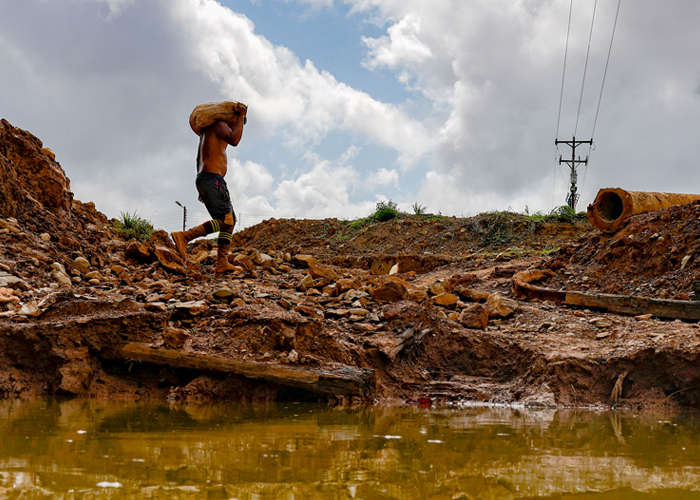
Venezuela has approved a new mining law to open the gold industry to international investors, but the legislation overlooks the symbiosis between illegal mining and the national government—and the dirty gold that results.
The Organic Mines Law (Ley Orgánica de Minas) was approved unanimously by the National Assembly on April 9. The law repeals regulations established in 1999 that prohibited foreign and private-sector investment in strategic minerals, particularly gold. The legislation is the latest in a series of efforts to open Venezuela’s resource markets to foreign investors after the United States captured and removed President Nicolás Maduro on January 3, 2026.
SEE ALSO: How Maduro’s Ouster Will Shift Criminal Dynamics in Venezuela
The United States government has also done its part. Since January, it has relaxed the sanctions imposed on Venezuela’s gold industry in 2019 and issued a license for gold imported from the state-owned mining company, Minerven (Compañía General de Minería de Venezuela). International commodities traders are now moving quickly to invest in the country’s gold industry.
The State and Criminal Groups in the Gold Trade
The majority of Venezuela’s gold is sourced from informal mines controlled by armed groups, and foreign investment risks further enabling the criminal activity and corruption that drive this illicit industry.
Mining hotspots are rife with criminal organizations. The Venezuelan mining sector is concentrated in the Orinoco Mining Arc (Arco Minero del Orinoco – AMO), a region designated as a mining zone by Maduro in 2016 that is predominantly located in the state of Bolívar but also includes parts of Amazonas and Delta Amacuro. Illegal mining operations are also found throughout protected areas of Amazonas.
Guerrilla groups, including the National Liberation Army (Ejército de Liberación Nacional – ELN), and factions of FARC dissidents such as the Acacio Medina Front, control operations in Amazonas and parts of Bolívar. Smaller armed mining gangs known as sindicatos including the R Organization (Organización R – OR) and Tren de Guayana, control smaller mines, supply labor, and act as quasi-governing bodies in the AMO.
SEE ALSO: Venezuela Security Policy: Illegal Mining and Deforestation
Today, the state exerts control over the AMO by working closely with criminal groups to source gold.
These groups are not marginal operators in the Venezuelan gold industry but are among the principal suppliers. As InSight Crime investigations have revealed, state-owned mining companies, including Minerven, which today is part of the larger entity the Venezuelan Mining Corporation (Corporación Venezolana de Minería – CVM), receive gold from mines or processing mills controlled by armed groups.
State companies also purchase gold from murky “strategic alliances” in which criminal organizations are often partners. These strategic alliances are awarded to politically connected individuals or military officials. In many cases, these actors coordinate directly with sindicatos to carry out the actual mining. The government provides these alliances with permissions and facilitates access to machinery and fuel, while the sindicatos take a percentage of production.
The new mining law envisions replacing strategic alliances with “mining brigades.” However, it contains little detail on what is to become of existing alliances or how the state will tackle criminal involvement in these operations.
Featured image: A Venezuelan miner carries rocks to a grinding mill in Venezuela’s Bolívar state. Credit: AP.
Don't Miss:
-
Former American Idol singer Caleb Flynn sentenced to life in prison for wife’s murder
-
Bogota mayor presses Chinese-led consortium for more metro workers as auditors flag delays
-
ICC unseals arrest warrants for 4 Taliban leaders wanted on gender persecution charges
-
Quebec votes in provincial election as separatist surge poses test for Canada’s PM Carney
-
“Here, We Confront Drug Traffickers Daily… And The U.S.?”